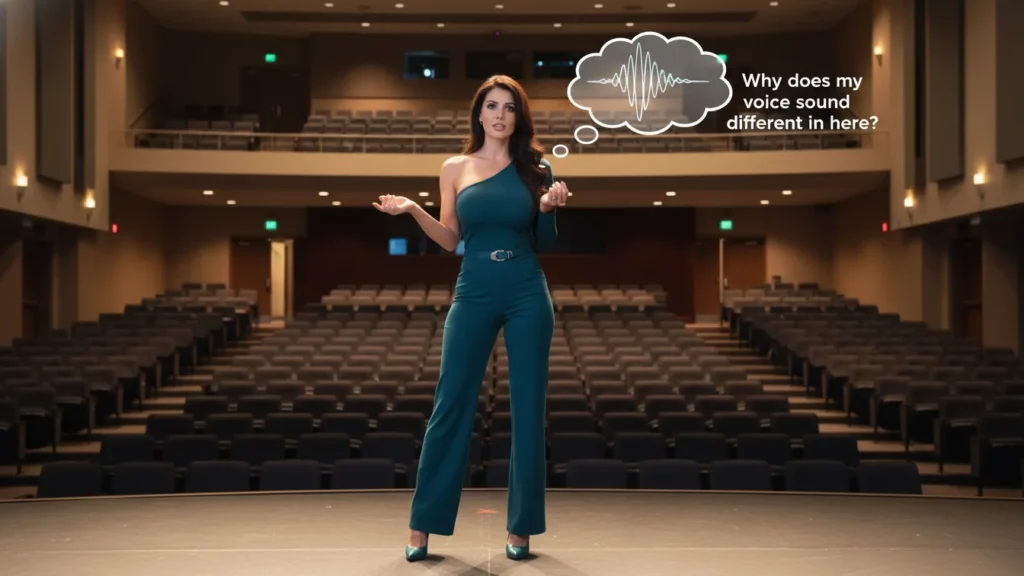
That Strange Moment When Your Voice Doesn’t Feel Like Yours
You step into a large hall, an empty classroom, a church, or an auditorium.
You say a single word.
And suddenly—your voice feels unfamiliar.
It may sound deeper, hollow, echoey, or strangely detached, almost as if someone else is speaking alongside you. Nothing about your throat changed. Your vocal cords didn’t shift. Yet your ears tell a different story.
This isn’t imagination.
It’s physics, space, and human perception quietly working together.
Understanding why your voice sounds different in large rooms reveals something fascinating about how sound behaves—and how your brain interprets it.
Sound Begins the Same Way — No Matter the Room
Your voice always starts the same way.
Air from your lungs moves upward, causing your vocal cords to vibrate. These vibrations create sound waves that travel outward through the air.
At this moment, nothing is different whether you’re in:
- A small bedroom
- A bathroom
- A massive concert hall
The change happens after sound leaves your mouth.
Small Rooms vs Large Rooms: Where Sound Goes Changes Everything
In a small room, sound waves:
- Hit nearby walls quickly
- Bounce back almost instantly
- Reach your ears with very little delay
Your brain merges all of this into one clean, familiar voice.
In large rooms, sound waves:
- Travel farther before hitting surfaces
- Reflect off distant walls, ceilings, and floors
- Return to your ears at different times
Instead of one clear signal, your ears receive multiple versions of your voice, layered over each other.
This layering is where the difference begins.
Echo vs Reverberation: Two Sounds People Often Confuse
Many people think they hear an echo—but most of the time, it’s reverberation.
Here’s the difference:
- Echo:
A distinct repeat of your voice, separated enough for your brain to hear it as another sound. - Reverberation:
A blend of sound reflections arriving too close together to separate clearly.
Large rooms create reverberation, not classic echoes.
Your voice doesn’t repeat—it stretches.
Why Your Voice Sounds Deeper or Hollow in Big Spaces
Large rooms tend to reinforce lower frequencies.
- Are longer
- Travel farther
- Lose less energy as they reflect
High-frequency sounds:
- Get absorbed more easily
- Fade faster
- Don’t reflect as strongly
This imbalance causes your voice to feel:
- Fuller
- Boomier
- Less sharp
Your voice hasn’t changed pitch—but the room is selectively shaping what reaches your ears.
The Role of Delayed Feedback in How You Hear Yourself
When you speak, your brain expects to hear your voice almost instantly.
In large spaces:
- Reflected sound arrives milliseconds later
- That delay is small—but noticeable to the brain
- Your auditory system interprets it as “external” sound
This makes your voice feel:
- Slightly detached
- Less controlled
- Like it’s coming from the environment, not just you
That’s why public speakers sometimes feel unsettled at first—it’s a sensory mismatch, not a vocal problem.
Why Empty Rooms Sound Stranger Than Crowded Ones
An empty hall exaggerates this effect.
Hard surfaces like:
- Concrete
- Glass
- Wood
reflect sound strongly.
But when people fill a room:
- Clothing absorbs sound
- Bodies scatter sound waves
- Reflections weaken
This is why:
- An empty auditorium sounds dramatic
- The same room sounds normal during a full event
The room didn’t shrink—the acoustic environment softened.
Why Bathrooms and Stairwells Do the Same Thing (But Faster)
Bathrooms are small, yet voices sound odd there too.
Why?
Because:
- Walls are hard and reflective
- Surfaces are very close
- Reflections return extremely fast
Instead of delay, you get intensity.
Large rooms stretch sound over time.
Bathrooms compress sound into sharp reflections.
Different size—same principle.
A Simple Comparison: How Room Size Changes Your Voice
| Environment | What Happens to Sound | How Your Voice Feels |
|---|---|---|
| Small bedroom | Fast reflections | Normal, familiar |
| Bathroom | Intense reflections | Bright, sharp |
| Empty hall | Long reverberation | Hollow, deep |
| Crowded room | Absorbed reflections | Natural, balanced |
| Outdoor space | Sound escapes | Quiet, thin |
Why Your Brain Struggles to “Recognize” Your Voice in Large Rooms
You usually hear your voice in two ways:
- Through air (sound waves)
- Through bone conduction (vibrations in your skull)
Large rooms amplify the air-conducted sound while bone conduction stays the same.
This shifts the balance your brain is used to.
The result?
Your voice feels unfamiliar—even though it’s still yours.
Common Misunderstandings About Voice Changes in Big Spaces
- “My voice is deeper here.”
The room boosts low frequencies—you didn’t change pitch. - “Something’s wrong with my hearing.”
Your hearing is fine; reflections are confusing perception. - “I sound worse in big rooms.”
You’re hearing the room, not your vocal quality.
Understanding this often brings immediate relief.
Why This Matters Today
Modern life places us in acoustically extreme environments:
- Open-plan offices
- Large malls
- Airports
- Event halls
Understanding how space shapes sound helps explain:
- Why speaking feels tiring in large rooms
- Why public speaking feels strange at first
- Why voices feel different on stage
It’s not about confidence or ability—it’s physics meeting perception.
Visualizing How Sound Behaves in Large Spaces
These visuals show how sound spreads, reflects, and layers in large environments—exactly what reshapes how your voice reaches your ears.
Key Takeaways
- Your voice itself doesn’t change—the room reshapes it
- Large spaces cause sound reflections to arrive at different times
- Low frequencies dominate in big rooms, making voices sound deeper
- Reverberation stretches sound instead of repeating it
- Your brain hears more “room” than “voice” in large spaces
- This effect is normal, predictable, and harmless
FAQs
Why does my voice echo more in empty rooms?
Empty rooms have fewer objects to absorb sound, allowing reflections to travel longer and return more strongly.
Why does my voice sound better once people enter the room?
People absorb sound waves, reducing harsh reflections and smoothing reverberation.
Does this mean microphones change how I sound too?
Microphones capture reflected sound differently than human ears, which can exaggerate room effects.
Why do singers prefer certain halls?
Good halls balance reflection and absorption, enhancing clarity without overwhelming reverberation.
Why does my voice feel quieter outdoors?
Outdoors, sound escapes instead of reflecting, so less of it returns to your ears.
Conclusion: Your Voice Is the Same—Space Is Doing the Talking
When your voice sounds different in a large room, it’s not a flaw or failure.
It’s a reminder that sound doesn’t exist in isolation.
Space shapes sound.
Surfaces guide it.
And your brain interprets it—all in real time.
Once you understand this, that strange voice no longer feels unfamiliar.
It simply sounds like you, heard through a bigger world.
Disclaimer: This article explains scientific concepts for general educational purposes and is not intended as professional or medical advice.