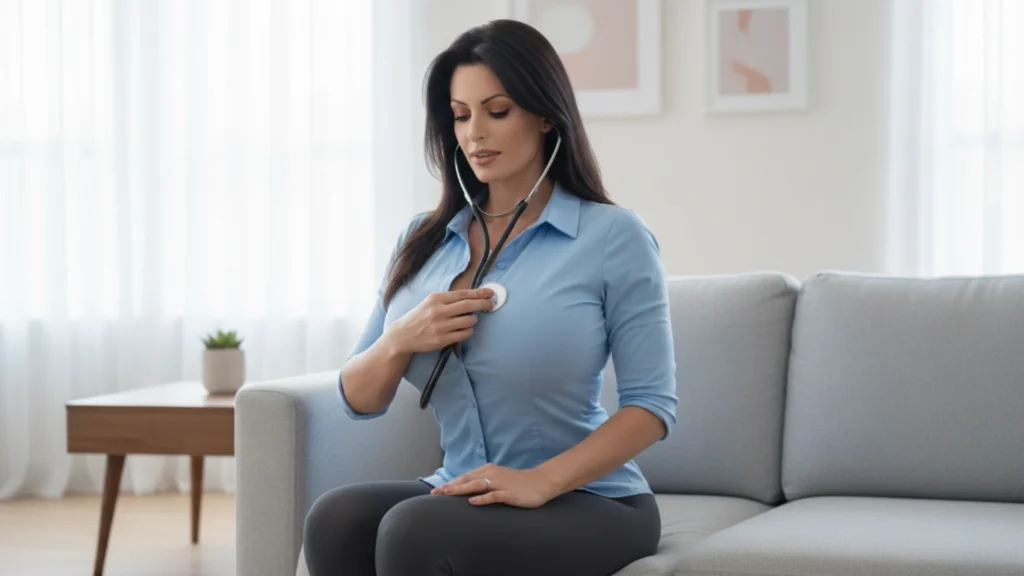
“The Familiar Moment We’ve All Felt”
You’re about to speak in front of others.
You’re waiting for important news.
You suddenly feel watched or judged.
Before you can think clearly, your heart starts pounding faster.
It feels automatic.
Uncontrollable.
Almost as if your body reacted before your mind did.
This experience is universal across cultures and ages. And it’s not a flaw, weakness, or sign that something is “wrong” with you.
It’s biology doing exactly what it evolved to do.
To understand why, we need to look at how your brain, nerves, hormones, and heart work together in moments of perceived pressure.
First, What Does “Nervous” Mean to the Body?
In everyday language, nervousness feels emotional.
But biologically, your body doesn’t process it as an emotion first.
It processes it as information.
Your brain constantly scans your environment, asking one core question:
“Is this situation safe, uncertain, or demanding?”
When uncertainty or potential threat is detected—even social or emotional—the brain sends signals that preparation is needed.
Importantly:
- The “threat” doesn’t have to be physical
- It doesn’t have to be real
- It just has to be perceived
Your heart doesn’t know the difference between:
- A wild animal nearby
- An exam starting
- An awkward social interaction
The body responds based on interpretation, not logic.
The Brain’s Early Warning System at Work
Deep inside your brain is a network designed for survival.
This system reacts before conscious thought.
Here’s what happens in simplified steps:
- Sensory input (a thought, sound, memory, or situation) is detected
- The brain labels it as important or uncertain
- A rapid signal is sent to the nervous system
- The body shifts into a higher readiness state
This shift happens in milliseconds.
Your heart speeding up is one of the first visible signs.
Meet the Autonomic Nervous System (Your Automatic Controller)
Your heart rate isn’t controlled by willpower.
It’s regulated by the autonomic nervous system, which runs automatically in the background.
This system has two main branches:
- Sympathetic nervous system → activates energy and alertness
- Parasympathetic nervous system → restores calm and balance
When you feel nervous, the sympathetic branch briefly takes control.
This is the same system involved in the well-known fight-or-flight response.
Why Speeding Up the Heart Makes Biological Sense
From a survival perspective, a faster heartbeat is useful.
It allows:
- Faster oxygen delivery to muscles
- Quicker energy availability
- Sharper alertness
- Faster reaction time
In ancient environments, this response increased survival.
Today, it still activates—even if the “threat” is psychological rather than physical.
Your body isn’t malfunctioning.
It’s following an old instruction set in a modern world.
The Role of Adrenaline (Without the Hype)
When the sympathetic nervous system activates, it signals the adrenal glands.
These glands release adrenaline (also called epinephrine).
Adrenaline doesn’t create fear or nervousness.
It amplifies readiness.
Its effects include:
- Increased heart rate
- Stronger heart contractions
- Faster breathing
- Heightened awareness
Think of adrenaline as turning up the system volume—not changing the song.
Heart Rate vs. Danger: A Key Distinction
One common misconception is that a fast heartbeat means danger.
Biologically, that’s not true.
A faster heart rate simply means:
“The body has shifted into a higher energy state.”
This same response happens during:
- Exercise
- Excitement
- Laughter
- Anticipation
- Nervousness
The heart doesn’t label emotions.
It responds to signals.
How Thoughts Alone Can Speed Up the Heart
Here’s something fascinating:
Your heart can accelerate without anything happening externally.
Just imagining a situation can trigger the same response.
Why?
Because the brain reacts to meaning, not reality.
A remembered embarrassment.
An upcoming event.
A sudden worry.
All can activate the same biological pathway.
This is why nervousness often feels “out of proportion” to the situation.
For example, many people notice their heart rate rise simply while waiting for a phone call or replaying an awkward moment in their mind — even while sitting completely still.
A Simple Comparison: Calm vs. Nervous State
| Body System | Calm State | Nervous State |
|---|---|---|
| Heart rate | Steady and slow | Faster and stronger |
| Breathing | Deep and regular | Shallow and quicker |
| Nervous system | Parasympathetic active | Sympathetic active |
| Energy use | Conservation mode | Mobilization mode |
| Brain focus | Reflective thinking | Rapid scanning |
This shift is temporary and designed to reverse once the situation passes.
Why Some People Feel It More Strongly Than Others
You might notice that some people’s hearts race dramatically, while others barely react.
This variation is normal.
Factors include:
- Sensitivity of the nervous system
- Past experiences and learning
- Personality traits
- Context and familiarity
- Current mental load or fatigue
None of these mean someone is weaker or stronger.
They simply reflect how finely tuned the body’s alert system is.
Common Misunderstandings About Nervous Heartbeats
Let’s clear up a few myths:
- “I should be able to control this.”
Heart rate is automatic, not voluntary. - “This means something is wrong.”
In most everyday situations, it’s a normal response. - “If I ignore it, it will stop.”
Attention doesn’t cause it—but understanding it often reduces fear around it. - “Calm people don’t feel this.”
Everyone does. Some just interpret it differently.
Understanding removes unnecessary alarm.
Why This Response Hasn’t Evolved Away
You might wonder: if nervousness is uncomfortable, why hasn’t evolution removed it?
Because the system is still useful.
It helps with:
- Preparation
- Focus
- Motivation
- Quick response
The problem isn’t the response itself.
It’s how modern environments trigger it frequently and unpredictably.
Why This Matters Today
In today’s world:
- Many “threats” are social or psychological
- Stressors are ongoing, not brief
- The body reacts faster than the situation resolves
Understanding why your heart speeds up changes how you experience it.
Knowledge doesn’t stop biology—but it changes interpretation.
And interpretation shapes emotional experience.
Key Takeaways
- A racing heart during nervousness is a normal biological response
- It’s controlled by the autonomic nervous system, not willpower
- The brain reacts to perceived importance, not just real danger
- Adrenaline prepares the body for action, not harm
- Understanding the mechanism reduces unnecessary fear
Your heart isn’t panicking.
It’s responding.
Frequently Asked Questions
1. Why does my heart beat faster before speaking or performing?
Because your brain detects social evaluation as important, triggering a readiness response.
2. Is a nervous heartbeat the same as fear?
Not exactly. Nervousness, excitement, and fear share biological pathways but differ in interpretation.
3. Can thinking alone really increase heart rate?
Yes. The brain responds to imagined or anticipated situations almost like real ones.
4. Why does it sometimes feel sudden?
Because the nervous system reacts faster than conscious awareness.
5. Does this response mean I’m stressed?
Not necessarily. It can occur during any moment of anticipation or uncertainty.
A Calm Way to Think About It
The next time your heart speeds up when you’re nervous, remember:
This is not your body losing control.
It’s your body preparing.
Your heart is following ancient instructions designed to help you respond—not harm you.
Understanding that simple truth often changes how the sensation feels.
Disclaimer: This article is intended for general educational purposes and explains biological concepts in a simplified, non-clinical way.






Pingback: Why You Feel Calm After Crying — The Science Behind Emotional Release
Pingback: Why Loud Sounds Increase Anxiety — The Hidden Science of the Brain’s Alarm System
Pingback: Why Your Brain Feels More Anxious at Night — A Scientific Explanation
Pingback: What If Humans Could Breathe Underwater — How Life, Cities, and the Planet Would Change
Pingback: Why Your Brain Overreacts to Small Threats — The Ancient Survival System Still Running Today