A Subtle Change You’ve Definitely Felt
You grab a bag.
It isn’t even that heavy.
Just a laptop. Groceries. A shoulder bag.
You start walking—and something changes.
Your steps feel uneven.
One shoulder lifts slightly.
Your body leans without you deciding to lean.
You didn’t choose to walk differently.
Your body did.
This quiet shift happens to almost everyone, and it reveals something fascinating about how human movement really works.
Walking Is a Balance Problem, Not a Simple Step Pattern
We often think of walking as automatic.
Left foot.
Right foot.
Repeat.
But biologically, walking is a constant balancing act.
With every step, your body:
- Moves forward while staying upright
- Shifts weight from one leg to the other
- Keeps your head stable for vision
- Prevents falling in any direction
Even without a bag, walking is controlled instability.
Adding a bag changes the rules instantly.
The Center of Mass: The Invisible Point That Matters Most
At the core of this change is something called your center of mass.
This is the point where your body’s weight is evenly balanced.
When you stand normally, it sits roughly around your lower torso.
When you carry a bag—especially on one side—that point moves.
And when the center of mass shifts, your walking pattern must adjust to keep you upright.
Why a Small Bag Makes a Big Difference
You might expect this effect only with heavy loads.
But even light bags can trigger noticeable changes because:
- The weight is often off-center
- The body prioritizes stability over symmetry
- Small imbalances matter during movement
Your nervous system doesn’t wait to see if the bag is “heavy enough.”
It responds immediately.
Your Brain Is Running a Real-Time Physics Simulation
As soon as you lift a bag, your brain begins recalculating.
Without conscious thought, it adjusts:
- Step width
- Stride length
- Arm swing
- Trunk angle
These changes help keep your center of mass over your base of support—your feet.
You don’t feel these calculations.
You feel the result: walking differently.
Why One Shoulder Lifts When Carrying a Bag
If you carry a bag on one shoulder, you may notice that shoulder rising slightly.
This happens because:
- The body is counterbalancing the added weight
- Muscles activate to prevent tipping
- The torso shifts to keep the head upright
It’s not poor posture.
It’s automatic compensation.
Why Your Arm Swing Changes
Normally, your arms swing opposite your legs to help balance rotational forces.
Add a bag, and this pattern adjusts.
You might notice:
- Reduced swing on the bag side
- Larger swing on the opposite arm
- Stiffer movement overall
These changes reduce unwanted twisting and help stabilize forward motion.
A Simple Analogy: Walking With a Backpack vs a Side Bag
Think of carrying weight in two ways:
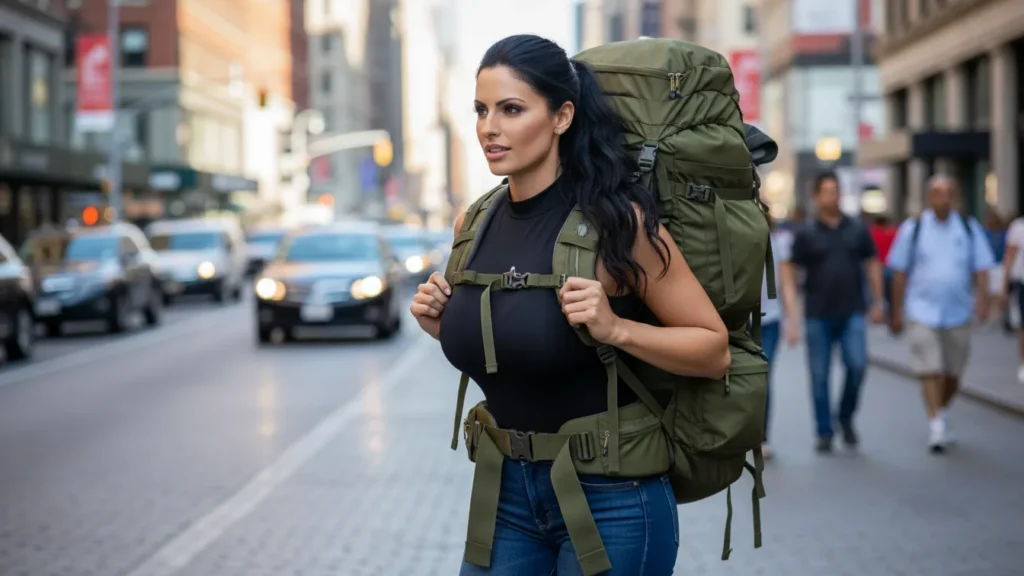
- Backpack: weight centered, balance mostly preserved
- Side bag: weight shifted, balance disrupted
Your walking adapts more dramatically when weight is uneven.
That’s why backpacks feel “easier” to walk with—even at the same weight.
What Happens in the Legs and Feet
Your legs also adapt when carrying a bag.
Subtle changes occur in:
- Ground contact timing
- Force distribution through each foot
- Muscle activation patterns
One leg may work slightly harder than the other, depending on where the weight sits.
These changes are tiny—but continuous.
Walking Without Thinking vs Walking With Load
| Feature | Normal Walking | Walking With a Bag |
|---|---|---|
| Center of mass | Stable, centered | Shifted |
| Step symmetry | Mostly even | Slightly uneven |
| Arm swing | Balanced | Adjusted |
| Trunk posture | Upright | Subtly tilted |
| Balance effort | Minimal | Increased |
None of this is a problem.
It’s adaptation.
Why the Change Feels “Unnatural” at First
When you first pick up a bag, walking can feel awkward.
That’s because:
- Your body is updating movement patterns
- Muscle timing is recalibrating
- Sensory feedback is being reweighted
Within minutes, the movement feels normal again.
Your nervous system learns quickly.
Common Misunderstandings About Walking With a Bag
Many people assume:
- They’re walking “wrong”
- The bag is too heavy
- Their posture is poor
In reality:
- Walking changes are expected
- The body is prioritizing balance
- Efficiency matters more than symmetry
Your movement isn’t flawed—it’s intelligent.
Why This Matters in Daily Life
Modern life involves constant load carrying:
- Laptops
- Handbags
- Shopping bags
- Backpacks
Understanding why walking changes helps explain:
- Why one side feels tired faster
- Why posture shifts unconsciously
- Why movement feels different with different bags
It’s not habit.
It’s physics and biology working together.
Why Children and Adults Adapt Differently
Children often exaggerate movement changes when carrying bags.
Adults appear smoother—but both are adapting.
The difference is experience.
Your nervous system becomes better at predicting and compensating with repetition.
Why This Happens Even When You Try to “Stand Straight”
You can consciously try to walk evenly.
But automatic balance systems operate faster than conscious control.
That’s why the adjustment happens anyway.
Balance always wins.
Key Takeaways
- Walking is a balance task, not just stepping
- Carrying a bag shifts your center of mass
- Your brain adjusts gait automatically
- Changes in posture and arm swing are protective
- Walking differently with a bag is normal and expected
Once you notice it, you’ll see it everywhere.
Frequently Asked Questions (FAQ)
Why do I lean slightly when carrying a bag?
Your body shifts to keep the center of mass over your feet and prevent tipping.
Why does one side feel more tired?
Uneven weight distribution causes asymmetrical muscle use.
Why does a backpack feel easier than a shoulder bag?
Backpacks keep weight centered, reducing balance adjustments.
Can you avoid walking differently with a bag?
Not completely. The nervous system adjusts automatically for stability.
Is this change harmful?
No. It’s a normal, adaptive movement response.
A Calm Way to Think About It
When you carry a bag, your body doesn’t complain.
It calculates.
It senses the shift, predicts the motion, and quietly rewrites how you move—all without asking for permission.
Walking differently isn’t a mistake.
It’s your balance system doing exactly what it evolved to do: keep you upright, stable, and moving forward.
Disclaimer: This article explains scientific concepts for general educational purposes and is not intended as professional or medical advice.