The Subtle Change You Don’t Notice — Until You Do
You’re sitting comfortably.
Relaxed shoulders.
Slight slouch.
Then someone enters the room.
Without thinking, your spine straightens. Your chest lifts. Your head rises just a little.
You didn’t decide to do this.
Your body simply adjusted.
This quiet shift happens to almost everyone, across cultures and ages. It shows up in classrooms, offices, gyms, cafés, and even video calls. And it happens even when the “observer” isn’t judging, speaking, or interacting at all.
So why does your body react this way?
The answer isn’t about confidence tricks or social pressure alone. It’s about how the human brain evolved to interpret attention — and how posture became one of the fastest signals your nervous system can change.
Posture Is Not Just Physical — It’s Social
We often think of posture as a mechanical issue:
- Muscles
- Bones
- Balance
But posture is also deeply social.
Long before humans used language, posture communicated crucial information:
- Strength or vulnerability
- Readiness or relaxation
- Status within a group
Standing taller wasn’t about aesthetics. It was about visibility and meaning.
Even today, posture acts as a silent broadcast system. When others are present, your body shifts from “private mode” to “social mode” — often automatically.
The Brain’s Social Radar Switches On
Human brains are exceptionally tuned to being observed.
The moment another person enters your awareness, several processes begin quietly:
- Attention monitoring increases
- Self-awareness rises
- Movement becomes more controlled
This doesn’t require eye contact. Just the possibility of being seen is enough.
From a biological perspective, observation signals one simple message:
“Your behavior now matters beyond yourself.”
Posture is one of the quickest ways the brain adjusts outward behavior — faster than speech, clothing, or facial expression.
Why Standing Straighter Is the Default Response
When observation is detected, the brain favors postural alignment because it offers multiple advantages at once:
- Improves balance and readiness
- Signals alertness
- Makes breathing more efficient
- Projects stability
All of this happens without conscious planning.
Slouching, on the other hand, is associated with rest, safety, and low demand. When alone, the brain allows it. When watched, the brain shifts toward a more “presentable” configuration.
This is not about trying to impress — it’s about adaptive readiness.
A Deeply Learned Signal From Early Life
Watch children in a classroom.
When the teacher walks by, spines straighten.
When attention moves away, shoulders relax again.
This pattern appears long before children understand social strategy. It’s learned through repeated associations:
- Being seen → expectations increase
- Being seen → feedback may follow
- Being seen → coordination matters
Over time, the brain stores posture adjustment as a low-effort response to social presence.
No instruction required. No conscious rulebook.
The Nervous System Tightens Control Under Observation
When you’re alone, your nervous system favors efficiency and comfort.
When observed, it favors precision.
This means:
- Muscles subtly increase tone
- Movements become smoother and more deliberate
- Slumping is corrected unconsciously
Standing straighter isn’t about tension — it’s about organization.
Your body shifts from a relaxed internal focus to an outward-facing one, aligning itself vertically to reduce unnecessary movement and instability.
Why This Happens Even When No One Is Judging You
A common misconception is that posture changes only happen when we fear evaluation.
But research and everyday observation show something surprising:
People adjust posture even when:
- Observers are strangers
- Observers are silent
- Observers are non-authoritative
The trigger isn’t judgment. It’s attention detection.
Human brains evolved in groups where being noticed often preceded interaction — positive or negative. So the brain doesn’t wait to evaluate intent. It prepares first.
The Evolutionary Advantage of Standing Tall
From an evolutionary standpoint, upright posture served several purposes:
- Made individuals easier to identify
- Displayed health and alertness
- Reduced misinterpretation of weakness
In group settings, those who appeared stable and aware were less likely to be targeted or overlooked.
Standing straighter wasn’t about dominance — it was about clear signaling.
That ancient reflex still operates today, even in offices and elevators.
Observation Changes Body Control Speed
Interestingly, posture changes happen faster than most other social adjustments.
Here’s why:
- Posture uses large muscle groups
- The spinal system responds quickly to sensory input
- Upright alignment stabilizes vision and breathing
The brain prefers changes that deliver multiple benefits with minimal effort.
Posture wins that trade-off.
How Being Watched Affects the Body vs Being Alone
| Situation | Brain Priority | Posture Response |
|---|---|---|
| Alone | Comfort, energy saving | Relaxed, slouched |
| Casually observed | Readiness, awareness | Straighter spine |
| Actively engaged | Precision, control | Upright and stable |
| Social evaluation | Visibility, clarity | Tall, controlled posture |
This shift isn’t conscious — it’s biological efficiency at work.
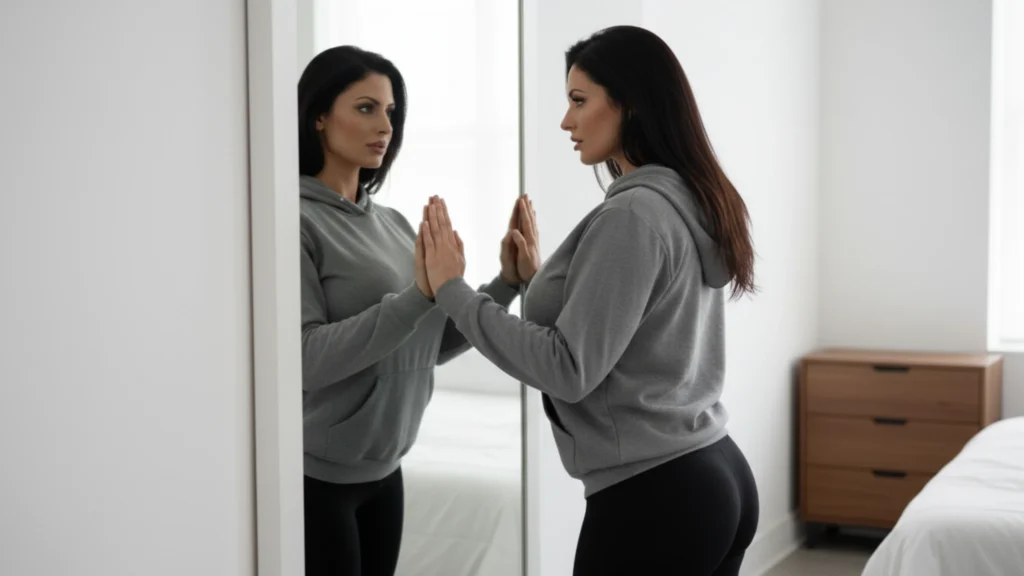
Why Mirrors and Cameras Trigger the Same Effect
Ever notice you sit up straighter when:
- Passing a mirror?
- Turning on a webcam?
- Seeing your reflection unexpectedly?
Your brain treats self-observation similarly to external observation.
Seeing yourself activates the same self-monitoring circuits:
- Body alignment increases
- Facial expression sharpens
- Movement becomes intentional
Your nervous system doesn’t distinguish much between being seen by others and seeing yourself being seen.
Why This Matters in Modern Life
Today, we live in environments filled with:
- Screens
- Cameras
- Reflections
- Virtual presence
Your brain is constantly receiving subtle “you might be observed” signals.
That means posture shifts happen more frequently than in earlier generations — not because people are more self-conscious, but because social awareness cues are everywhere.
Understanding this helps explain why posture fatigue can happen even without physical strain.
Common Misunderstandings About Standing Straighter
“It means I’m insecure.”
Not true. This response appears in confident and relaxed people alike.
“It’s a learned social trick.”
It’s largely automatic, not strategic.
“Only happens when I care about opinions.”
It happens even without evaluation or emotional involvement.
This is biology, not personality.
Why the Effect Fades When Observation Becomes Familiar
Over time, the brain recalibrates.
In familiar settings:
- Muscle tone decreases again
- Posture relaxes
- The sense of being “monitored” fades
This is why you eventually slouch around close friends or coworkers. The brain downgrades social alert level once predictability increases.
Why You Can’t Fully Turn This Off
Even people who consciously try to “relax” under observation still experience subtle posture changes.
That’s because:
- These responses occur below conscious control
- They’re handled by fast neural pathways
- They evolved for speed, not reflection
You can influence posture — but you can’t erase the reflex entirely.
And that’s okay. It means your nervous system is doing exactly what it was designed to do.
Key Takeaways
- Standing straighter when watched is an automatic brain–body response
- It’s driven by social awareness, not insecurity
- The nervous system increases posture control under observation
- This reflex evolved to support readiness and clear signaling
- Modern environments trigger this response more often than we realize
Frequently Asked Questions
Why do I straighten my back even when no one says anything?
Because the brain responds to the presence of attention, not verbal feedback.
Does this mean I’m stressed when watched?
Not necessarily. It reflects increased awareness, not distress.
Why does posture change faster than facial expressions?
Posture uses larger muscle systems that adjust more quickly and efficiently.
Why does this happen on video calls?
Cameras activate self-monitoring systems similar to being observed in person.
Can posture awareness fade over time?
Yes. Familiar environments reduce perceived observation signals.
A Calm Way to Think About It
Standing straighter when watched isn’t about performance or pressure.
It’s your body saying, quietly and efficiently:
“I’m here. I’m aware. I’m ready.”
Once you understand that, the behavior feels less mysterious — and far more human.
Disclaimer: This article explains scientific concepts for general educational purposes and is not intended as professional or medical advice.