Time Feels Constant… Until the Universe Proves Otherwise
In everyday life, time feels steady.
A second is always a second.
A clock ticks the same way whether you’re in your bedroom or walking down the street.
But the universe has a surprising secret:
Time does not flow at the same speed everywhere.
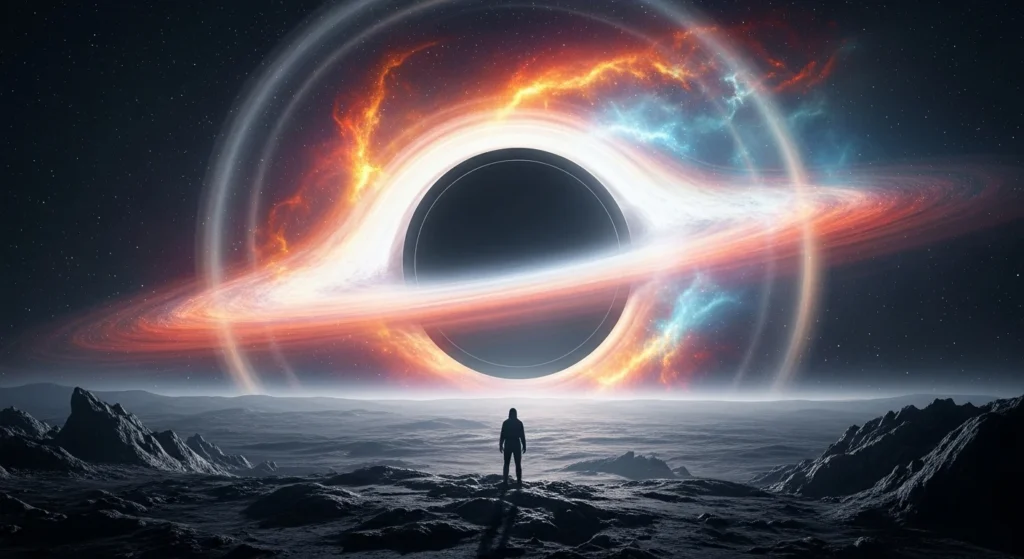
Near a black hole, time can slow down dramatically.
To the point where one hour for you could be years for someone far away.
That sounds like science fiction…
But it’s actually one of the most well-established consequences of modern physics.
The reason comes from one of the deepest truths Einstein ever revealed:
Gravity doesn’t just pull on objects.
It bends time itself.
Let’s explore why this happens in a clear, grounded way.
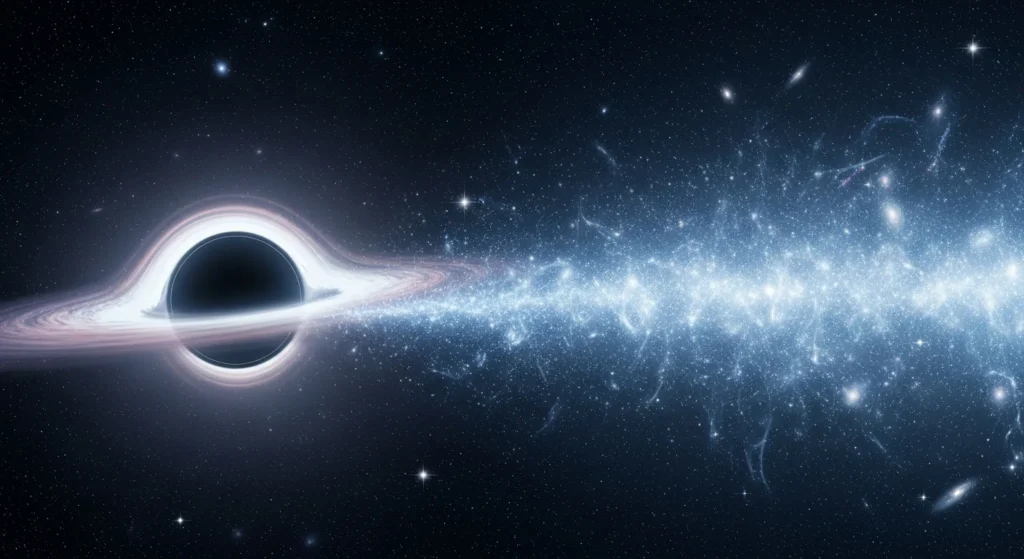
What Is a Black Hole, Really?
A black hole is a region of space where gravity becomes so intense that:
- Matter cannot escape
- Light cannot escape
- Space and time behave in extreme ways
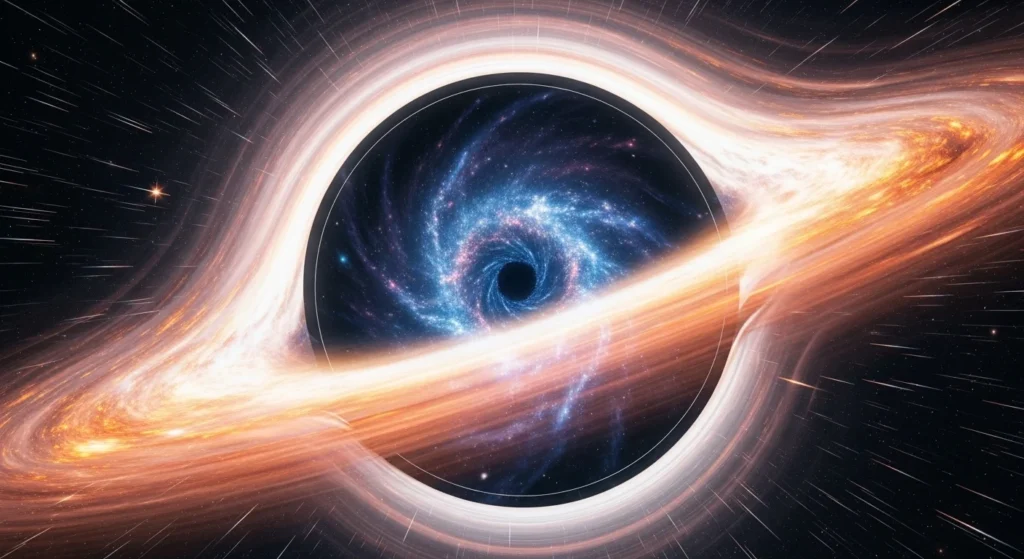
At the boundary lies the event horizon—
A one-way edge beyond which nothing returns.
Black holes form when massive stars collapse under their own weight, compressing matter into an unbelievably dense point.
This creates gravity so strong that it doesn’t just affect motion…
It affects the structure of spacetime.
The Key Idea: Space and Time Are Connected
To understand why time slows, we need one simple concept:
Space and time are not separate things.
Einstein showed that they are woven together into a single fabric called:
Spacetime
Think of spacetime like a flexible trampoline sheet.
- Objects with mass sit on the sheet
- The sheet bends around them
- Other objects roll toward the dip
That bending is what we experience as gravity.
But here’s the crucial part:
Spacetime includes time, not just space.
So when gravity bends spacetime…
It bends time too.
Gravity Doesn’t Just Pull—It Slows Time
This effect is called:
Gravitational time dilation
The stronger the gravity, the slower time passes.
This isn’t a metaphor.
It’s a measurable physical reality.
Time literally ticks more slowly in stronger gravitational fields.
A Simple Everyday Example (Closer Than You Think)
Time dilation happens even on Earth.
Gravity at your feet is slightly stronger than gravity at your head.
That means:
- Time moves a tiny bit slower closer to the ground
- Time moves a tiny bit faster higher up
The difference is extremely small…
But it has been measured with precise atomic clocks.
In fact, GPS satellites must correct for time dilation, or navigation would drift by kilometers each day.
So time slowing down is not just a black hole thing.
Black holes simply take it to the extreme.
Why Black Holes Cause the Most Extreme Time Slowing
A black hole has enormous mass packed into a tiny volume.
That creates incredibly intense gravity near the event horizon.
As you approach a black hole:
- Spacetime becomes more distorted
- The gravitational pull rises sharply
- Time dilation becomes stronger and stronger
From your perspective near the black hole:
- Your clock feels normal
- Your heartbeat feels normal
- Everything seems fine locally
But to an observer far away…
Your time appears to slow down.
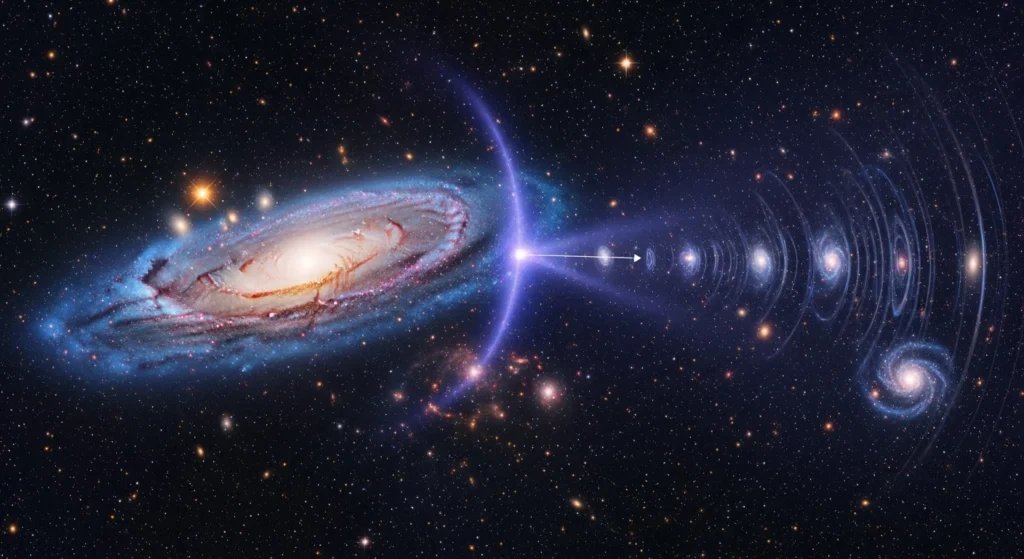
The Strange Observer Effect: Two People, Two Timelines
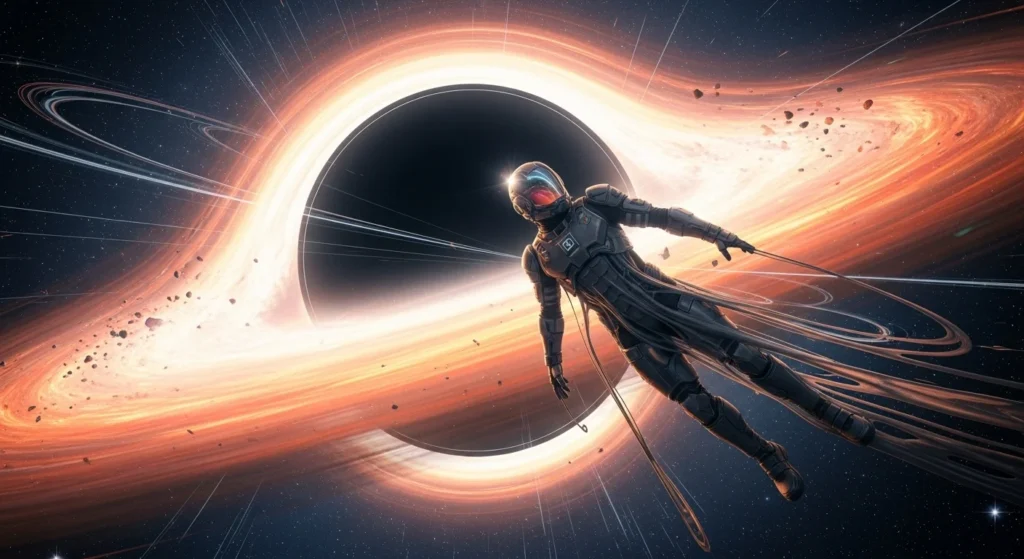
Imagine two astronauts:
Astronaut A
Stays far away from the black hole.
Astronaut B
Approaches close to the event horizon.
Astronaut B sends a signal once every second.
Astronaut A watches those signals.
At first, they arrive normally…
Then slower…
Then even slower…
Until it appears that Astronaut B’s time is almost frozen.
Astronaut A never sees Astronaut B cross the event horizon.
Instead, B seems to “pause” near the edge.
This is one of the strangest visual consequences of relativity.
Time doesn’t stop for the falling astronaut…
But it appears to slow from the outside.
Both perspectives are valid.
Common Misunderstanding: “Does Time Actually Stop?”
Not exactly.
Time doesn’t stop in an absolute sense.
Instead:
- Time slows relative to someone farther away
- The closer you are to extreme gravity, the slower your time runs compared to theirs
This is all about comparison.
Relativity means there is no single universal clock for the entire universe.
Time is local.
Why Does Gravity Slow Time in the First Place?
This is one of the deepest insights in physics.
Einstein’s general relativity tells us:
Gravity is not just a force.
It is a curvature in spacetime.
And clocks measure time by moving through spacetime.
When spacetime is heavily warped, the “path” through time is altered.
A useful analogy:
Walking Through Thick Snow
Imagine time as walking forward.
In empty space, it’s like walking on a clear road.
Near a black hole, it’s like walking through deep snow:
- Progress still happens
- But it takes more “effort” through spacetime
- The motion through time slows relative to others
Gravity changes the geometry of reality.
And time is part of that geometry.
Time Dilation Near the Event Horizon
The closer you get to the event horizon:
- Time dilation increases without limit (from the outside view)
That’s why black holes are often described as places where time becomes infinitely stretched.
But again:
For the person falling in, time feels normal.
They don’t experience “frozen time.”
The weirdness appears in the comparison between distant observers.
Does This Mean Time Travel Is Possible?
In a sense, gravitational time dilation is a form of “future travel.”
If you spent time near a black hole and returned, you could find that:
- More time passed elsewhere than for you
One hour for you…
Years for the rest of the universe.
That’s not fantasy.
That’s physics.
However, getting close enough safely is another matter entirely.
Black Holes as Natural Time Machines (In Theory)
Black holes show that the universe allows time to stretch and shift.
They are like cosmic laboratories where:
- Gravity reaches extremes
- Relativity dominates
- Our intuition breaks down
They reveal that time is not rigid.
It’s flexible.
And gravity is the sculptor.
Why This Matters Today (Evergreen Perspective)
Understanding time dilation isn’t only about black holes.
It helps answer profound questions:
- What is time made of?
- Is time universal or personal?
- How does gravity shape reality?
- What happens at the edge of known physics?
Black holes are not just space curiosities.
They are windows into the deepest structure of existence.
The Big Takeaway
So why does time slow down near a black hole?
Because:
✅ Gravity bends spacetime
✅ Time is part of spacetime
✅ Stronger gravity warps time more
✅ Near a black hole, gravity becomes extreme
✅ Time passes more slowly relative to distant observers
A black hole doesn’t just bend light.
It bends the flow of time itself.
Final Thought
Time feels like the most steady thing in life.
But near a black hole, the universe reminds us:
Time is not a background.
Time is part of the universe’s shape.
And gravity can stretch it like a cosmic thread.