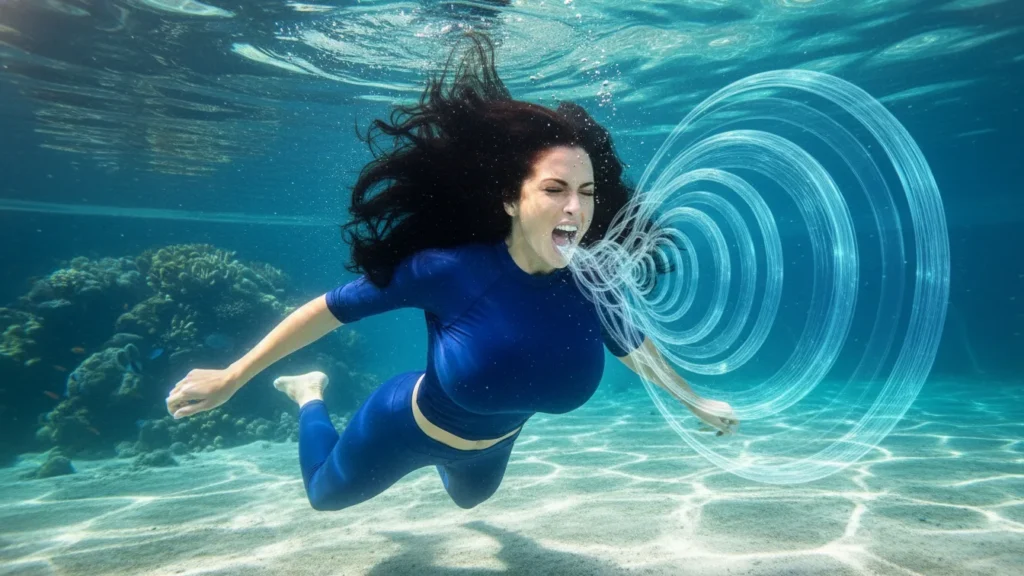
When Sound Behaves in a Way That Feels Unexpected
Have you ever dipped your head underwater and noticed something strange?
Sounds don’t disappear.
They don’t slow down the way you might expect.
They feel different — sharper, closer, harder to locate.
Most people assume water should block sound. After all, it feels heavier than air.
But in reality, sound travels much faster in water than it does in air.
This isn’t a trick of perception.
It’s a direct result of how sound moves through matter — and how tightly that matter is packed together.
To understand why, we need to look at what sound actually is.
What Sound Really Is (And What It Isn’t)
Sound is not a thing that travels like a flying object.
It’s a moving pattern of vibrations.
When something makes a sound:
- It vibrates
- That vibration pushes nearby particles
- Those particles push the next ones
- Energy moves forward as a wave
No particles travel long distances.
The motion travels.
Think of it like a stadium wave.
People stand up and sit down, but no one runs around the stadium.
Sound works the same way — but with molecules.
The Key Factor: How Close the Molecules Are
The speed of sound depends mainly on how efficiently vibrations move from one particle to the next.
This depends on two things:
- How close together the particles are
- How strongly connected they are
Let’s compare air and water.
In Air:
- Molecules are far apart
- Vibrations must “jump” larger gaps
- Energy transfer is slower
In Water:
- Molecules are packed tightly
- Vibrations pass quickly from one to the next
- Energy transfer is much faster
This alone explains a huge part of the difference.
How Much Faster Is Sound in Water?
Here’s the surprising part.
- Speed of sound in air: ~343 meters per second
- Speed of sound in water: ~1,480 meters per second
That’s over four times faster.
Sound doesn’t struggle in water — it thrives.
A Simple Analogy: Passing a Message in a Crowd
Imagine passing a message by tapping shoulders.
- In a sparse crowd, people are far apart. Each tap takes effort and time.
- In a packed crowd, everyone is touching. The signal spreads instantly.
Water is the packed crowd.
Air is the empty room.
Sound prefers company.
Why Liquids Beat Gases at Carrying Sound
It’s tempting to think that solids would always be best — and often they are — but liquids have a special advantage.
Water molecules:
- Are close together
- Can move enough to transmit vibrations
- Don’t absorb as much energy as gases
Gases absorb vibration energy as heat more easily.
Liquids keep vibrations moving.
This balance makes water an excellent sound carrier.
Comparison Table: Sound in Air vs Water
| Feature | Air | Water |
|---|---|---|
| Molecular spacing | Very far apart | Very close together |
| Energy transfer | Less efficient | Highly efficient |
| Speed of sound | ~343 m/s | ~1,480 m/s |
| Sound clarity | Lower | Higher (but distorted to ears) |
| Direction detection | Easy | Difficult |
Why Underwater Sounds Feel Closer and Louder
Many swimmers notice something odd:
Sounds underwater feel louder, even if they’re far away.
This happens because:
- Sound loses less energy in water
- Vibrations reach your body more efficiently
- Your skull and tissues conduct sound directly
Instead of just entering your ears, sound travels through your bones and body.
That creates the sensation of closeness.
Why It’s Hard to Tell Direction Underwater
Even though sound travels faster in water, your brain struggles to locate it.
Why?
On land, your brain uses:
- Tiny timing differences between ears
- Differences in sound intensity
- Ear shape reflections
Underwater:
- Sound reaches both ears almost simultaneously
- Directional cues disappear
- Vibrations bypass the outer ear
Speed increases, but spatial clarity decreases.
Common Misconception: “Water Blocks Sound”
This idea persists because water blocks air-based hearing.
Your ears are designed for air vibrations.
Underwater, they work poorly — not because sound is weak, but because it’s too efficient in the wrong way.
Sound isn’t missing.
Your ears just aren’t tuned for it.
Why This Matters Today
Understanding sound in water helps explain:
- Why marine animals communicate over long distances
- Why submarines rely on sound, not light
- Why underwater environments feel disorienting
- Why sonar works where vision fails
Sound behaves differently — but predictably — when the medium changes.
And water changes everything.
How Marine Animals Take Advantage of This
Whales and dolphins use water’s sound efficiency brilliantly.
They rely on:
- Long-distance communication
- Echo-based navigation
- Sound reflection instead of vision
Because sound travels so far and so fast in water, it becomes the ocean’s primary information channel.
Light fades quickly underwater.
Sound does not.
The Deeper Physics (Made Simple)
At a deeper level, sound speed depends on:
- Elasticity of the medium (how easily it returns to shape)
- Density of the medium (how much mass is packed in)
Water is dense and elastic.
Air is light but poorly elastic.
This combination lets sound race through water with ease.
Key Takeaways
- Sound is vibration, not moving matter
- Tightly packed molecules transmit sound faster
- Water carries sound over four times faster than air
- Faster sound doesn’t mean clearer direction
- Your ears are built for air, not water
- This principle powers marine communication and sonar
Frequently Asked Questions
1. Does sound travel faster in water than in solids?
In most solids, sound travels even faster than in water, but water still outperforms air by a wide margin.
2. Why does sound feel louder underwater?
Because vibrations travel efficiently through water and your body, not just through your ears.
3. Can humans hear better underwater with training?
Training helps awareness, but human ears are physically designed for air, not water.
4. Does temperature affect sound speed in water?
Yes. Warmer water slightly increases sound speed due to increased molecular motion.
5. Why do underwater sounds feel distorted?
Because sound reaches your inner ear through bone and tissue pathways your brain isn’t used to interpreting.
A Calm Way to Think About It
Sound doesn’t slow down because water is heavy.
It speeds up because water is connected.
When molecules stay close, energy flows freely.
Sound simply takes the fastest path available.
And in water, that path is wide open.
Disclaimer: This article explains physical science concepts for general educational purposes only and is not intended as medical or professional advice.