For decades, the word “UFO” carried a certain feeling.
It brought to mind blurry photos, late-night speculation, and science fiction stories.
Serious scientists often avoided the topic entirely.
But something has changed.
In recent years, UFO reports — now more often called UAPs (Unidentified Aerial Phenomena) — have entered mainstream scientific and governmental discussion.
Not because scientists suddenly believe aliens are visiting Earth…
But because the data, technology, and context have shifted.
So why are scientists taking UFO reports more seriously now?
The answer is surprisingly grounded:
Better sensors, more reporting, official investigations, and a growing commitment to studying the unknown without jumping to conclusions.
Let’s explore what’s really happening — clearly, calmly, and scientifically.
UFO vs UAP: Why the Language Changed
One of the first changes is terminology.
Scientists and agencies now prefer UAP, not UFO.
UFO (Unidentified Flying Object)
Sounds like a “thing” or craft.
UAP (Unidentified Aerial Phenomenon)
Focuses on what is actually observed: a phenomenon.
This shift matters because science begins with observation, not assumptions.
UAP is a more neutral term that avoids immediately implying extraterrestrial origins.
Better Technology Means Better Observations
One major reason for renewed attention is simple:
We have far better instruments now than we did decades ago.
Modern military and civilian systems include:
- High-resolution radar
- Infrared cameras
- Satellite tracking
- Advanced flight sensors
- AI-based object detection
In the past, many UFO sightings were based on:
- Human perception
- Grainy film
- Limited tracking data
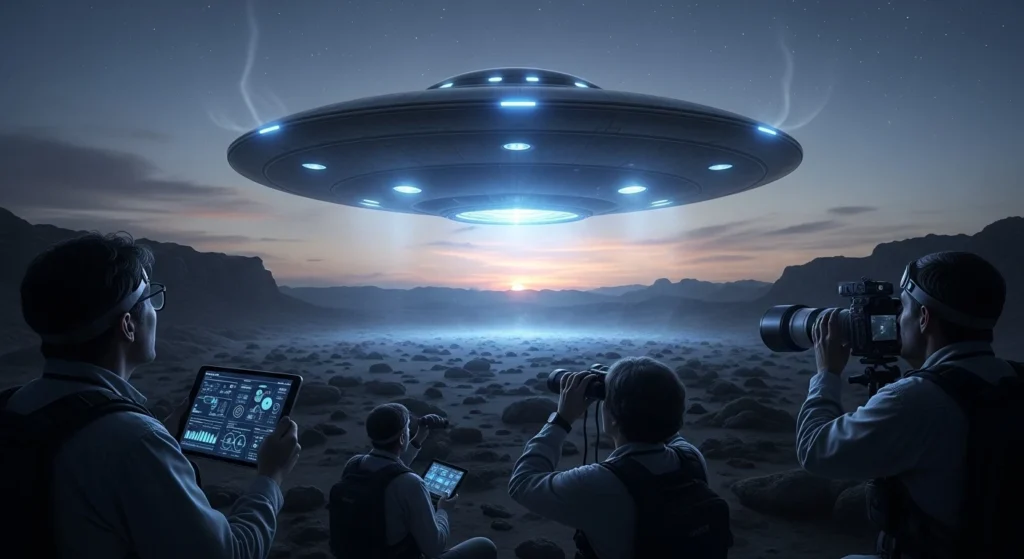
Now, unusual objects may be detected across multiple sensor systems at once.
That makes some cases harder to dismiss immediately.
Real-life comparison
It’s like upgrading from a blurry security camera to a 4K motion-tracking system.
You still may not know what you’re seeing —
But you know it’s worth examining carefully.
More Pilots Are Willing to Report What They See
Another key change is cultural.
For decades, pilots avoided reporting strange sightings because of stigma.
They feared:
- Being mocked
- Career consequences
- Being seen as unreliable
Now, reporting channels have improved, especially within military aviation.
When trained observers with flight expertise report something unusual, scientists take note — not because it proves anything extraordinary, but because pilot testimony is valuable data.
Government Investigations Made the Topic More Legitimate
In recent years, official investigations have brought the UAP topic into the open.
Agencies have acknowledged that:
- Some aerial observations remain unexplained
- Data collection needs improvement
- National security requires understanding unknown airspace events
This doesn’t mean governments confirmed alien spacecraft.
It means they confirmed something more modest:
Some incidents lack enough information for a confident identification.
That alone is enough reason for further study.
Scientists Are Interested in “Unidentified,” Not “Alien”
A crucial point:
Science is not chasing alien narratives.
Science is interested in unresolved observations.
In many cases, UAP reports eventually turn out to be:
- Weather balloons
- Aircraft misidentification
- Drone activity
- Atmospheric effects
- Sensor glitches
- Optical illusions
But a small fraction remain unclear due to limited or classified data.
Scientists argue that unexplained does not mean unexplainable — it means more data is needed.
The Role of Human Perception and Misinterpretation
Science also recognizes a key truth:
Humans are not perfect observers.
Even trained professionals can misjudge:
- Distance
- Speed
- Size
- Direction
The sky is a confusing environment with limited reference points.
For example:
A small object close by can appear similar to a large object far away.
This is why modern scientific interest focuses heavily on sensor data, not just eyewitness accounts.
Atmospheric Phenomena Can Look Extremely Strange
Nature produces many effects that can be mistaken for objects.
Examples include:
- Temperature inversions
- Lenticular clouds
- Ball lightning
- Meteor fragmentation
- Satellite flares
- Aurora-like plasma effects
A key scientific approach is asking:
Could the observation be explained by physics and atmosphere before anything else?
In many cases, yes.
In some cases, not enough data exists.
The Data Problem: Most Cases Lack Full Information
Even when unusual sightings occur, scientists face a major limitation:
Lack of complete, open, high-quality data.
Many incidents involve:
- Classified sensor systems
- Partial recordings
- Missing context
- No independent verification
Science thrives on reproducibility and transparency.
Until better public datasets exist, most UAP cases remain difficult to resolve scientifically.
New Scientific Organizations Are Studying UAPs Carefully
In the last few years, serious academic efforts have emerged.
Some scientists argue that:
- Studying anomalies is part of science
- Ignoring reports doesn’t make them go away
- Better monitoring benefits aviation safety
The goal is not sensational conclusions —
It is rigorous classification and atmospheric understanding.
Think of it like studying rare weather events:
Most will have explanations.
Some may teach us something new about sensors, perception, or the sky.
Mistakes to Avoid in the UFO Conversation
Here are common misconceptions that distort the topic:
Mistake 1: “Unidentified means alien”
No. Unidentified means not enough information.
Mistake 2: “Scientists now believe in UFOs”
Scientists believe in investigating data, not jumping to conclusions.
Mistake 3: “Every sighting is a hoax”
Many sightings are honest misinterpretations or technical artifacts.
Mistake 4: “The truth is being hidden”
Some data is classified for defense reasons, but classification is not confirmation.
Actionable Insight: How Science Handles the Unknown
One of the healthiest lessons from UAP research is how science works:
- Observe carefully
- Gather multiple data sources
- Test ordinary explanations first
- Remain open, but skeptical
- Avoid storytelling without evidence
- Improve measurement tools
That is the scientific mindset.
Not belief.
Not dismissal.
Curiosity with discipline.
Why This Matters Today (Evergreen)
The growing seriousness around UAP reports reflects something bigger:
Science is expanding its ability to study rare, complex observations.
Better sensors and open discussion help with:
- Aviation safety
- Airspace monitoring
- Understanding atmospheric physics
- Improving detection technology
Even if every UAP case ends up having a normal explanation, the process strengthens scientific awareness.
The universe is vast.
The sky is complex.
And science is at its best when it investigates mysteries responsibly.
Key Takeaways
- UFO reports are now often called UAPs to avoid assumptions
- Improved radar, infrared, and satellite sensors provide better data
- Pilots report sightings more openly due to reduced stigma
- Governments investigate UAPs mainly for airspace safety and security
- Scientists are interested in unidentified phenomena, not alien conclusions
- Many sightings have ordinary explanations, but some lack enough data
- Scientific study emphasizes evidence, transparency, and caution
FAQ: Scientists and UFO Reports
1. Are scientists saying UFOs are alien spacecraft?
No. Serious scientific interest focuses on unexplained observations, not extraterrestrial conclusions.
2. Why use the term UAP instead of UFO?
UAP is more neutral and focuses on phenomena rather than assuming an object or craft.
3. Do most UFO sightings have explanations?
Yes. Most are later linked to balloons, drones, atmospheric effects, or sensor errors.
4. Why are pilots important in these reports?
Pilots are trained observers, and their reports often include supporting sensor data.
5. What would scientists need to take UAPs further?
High-quality, open, reproducible datasets with multiple independent sensor confirmations.
Conclusion: More Serious Science, Not More Speculation
Scientists aren’t taking UFO reports seriously because they’ve confirmed aliens.
They’re taking them seriously because:
- Better tools are detecting unusual events
- Reporting is more open
- Some cases remain unresolved
- Science investigates anomalies carefully
This is not a story of sudden belief.
It’s a story of improved observation.
And science has always been about one thing:
Exploring the unknown — responsibly, patiently, and honestly.