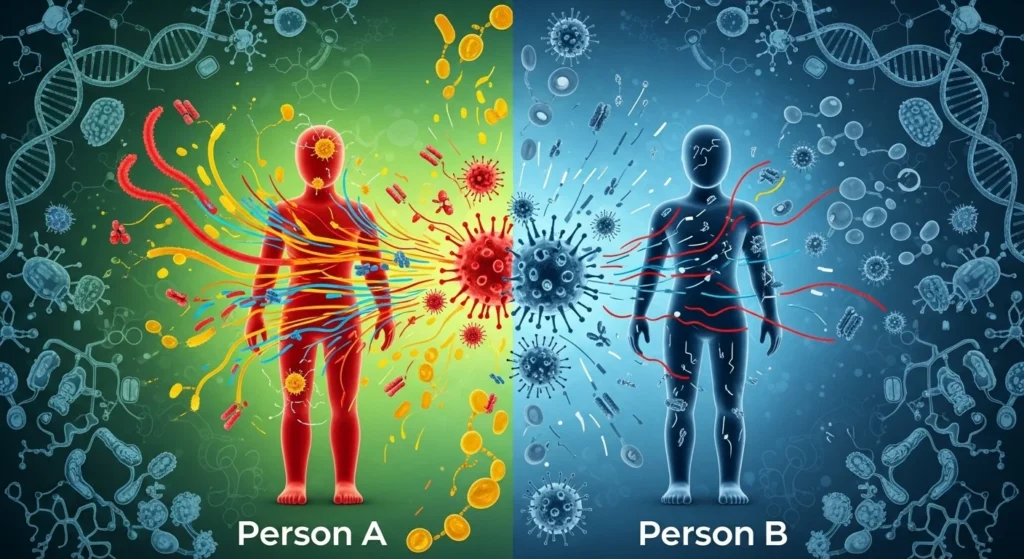
Why Do People React So Differently to the Same Germ?
Have you ever noticed something puzzling?
Two people catch the same cold.
One feels tired for a day.
The other feels wiped out for a week.
Or two people receive the same vaccine…
And their bodies respond differently.
This can feel mysterious.
Is one immune system “better”?
Is the other “weaker”?
The truth is more interesting:
The immune system is not a one-size-fits-all machine.
Immune responses differ between people because immunity is shaped by:
- Genetics
- Past exposure history
- Microbial environments
- Age and biology
- The immune system’s unique memory
Your immune response is deeply personal—like a fingerprint of your life and biology.
Let’s explore why no two immune systems react exactly the same way.
The Immune System Is Not a Single Organ — It’s a Network
A common misconception is that immunity is one thing you either “have” or “don’t have.”
In reality, the immune system is a vast network of:
- Cells
- Proteins
- Signaling molecules
- Organs like the spleen and lymph nodes
- Barrier defenses like skin and mucus
It functions more like an orchestra than a single shield.
Different people have slightly different orchestras:
Different players, different tuning, different rhythms.
That’s why immune responses vary.
Innate Immunity: The Body’s First, Fast Response
Everyone is born with innate immunity—the rapid-response system.
It detects general danger patterns and reacts quickly.
Innate defenses include:
- Inflammation signals
- Fever responses
- Immune cells that patrol tissues
But even innate immunity differs between individuals.
Some people’s early warning systems are more reactive.
Others are slower or quieter.
That first “alarm phase” affects everything that follows.
The immune system’s starting speed is not identical across bodies.
Adaptive Immunity: Immune Memory Makes Responses Personal
The second layer is adaptive immunity, which learns over time.
Adaptive immunity creates memory cells that remember past invaders.
This is why exposure history matters so much.
Your immune response depends on what your body has encountered before:
- Childhood infections
- Vaccinations
- Environmental microbes
- Regional exposure patterns
Two people may meet the same virus…
But one immune system may recognize parts of it faster.
The other may treat it as unfamiliar.
Immune memory is like a library.
Everyone’s library is different.
Why This Happens: Genetics Shape the Immune Blueprint
Genes influence how immune systems are built.
Genetic variation affects:
- How immune cells recognize threats
- How strongly inflammation is triggered
- How quickly antibodies are produced
One major example is the HLA system, which helps immune cells identify foreign material.
Different genetic versions mean different recognition styles.
Think of genetics like the immune system’s hardware.
The immune system runs similar software…
But the hardware varies from person to person.
That creates differences in response.
The Microbiome: Your Body’s Invisible Immune Partner
Your immune system does not work alone.
It constantly interacts with trillions of microbes living in and on your body—the microbiome.
Gut bacteria influence:
- Immune training
- Inflammation balance
- Barrier strength
- Immune sensitivity
Because everyone’s microbiome is unique, immune responses differ.
Two people may have very different microbial ecosystems based on:
- Diet
- Location
- Early life exposure
- Lifestyle environments
Your microbes help shape how your immune system reacts.
Immunity is partly a partnership.
Age Changes Immune Response Over Time
Immune systems are not static.
They change across the lifespan.
In childhood:
- The immune system is learning constantly
- Responses can be strong but inexperienced
In adulthood:
- Immunity becomes more specialized
- Memory becomes deeper
In older age:
- Immune responses can become slower
- Inflammation regulation may shift
This is why age strongly affects immune response.
Two people of different ages may react very differently to the same exposure.
Immune function is a moving timeline, not a fixed trait.
Environment Shapes Immune Sensitivity
The immune system is influenced by surroundings.
Environmental factors include:
- Air quality
- Seasonal patterns
- Stress levels
- Sleep rhythms
- Exposure to diverse microbes
The immune system is constantly adjusting to context.
Someone living in one environment may develop different immune calibration than someone living elsewhere.
Immunity is not isolated inside the body.
It’s a system responding to the world around it.
The Immune System Balances Strength and Restraint
A key misunderstanding is that a “stronger” immune response is always better.
But immune responses are about balance.
Too little response can allow infection.
Too much response can create unnecessary inflammation.
The immune system must constantly choose:
- How intensely to react
- How quickly to shut down
- How much energy to invest
Different people have different immune calibration.
Some immune systems are more sensitive.
Others are more restrained.
Variation is normal biology, not simply “strong vs weak.”
Everyday Examples You’ve Definitely Seen
Immune differences appear all the time:
- One person gets seasonal allergies, another doesn’t
- One person rarely catches colds, another does more often
- People experience different vaccine side effects
- The same virus produces different symptom intensity
These variations are not random.
They reflect individualized immune ecosystems built from genes, memory, and environment.
Common Misconception: “If You Get Sick Easily, Your Immune System Is Weak”
Immune response is not a single strength meter.
Getting sick more often can reflect:
- Exposure differences
- Immune learning stage
- Microbiome variation
- Stress and sleep effects
- Random chance
The immune system is complex.
Illness frequency is not a simple scoreboard.
Variation is part of immune diversity.
Comparison Table: Why Immune Responses Differ
| Factor | How It Influences Immunity | Why People Differ |
|---|---|---|
| Genetics | Threat recognition and signaling | Different inherited immune blueprints |
| Immune memory | Faster response to familiar invaders | Different exposure histories |
| Microbiome | Immune training and inflammation balance | Unique microbial ecosystems |
| Age | Speed and regulation of immune function | Immune system evolves over life |
| Environment | Calibration to surroundings | Different lifestyles and exposures |
| Stress and rhythm | Affects immune energy allocation | Bodies respond differently to demand |
Why This Matters Today (Evergreen)
Understanding immune variation helps explain an important truth:
Human biology is diverse.
Public health, vaccines, and infection patterns will always show variation because immune systems are individualized.
This knowledge reduces confusion:
If two people react differently, it doesn’t mean one is “better.”
It means immune responses are shaped by many variables working together.
Immunity is not uniform.
It is personal biology in action.
Immune Diversity Is Actually Useful
From an evolutionary perspective, immune variation is beneficial.
If every human responded identically, a single pathogen could overwhelm everyone equally.
Diversity creates resilience at the population level.
Different immune strategies mean:
- Different strengths
- Different vulnerabilities
- Different responses
Variation is not an error.
It is part of biological adaptability.
Simple, Educational Understanding (No Medical Claims)
Immune responses differ between people because:
- Genetics shape immune recognition systems
- Adaptive immunity is built from personal exposure history
- The microbiome trains immune balance uniquely
- Age changes immune speed and regulation
- Environment influences immune calibration
- Immunity is about balance, not just intensity
Your immune system is a reflection of both biology and life experience.
Key Takeaways
- Immune responses differ because the immune system is complex and individualized
- Genetics influence how threats are recognized and processed
- Immune memory depends on past exposures and vaccines
- The microbiome plays a major role in immune regulation
- Age and environment shape immune response patterns
- Immune variation is normal and biologically expected
FAQ: Common Curiosity Questions
1. Why do two people get different symptoms from the same virus?
Because genetics, immune memory, and immune regulation differ between individuals.
2. Does a stronger immune response always mean better protection?
Not always. Immunity requires balance, not maximum intensity.
3. How does the microbiome affect immunity?
Gut microbes help train immune responses and influence inflammation regulation.
4. Why do immune systems change with age?
Immune systems evolve across life, shifting in speed, memory, and regulation.
5. Is immune variation normal?
Yes. Immune diversity is expected and helps populations stay resilient.
Conclusion: Your Immune Response Is Uniquely Yours
Immune responses differ between people because immunity is not a simple shield.
It is a living system shaped by:
- Your genes
- Your microbial partners
- Your history of exposures
- Your age and environment
- Your body’s immune memory
No two immune systems are identical.
That variation is part of what makes human biology adaptable.
Your immune response is not just a reaction…
It is the story of your body learning how to defend, balance, and remember.
Disclaimer: This article explains scientific concepts for general educational purposes and is not intended as professional or medical advice.