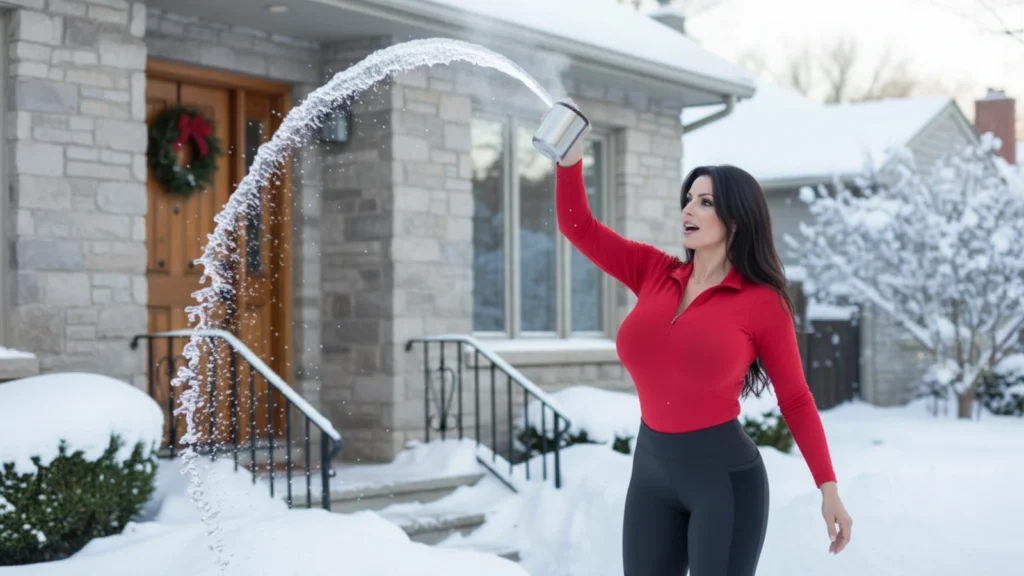
“When Common Sense Gets It Wrong”
You fill two identical containers.
One with cold water.
One with hot water.
You place both in a freezer.
Logic says the cold water should freeze first.
But sometimes… it doesn’t.
👉 In certain conditions, hot water can freeze faster than cold water.
This sounds impossible.
Yet it has been observed repeatedly—in homes, labs, and classrooms.
This strange behavior isn’t a trick or myth. It’s a real scientific phenomenon that reveals how complex water, heat, and motion really are.
Let’s break it down—clearly, calmly, and step by step.
First: Is This Really True?
Yes—but with an important clarification.
Hot water does not always freeze faster than cold water.
It happens only under specific conditions.
When it does occur, scientists call it the Mpemba effect—named after a student who noticed it while making ice cream.
The key takeaway is this:
👉 Freezing is not just about starting temperature. It’s about how heat leaves the system.
Why Freezing Isn’t Just “Getting Cold”
Freezing is a process, not a moment.
For water to freeze, several things must happen:
- Heat must leave the water
- The water must reach the freezing point
- Molecules must arrange into a solid structure
Each step can be influenced by how the water starts—and how it behaves while cooling.
That’s where hot water sometimes gains an advantage.
Reason #1: Hot Water Loses Heat Faster at First
Hot water and cold water don’t cool at the same rate.
Hot water:
- Transfers heat to its surroundings more rapidly
- Creates stronger temperature differences
- Releases energy faster early on
Think of it like rolling downhill.
A steeper slope (hot water) lets you lose height faster at the start.
In some setups, this rapid early cooling allows hot water to “catch up” and overtake cold water.
Reason #2: Evaporation Reduces the Amount of Water
Hot water evaporates more.
That matters more than most people realize.
When evaporation happens:
- The hottest molecules escape
- Remaining water cools faster
- Total water volume decreases
Less water means:
👉 Less material needs to freeze.
In open containers, this effect can significantly speed up freezing.
Cold water doesn’t evaporate nearly as much, so it keeps more volume—and more heat.
Reason #3: Hot Water Mixes Itself Better
Hot water naturally circulates as it cools.
Warm water rises.
Cooler water sinks.
This internal movement:
- Distributes temperature evenly
- Prevents insulating warm layers
- Improves heat transfer to the environment
Cold water, by contrast, can develop stable layers that slow cooling.
Better mixing = faster energy loss.
Comparison Table: Hot Water vs Cold Water Cooling
| Factor | Hot Water | Cold Water |
|---|---|---|
| Initial heat loss | Very fast | Slower |
| Evaporation | High | Minimal |
| Internal mixing | Strong | Weak |
| Water volume loss | Greater | Little |
| Cooling efficiency | Sometimes higher | More stable |
This combination explains why outcomes can flip.
Reason #4: Dissolved Gases Behave Differently
Cold water contains more dissolved gases (like oxygen).
Hot water releases many of these gases when heated.
Why this matters:
- Dissolved gases can affect freezing behavior
- Gas-free water may freeze more efficiently
- Crystal formation can happen differently
This subtle effect doesn’t act alone—but it contributes to the overall picture.
Reason #5: The Freezer Environment Matters
Freezers are not perfectly uniform.
Hot containers can:
- Melt frost beneath them
- Make better contact with cold surfaces
- Improve heat conduction
Cold containers may sit on insulating ice layers, slowing heat loss.
So sometimes, hot water simply has better thermal contact with the freezer.
Common Misunderstanding: “Hot Water Is Colder Faster”
Hot water does not magically become cold faster in all cases.
What actually happens is:
- Hot water may cool faster initially
- Certain processes favor rapid energy loss
- Under the right conditions, it reaches freezing first
This is not a rule—it’s a conditional outcome.
Everyday Examples You’ve Probably Seen
You may have noticed this effect without realizing it:
- Hot water forming ice patterns faster outdoors in winter
- Warm puddles freezing quicker than shallow cold ones
- Steam accelerating cooling in cold air
Water behaves differently when temperature gradients are extreme.
Why Scientists Still Study This
Despite centuries of observation, the Mpemba effect is still actively researched.
That’s because:
- Multiple mechanisms interact at once
- Small changes affect outcomes
- Water has unusually complex properties
It’s a reminder that even everyday substances can surprise us.
Why This Matters Today
Understanding this phenomenon helps us:
- Learn how heat transfer actually works
- Appreciate why intuition fails in physics
- Design better cooling and freezing systems
More broadly, it shows why science depends on observation—not assumption.
Key Takeaways
- Hot water can freeze faster, but only under certain conditions
- Faster heat loss, evaporation, and mixing play key roles
- Freezing depends on processes, not just temperature
- Water behaves in uniquely complex ways
- Science often challenges “common sense”
Frequently Asked Questions (FAQ)
1. Does hot water always freeze faster than cold water?
No. It only happens under specific conditions.
2. Is this effect rare?
It’s uncommon but well-documented.
3. Does container shape matter?
Yes. Surface area and material can influence heat loss.
4. Can this happen in home freezers?
Yes, especially with open containers.
5. Is this phenomenon dangerous or harmful?
No. It’s simply a physical behavior of water.
Conclusion: A Reminder That Nature Isn’t Simple
Hot water freezing faster than cold water feels wrong—but it isn’t.
It’s a reminder that:
- Nature follows rules, not intuition
- Processes matter more than labels
- Even familiar substances can behave unexpectedly
The next time science surprises you, remember:
Confusion is often the first step toward understanding.
Disclaimer: This article explains scientific concepts for general educational purposes and is not intended as professional or medical advice.





Pingback: What If Gravity Suddenly Became Stronger — How the World Would Instantly Change
Pingback: Why We See Lightning Before Hearing Thunder — A Simple Science of Speed
Pingback: Why You Slip More on Ice — The Surprising Science Beneath Your Feet
Pingback: Why Mirrors Reverse Left and Right — The Simple Science Behind a Familiar Mystery