When Worry Turns Physical
You’re not in danger.
Nothing has happened.
There’s no injury, no illness, no visible threat.
And yet your body reacts.
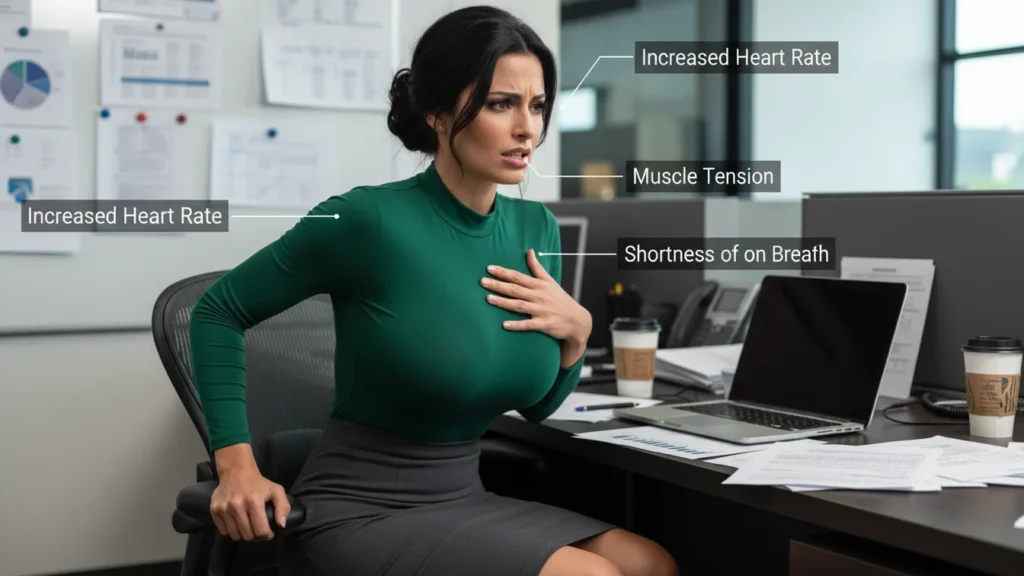
Your heart races.
Your chest feels tight.
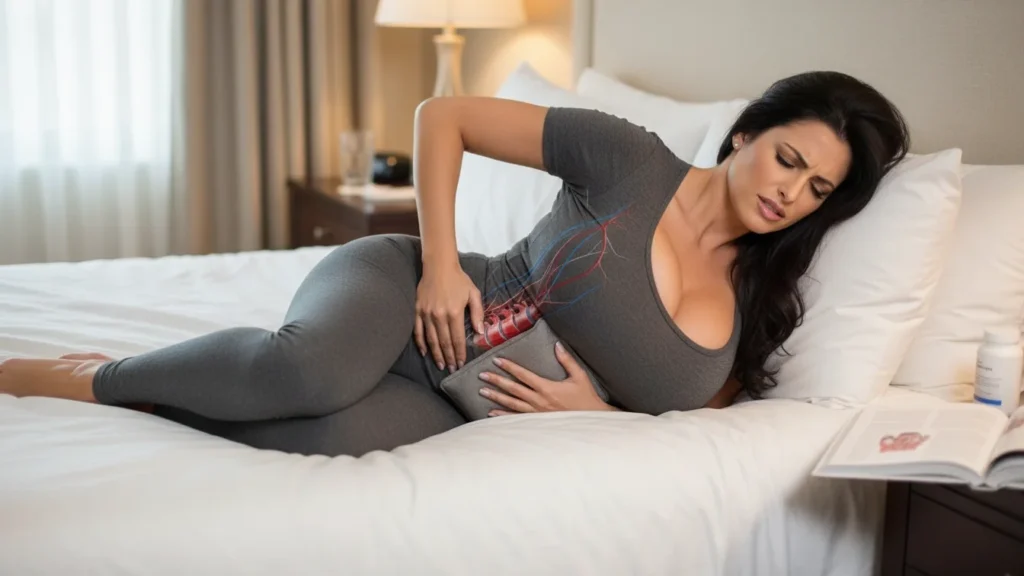
Your stomach twists.
Your hands feel shaky or numb.
These physical sensations can be the most frightening part of anxiety — often more distressing than anxious thoughts themselves.
But anxiety causing physical symptoms is not a malfunction.
It’s a predictable biological response built into the human nervous system.
Anxiety Is a Body State, Not Just a Thought
One of the biggest misunderstandings about anxiety is believing it exists only in the mind.
In reality, anxiety is a whole-body condition.
It begins in the brain, but its purpose is physical:
- Prepare the body
- Increase alertness
- Mobilize energy
- Protect against potential danger
Thoughts are only one part of the system. The body is where the response is designed to act.
The Brain’s Job Is Survival, Not Comfort
Your brain evolved to keep you alive — not to keep you calm.
When the brain detects uncertainty or potential threat, it activates a powerful survival system. This system does not wait for proof. It acts quickly, because hesitation once meant danger.
The brain essentially asks:
“Should we prepare the body just in case?”
If the answer is even maybe, the physical response begins.
The Fight-or-Flight Response Explains Most Symptoms
At the center of anxiety’s physical effects is the fight-or-flight response.
This response:
- Increases heart rate
- Speeds breathing
- Tightens muscles
- Redirects blood flow
- Heightens sensory awareness
These changes are helpful in physical danger — but uncomfortable during modern stress.
Anxiety triggers the same response without an actual physical threat.
Why the Body Reacts Before the Mind
Many people notice physical symptoms before anxious thoughts.
This happens because:
- The brain can trigger body responses subconsciously
- Physical changes occur faster than conscious reasoning
- The body sends signals upward before thoughts form
You might feel tightness, dizziness, or nausea first — then your mind asks, “What’s wrong?”
The order matters: body first, explanation later.
Why the Heart Feels Involved So Often
Heart-related sensations are among the most common anxiety symptoms.
During anxiety:
- Heart rate increases to deliver oxygen
- Blood pressure shifts
- Chest muscles tense
The brain closely monitors the heart, so any change feels urgent and noticeable.
This is why anxiety-related sensations can feel dramatic — even when they’re part of a normal stress response.
Why Breathing Feels Strange or Difficult
Breathing is automatically adjusted during anxiety.
The body prepares for action by:
- Breathing faster
- Shallow breathing
- Increasing oxygen intake
This change can create sensations like:
- Shortness of breath
- Air hunger
- Chest tightness
- Lightheadedness
These sensations are uncomfortable — but they are the result of over-preparation, not danger.
The Gut Is One of the First Targets
The digestive system is extremely sensitive to stress.
During anxiety:
- Digestion slows or speeds up
- Gut muscles tighten
- Sensation awareness increases
This can cause:
- Nausea
- Stomach pain
- Urgency
- Butterflies
Digestion is temporarily deprioritized so energy can be redirected elsewhere.
Why Muscles Become Tight and Sore
Anxiety primes the body for movement.
Muscles:
- Tighten for quick action
- Remain semi-activated
- Stay ready to react
When there’s no physical release (like running or fighting), this tension lingers — leading to soreness, stiffness, or shaking.
The body is ready, but never used.
Why Dizziness and Lightheadedness Occur
Anxiety changes blood flow patterns.
Blood is directed toward:
- Large muscles
- Vital organs
Less is prioritized for:
- Hands
- Feet
- Peripheral systems
Combined with faster breathing, this can cause:
- Dizziness
- Floating sensations
- Feeling “unreal”
These sensations are disorienting — but not harmful.
The Feedback Loop That Makes Anxiety Feel Worse
Physical symptoms don’t occur in isolation.
They create a loop:
- Brain detects uncertainty
- Body activates
- Physical sensations appear
- Brain interprets sensations as threat
- Anxiety increases
This loop explains why anxiety can escalate quickly — even without external danger.
Why Physical Symptoms Feel So Convincing
The brain treats body signals as high-priority information.
From an evolutionary standpoint:
- Ignoring physical warnings was risky
- Responding quickly increased survival
So when physical symptoms appear, the brain assumes they matter.
This is why reassurance can feel ineffective — the body is speaking louder than logic.
Common Misunderstandings About Anxiety Symptoms
“If it’s physical, it must be medical.”
Physical symptoms can come from nervous system activation.
“This means something is seriously wrong.”
Anxiety symptoms are real but not dangerous.
“I should be able to control this.”
These responses are automatic, not chosen.
“It’s all in my head.”
It’s in the brain–body system — and very real.
A Simple Comparison: Calm vs. Anxious Body
| System | Calm State | Anxiety State |
|---|---|---|
| Heart rate | Steady | Elevated |
| Breathing | Slow, deep | Fast, shallow |
| Muscles | Relaxed | Tense |
| Digestion | Active | Altered |
| Sensory awareness | Balanced | Heightened |
Why This Happens More in Modern Life
Modern stress is:
- Ongoing
- Psychological
- Unresolved by physical action
The body evolved for short bursts of danger followed by release.
Today, stress signals stay on — but the body never discharges the energy. Physical symptoms accumulate instead.
Why This Matters Today
Many people fear anxiety symptoms more than anxiety itself.
Understanding the biology behind them:
- Reduces fear of the sensations
- Breaks the interpretation loop
- Separates discomfort from danger
The body is not betraying you.
It’s overprotecting you.
Key Takeaways
- Anxiety activates a full-body survival response
- Physical symptoms are real and biologically driven
- The body often reacts before conscious thought
- Symptoms reflect preparation, not harm
- Understanding reduces fear of sensations
Frequently Asked Questions
Why does anxiety cause so many different physical symptoms?
Because the stress response affects multiple body systems at once.
Why do symptoms change from day to day?
Because stress, energy, and attention levels vary.
Why do symptoms feel worse when I focus on them?
Attention amplifies body signals.
Can anxiety cause symptoms even when I feel calm mentally?
Yes. Body responses can activate without conscious worry.
Are anxiety symptoms dangerous?
They are uncomfortable but typically not harmful.
A Calm Conclusion
Anxiety causes physical symptoms because it was never meant to stay in the mind.
It evolved to move the body.
In modern life, where threats are abstract and constant, this system often activates without release — leaving physical sensations behind.
Understanding this transforms fear into knowledge.
And knowledge turns symptoms from something terrifying into something explainable.
Your body isn’t broken.
It’s trying to protect you — sometimes a little too enthusiastically.
Disclaimer: This article explains scientific concepts for general educational purposes and is not intended as professional or medical advice.