A Black Hole So Large It Breaks Human Intuition
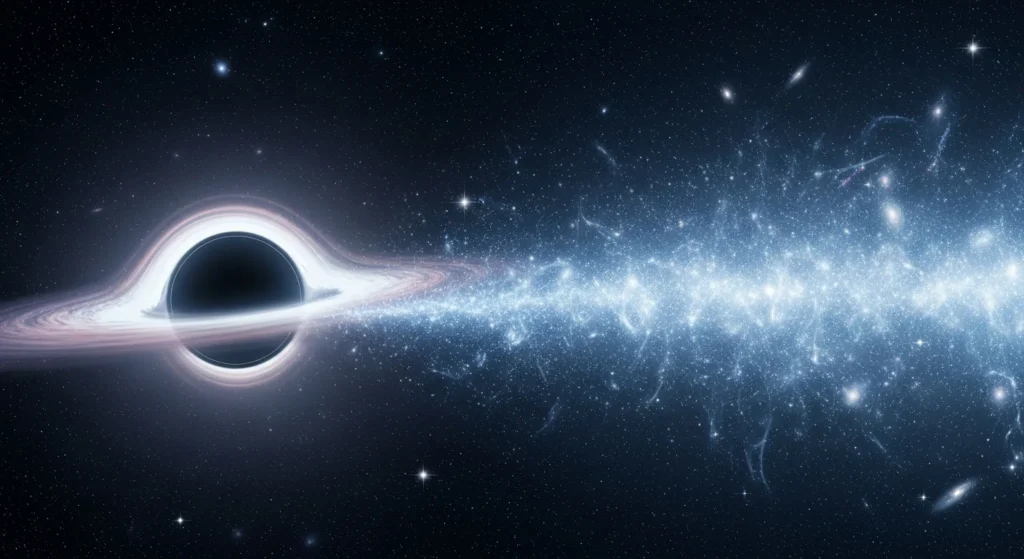
Black holes already feel like the most extreme objects in existence.
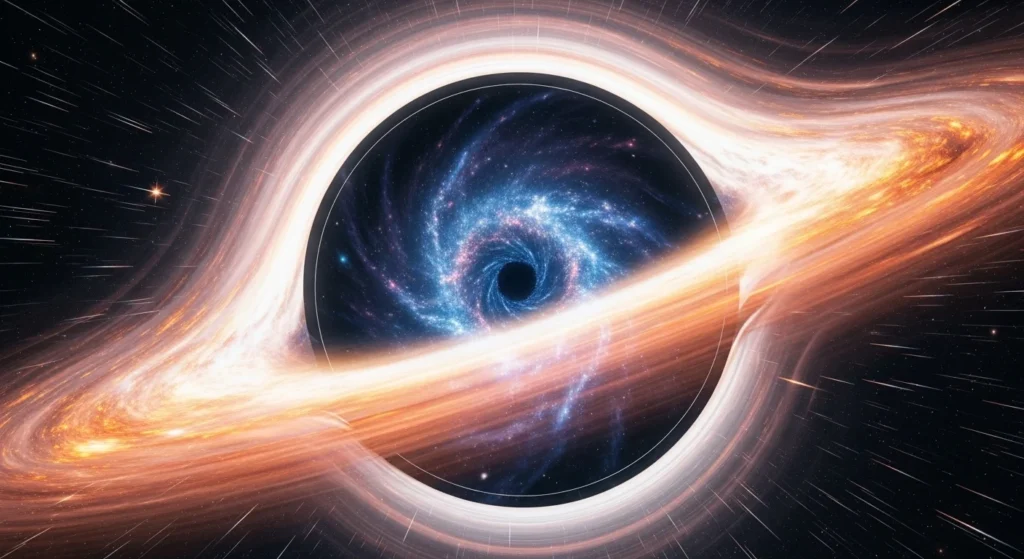
They bend light.
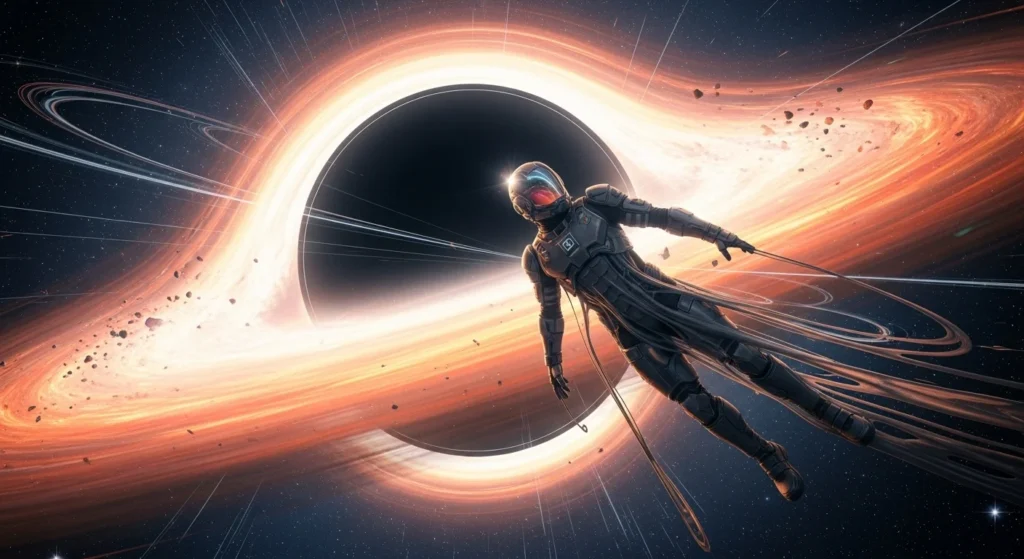
They hide entire stars behind invisible horizons.
But then comes an even more mind-stretching question:
How big can a black hole actually get?
Some black holes are not just massive…
They are so enormous that they make our Sun look like a single grain of sand.
Astronomers have discovered black holes with masses tens of billions of times greater than the Sun.
These are the true giants of the cosmos.
So what is the most massive black hole ever discovered?
And how do scientists even measure something that cannot be seen?
Let’s explore this cosmic scale in a clear, educational way.
First: What Does “Massive” Mean for a Black Hole?
Black holes come in different size categories:
Stellar-Mass Black Holes
- Form from collapsing stars
- Usually 5 to 100 times the Sun’s mass
Supermassive Black Holes
- Found in galaxy centers
- Range from millions to billions of solar masses
Ultramassive Black Holes
- The rarest giants
- Can exceed 10 billion solar masses
The biggest black holes known fall into this last group.
They are cosmic heavyweights beyond normal imagination.
The Most Massive Black Hole Ever Discovered (So Far)
One of the largest known black holes is located in the galaxy:
Holmberg 15A
Astronomers estimate its central black hole may have a mass of:
~40 billion times the mass of the Sun
That number is difficult to grasp.
So here’s a comparison:
- Sun = 1 solar mass
- Typical supermassive black hole = millions or billions
- Holmberg 15A’s black hole = tens of billions
It belongs to an elite category of ultramassive black holes.
Another Cosmic Contender: TON 618
When people ask about the biggest black hole ever discovered, one name appears again and again:
TON 618
This is a distant quasar powered by a black hole estimated at:
~66 billion solar masses
That makes TON 618 one of the most massive black holes ever measured.
It is so bright and distant that we see it as it was when the universe was much younger.
TON 618 is often considered the largest known black hole by mass estimate.
Wait—How Can We Measure a Black Hole’s Mass?
Here’s the fascinating part:
Astronomers don’t weigh black holes directly.
They measure their gravitational influence.
It’s like knowing there’s an invisible elephant in a room…
Because you can see the floor bending beneath it.
Scientists estimate black hole mass by observing:
1. Star Orbits
Stars near a black hole orbit extremely fast.
The faster they move, the stronger the gravity.
That reveals the mass.
2. Gas Motion in Galaxy Centers
Hot gas swirls around the black hole like water down a drain.
Its speed gives clues about the black hole’s weight.
3. Quasar Brightness
In objects like TON 618, the black hole is feeding.
The glowing disk of infalling matter becomes incredibly luminous.
That brightness can help estimate mass.
4. Gravitational Lensing
Sometimes, a black hole’s gravity bends light from objects behind it.
This warping effect also hints at mass.
How Big Is a 60-Billion-Solar-Mass Black Hole?
Let’s make it real.
Black holes have an event horizon radius proportional to their mass.
For TON 618:
Its event horizon could span more than 1,000 astronomical units.
That’s roughly:
- Bigger than the entire Solar System
- Larger than Pluto’s orbit many times over
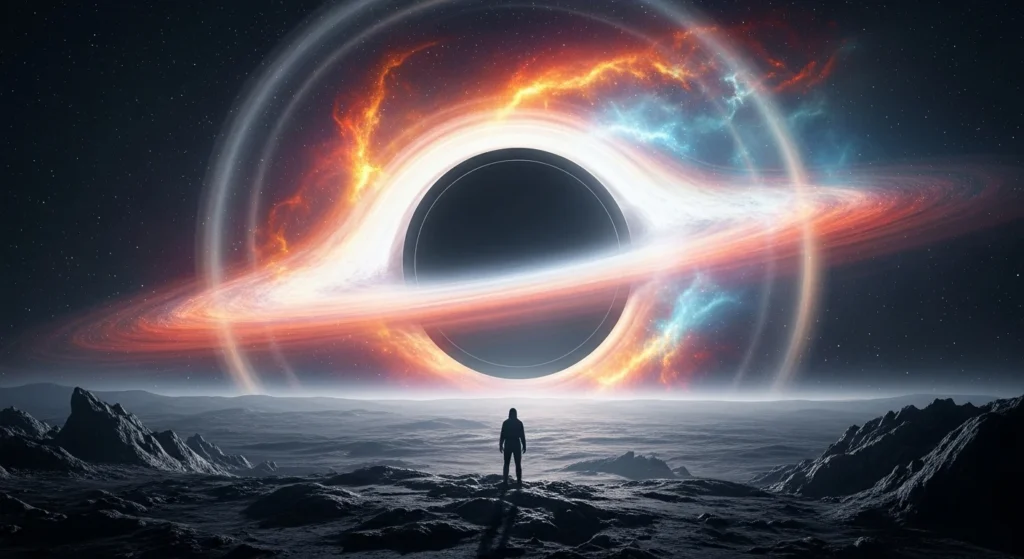
Imagine a black hole so large that the boundary where light cannot escape could swallow our planetary neighborhood whole.
That’s what these giants represent.
Why Do Some Black Holes Become So Huge?
The biggest mystery is not that black holes exist…
It’s how they grow so enormous.
Scientists believe ultramassive black holes form through:
Galaxy Mergers
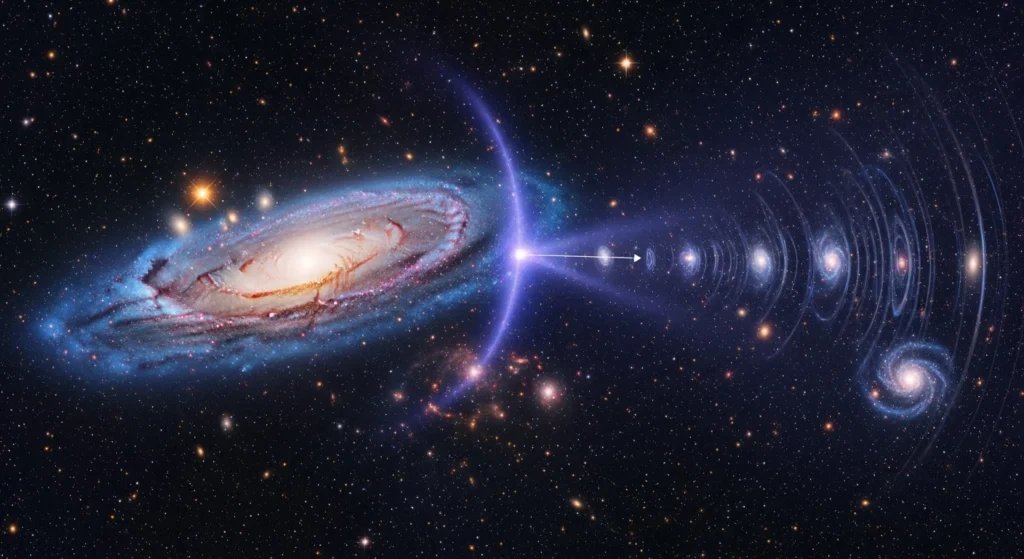
When galaxies collide, their central black holes eventually merge too.
Over billions of years, this can create enormous giants.
Long-Term Feeding
A black hole can grow by steadily pulling in gas, dust, and stars.
Quasars represent periods of intense feeding.
Early Universe Growth
Some supermassive black holes existed surprisingly early.
That suggests the universe had ways to build huge black holes quickly.
This remains an active area of research.
Common Misunderstanding: “Is This the Biggest Black Hole in the Universe?”
Not necessarily.
The biggest black hole we’ve discovered is simply the biggest we know so far.
The universe contains trillions of galaxies.
Many regions remain unobserved.
There could be even larger black holes waiting in the cosmic dark.
Astronomy is always limited by what light has reached us—and what our instruments can detect.
What These Giants Reveal About the Universe
The largest black holes are not just record holders.
They teach scientists about:
- How galaxies evolve
- How matter behaves under extreme gravity
- The history of cosmic structure
- The limits of black hole formation
These objects sit at the center of the biggest galaxies and help shape their growth.
In a sense:
To understand galaxies, you must understand their black holes.
The Universe’s Strange Balance
It’s almost poetic:
The brightest quasars are powered by the darkest objects.
The largest engines of cosmic energy are invisible.
A black hole billions of times the Sun’s mass can outshine an entire galaxy when feeding…
Yet it cannot be seen directly.
Only its effects reveal its presence.
Why This Matters Today (Evergreen Perspective)
Studying the most massive black holes helps answer some of the universe’s biggest questions:
- How did structure form after the Big Bang?
- What limits exist in nature?
- How does gravity behave at extremes?
- What will happen to galaxies in the far future?
These giants are not just curiosities.
They are key pieces of the cosmic story.
The Takeaway: The Largest Black Holes Are Cosmic Colossi
So, what is the most massive black hole ever discovered?
Some of the strongest contenders include:
- TON 618 (~66 billion solar masses)
- Holmberg 15A (~40 billion solar masses)
These black holes redefine what “massive” means.
They are larger than solar systems.
Heavier than imagination.
And they remind us that the universe still holds extremes beyond everyday understanding.
Final Thought
The largest black hole ever found isn’t just the biggest thing in space…
It’s a reminder that nature builds on scales so vast, the human mind must stretch just to picture them.
And somewhere out there, an even larger one may still be waiting.