“Imagine Looking Up — and the Sun Feels Closer”
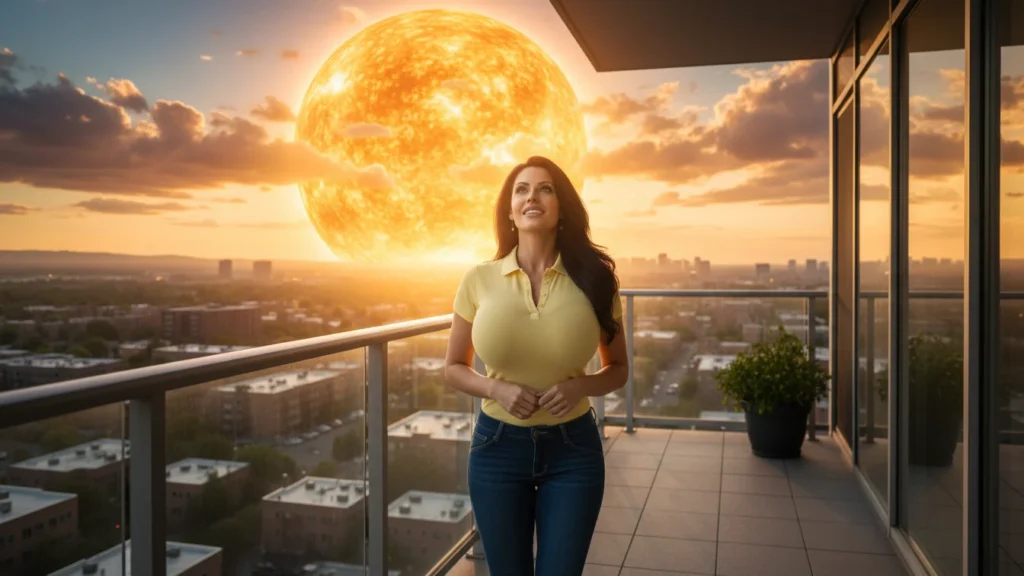
Picture an ordinary morning.
The Sun rises as usual…
but something feels different.
It looks bigger.
Brighter.
More intense than yesterday.
Not dramatically closer—but unmistakably larger.
This single change would quietly rewrite the rules of life on Earth.
In this article, we explore what would happen if the Sun suddenly grew larger, using well-established astronomy and physics—calmly, clearly, and without exaggeration.
First, What Does “The Sun Growing Larger” Actually Mean?
When we say “larger,” we could mean two different things:
- The Sun’s radius increases (it physically expands)
- The Sun’s mass stays the same, but its surface spreads out
These details matter because size, mass, brightness, and gravity are not the same thing.
For this thought experiment, we’ll assume:
- The Sun suddenly expands in size
- Its mass remains roughly the same
- Its energy output increases as a result of the expansion
This lets us explore the most meaningful effects on Earth.
The Sun Isn’t Static — Stars Do Change Size
Although the Sun won’t suddenly expand in reality, stars do grow larger over time.
As stars age:
- Their internal reactions change
- Energy output increases
- Outer layers expand
In the distant future, the Sun will slowly become a red giant.
But that process takes billions of years.
Our scenario simply compresses that change into an instant—so we can clearly see the consequences.
The First Thing Earth Would Notice: More Light and Heat
A larger Sun means a larger surface area emitting energy.
That leads to:
- Increased sunlight reaching Earth
- Higher energy per square meter
- Stronger heating of the atmosphere and surface
Even a small increase in the Sun’s size could dramatically increase Earth’s temperature.
Think of it like standing closer to a campfire.
The fire hasn’t changed who it is—but the heat you feel rises fast.
Why Distance Matters More Than We Realize
Earth’s distance from the Sun is finely balanced.
Move Earth slightly closer—or make the Sun slightly larger—and the effects multiply.
Increased sunlight would:
- Warm oceans
- Increase evaporation
- Alter cloud formation
- Shift global climate patterns
This wouldn’t happen evenly.
Some regions would heat faster than others.
The Atmosphere Would Start Acting Differently
Earth’s atmosphere responds quickly to energy changes.
With a larger Sun:
- Air temperatures rise
- Weather systems intensify
- Wind and pressure patterns shift
Warm air holds more moisture.
That would increase:
- Cloud formation in some regions
- Dryness in others
- Overall climate instability
The atmosphere isn’t just air—it’s an energy system.
Oceans: Earth’s Heat Buffer Under Stress
Oceans absorb enormous amounts of heat.
At first, they would act as buffers—slowing temperature rise.
But with sustained increased sunlight:
- Surface waters warm
- Evaporation increases
- Heat penetrates deeper layers
Warmer oceans feed stronger atmospheric activity.
This feedback loop would reshape Earth’s climate.
Why Plants Would React Before Animals
Plants depend directly on sunlight.
More light isn’t always better.
If the Sun grew larger:
- Photosynthesis could initially increase
- Heat stress would follow
- Water loss would accelerate
Plants evolved for a narrow light and temperature range.
Disrupt that balance, and ecosystems respond quickly.
Gravity: Would a Bigger Sun Pull Earth In?
This is a common misunderstanding.
Size does not equal gravity.
Gravity depends on mass, not surface size.
If the Sun’s mass stayed the same:
- Earth’s orbit would remain mostly stable
- Planets wouldn’t suddenly spiral inward
However, changes in solar radiation—not gravity—would drive most effects.
Why the Sky Would Look Different
A larger Sun would appear:
- Bigger in the sky
- Brighter
- More visually intense
Sunrise and sunset would feel harsher.
Shadows would sharpen.
Colors could appear washed out during the day due to increased glare.
Small changes in stellar size can alter how a planet feels visually.
The Inner Solar System Would Feel It First
Mercury and Venus would experience:
- Extreme heating
- Atmospheric changes
- Possible surface transformations
Earth sits in a delicate middle zone.
A slightly larger Sun could push Earth closer to the inner planets’ conditions.
A Clear Comparison: Today’s Sun vs a Larger Sun
| Feature | Current Sun | Larger Sun |
|---|---|---|
| Apparent size in sky | Stable | Noticeably larger |
| Sunlight intensity | Balanced | Stronger |
| Earth’s climate | Stable | Increasingly unstable |
| Ocean temperature | Regulated | Rising |
| Habitability | High | Gradually challenged |
The difference is subtle at first—but powerful over time.
Common Misunderstanding: “The Sun Would Swallow Earth”
A larger Sun wouldn’t instantly engulf Earth.
That only happens much later in a star’s life when it becomes a true red giant.
Our scenario focuses on energy balance, not collision.
The danger comes from heat—not contact.
Why This Happens — The Core Scientific Reason
Earth’s systems are finely tuned to the Sun’s size and energy output, so even small solar changes ripple through climate, atmosphere, and life.
That balance is what makes Earth habitable.
Why This Matters Today
This thought experiment highlights something important:
Earth’s stability isn’t accidental.
It depends on:
- Stellar size
- Distance
- Energy balance
- Interconnected systems
Understanding this builds appreciation for how rare and precise habitable conditions truly are.
Key Takeaways
- A larger Sun would increase heat and light on Earth
- Climate systems would respond quickly
- Oceans and atmosphere would enter feedback loops
- Gravity wouldn’t change much if mass stayed constant
- Earth’s habitability depends on delicate solar balance
Frequently Asked Questions
Would Earth instantly become unlivable?
No. Changes would unfold over time, starting with climate disruption.
Would seasons disappear?
Seasons would still exist, but temperature extremes would intensify.
Would the Sun look dangerously bright?
It would appear noticeably larger and harsher, especially at midday.
Would Earth’s orbit change?
Not significantly, as long as the Sun’s mass remained the same.
Is this something scientists expect soon?
No. The Sun changes size extremely slowly over billions of years.
A Calm, Educational Conclusion
The Sun feels constant because, on human timescales, it is.
But even small changes in a star’s size or energy output can reshape an entire planet.
By imagining a slightly larger Sun, we learn a powerful lesson:
Life on Earth exists not just because the Sun shines—but because it shines just enough.
Disclaimer: This article explains scientific concepts for general educational purposes and is not intended as professional or medical advice.