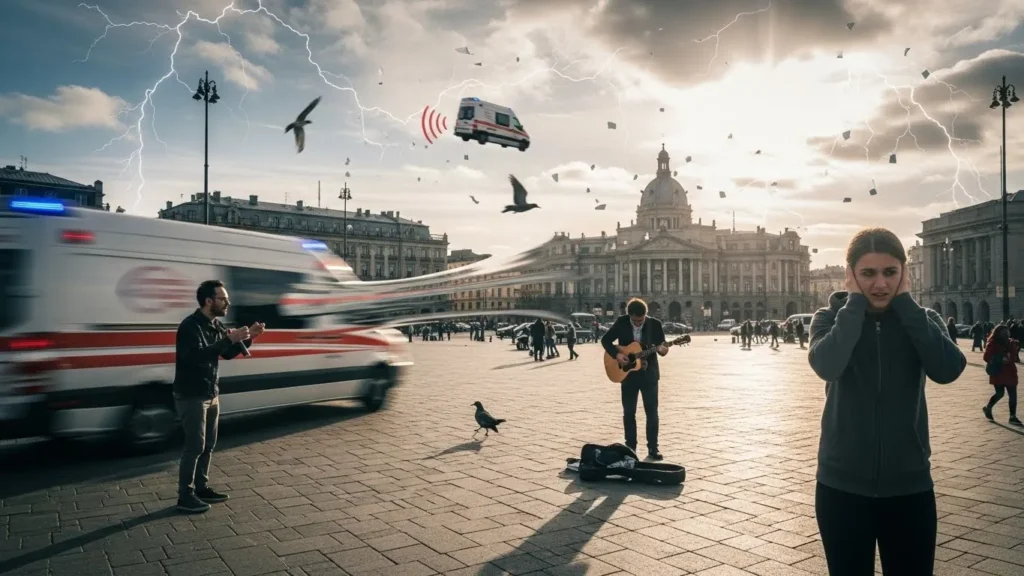
“A World Where You Hear Before You See”
Imagine standing far away from a fireworks display.
You hear the boom first.
Only afterward do you see the explosion light up the sky.
It feels wrong — unsettling.
This reversal alone hints at how deeply our understanding of reality depends on light being faster than sound.
Today, we always:
- See lightning before hearing thunder
- See lips move before hearing words
- See explosions before the shockwave arrives
Now imagine the opposite.
Sound arrives first. Light follows later.
This single change would quietly unravel how we experience time, distance, and cause-and-effect.
First, Why Sound Is Slower Than Light
To understand the “what if,” we need the “why.”
Sound and light are fundamentally different.
Sound:
- Is a mechanical wave
- Requires a medium (air, water, solid)
- Moves by vibrating particles
Light:
- Is an electromagnetic wave
- Needs no medium
- Travels through empty space
Sound must push matter out of the way.
Light does not.
That’s why sound crawls compared to light racing across space.
The Vast Speed Difference We Take for Granted
In everyday life:
- Sound moves roughly as fast as a fast airplane
- Light circles Earth multiple times in a single second
This gap is so large that our brains have built their understanding of reality around it.
Light defines when something happens.
Sound confirms what happened.
Flip their speeds, and that relationship collapses.
What “Faster Than Light” Really Means
This thought experiment isn’t about realism — it’s about consequences.
If sound traveled faster than light:
- Sound would arrive before visual information
- Effects could be perceived before causes
- Timing relationships would reverse
This isn’t just strange.
It challenges the very idea of sequence.
Everyday Life Would Feel Deeply Disorienting
Consider simple situations:
Conversations
You’d hear someone speak before seeing their mouth move.
Your brain relies on visual cues to interpret speech.
Those cues would always lag behind.
Speech would feel detached from faces.
Sports
You’d hear a bat hit a ball before seeing the swing.
Crowd reactions would reach you before the action.
Accidents
You’d hear crashes before seeing anything move.
The brain would constantly struggle to align senses.
Why the Brain Depends on Light Leading Sound
Human perception assumes:
- Light arrives first
- Sound fills in details
This helps the brain:
- Judge distance
- Predict motion
- Understand causality
When you hear thunder after lightning, your brain knows:
- The event already happened
- The delay reveals distance
Reverse that, and sound would no longer indicate where something is.
Distance perception would break.
A Simple Comparison: Normal Physics vs Reversed Speeds
| Feature | Current Reality | Sound Faster Than Light |
|---|---|---|
| Order of perception | See → Hear | Hear → See |
| Distance judgment | Reliable | Confusing |
| Cause-and-effect | Intuitive | Reversed |
| Communication clarity | High | Disrupted |
| Sense of time | Stable | Fragmented |
The world wouldn’t be louder.
It would be harder to understand.
Why Causality Would Feel Broken
Causality means:
- Causes come before effects
Light currently anchors causality visually.
If sound outran light:
- You could hear consequences before seeing actions
- Reactions could precede visuals
- Prediction would replace confirmation
The brain would receive answers before questions.
This doesn’t just confuse senses — it undermines how we learn.
What Happens to Science and Measurement?
Much of science relies on light:
- Observations
- Measurements
- Timing
If sound arrived first:
- Experiments would feel inconsistent
- Data interpretation would become complex
- Synchronization would fail
Even simple measurements like speed and distance rely on light as the fastest signal.
Remove that assumption, and many systems collapse conceptually.
Common Misunderstanding: Louder Means Faster
Some people assume sound is “slower” only because it’s weaker.
That’s not true.
Sound’s speed is limited because:
- It depends on particle interaction
- Matter resists compression
- Energy transfer takes time
Making sound louder increases intensity — not speed.
Speed is about how fast information moves, not how strong it feels.
Would This Affect Space?
Sound cannot normally travel in space.
But if sound somehow moved faster than light:
- It would still require a medium
- Space would remain silent unless filled
However, if sound had universal speed dominance:
- Communication systems would shift entirely
- Light-based signals would be obsolete
The universe would prioritize vibration over vision.
Why Evolution Couldn’t Handle This World Easily
Human senses evolved under fixed rules.
Eyes evolved because light:
- Arrives instantly (for practical purposes)
- Carries spatial detail
- Works at long distances
Hearing evolved as:
- Secondary confirmation
- Directional support
- Environmental awareness
If sound dominated speed:
- Vision would lose leadership
- Brains would require total rewiring
- Survival cues would misalign
Our current biology depends on light being first.
Why This Matters Today
This thought experiment reveals something subtle:
Physics isn’t just equations.
It shapes experience.
The speed of light isn’t important only for scientists.
It determines:
- How we perceive reality
- How we communicate
- How we trust our senses
When physics sets a limit, it also creates order.
The Hidden Gift of Slower Sound
We rarely appreciate sound being slow.
But its slowness gives us:
- Distance awareness
- Emotional anticipation
- Environmental context
Hearing thunder after lightning tells us:
- How far the storm is
- Whether it’s approaching
If sound were faster, that information disappears.
Slowness adds meaning.
Would the World Be Dangerous or Just Confusing?
Mostly confusing.
People wouldn’t instantly die or panic.
But:
- Coordination would suffer
- Reaction timing would degrade
- Learning would slow
Society depends on shared perception.
Break perception, and cooperation weakens.
Key Takeaways
- Sound and light differ because of how they travel
- Light arriving first anchors perception and causality
- Faster-than-light sound would reverse sensory order
- Distance, timing, and learning would be disrupted
- The brain depends on light leading sound
- Physics shapes how reality feels, not just how it works
Frequently Asked Questions
Can sound ever travel faster than light?
No. Sound requires a medium and cannot exceed light’s universal speed limit.
Why do we see lightning before thunder?
Light travels vastly faster than sound through air.
Would faster sound mean instant communication?
It would still depend on medium, direction, and clarity.
Would vision become useless?
No, but it would lose its role as the primary timing sense.
Does anything travel faster than light?
No information or signal has been shown to exceed light speed.
A Calm Conclusion
If sound traveled faster than light, the universe wouldn’t explode.
But meaning would fracture.
We would hear outcomes before actions.
Experience consequences before causes.
Trust our senses less.
This thought experiment shows why the universe feels orderly.
Not because it’s quiet —
but because light leads, and sound follows.
That simple sequence holds reality together.
Disclaimer: This article explains scientific concepts for general educational purposes and is not intended as professional or medical advice.