“Imagine Waking Up to a Waterless Planet”
You look at a map of Earth.
The familiar blues are gone.
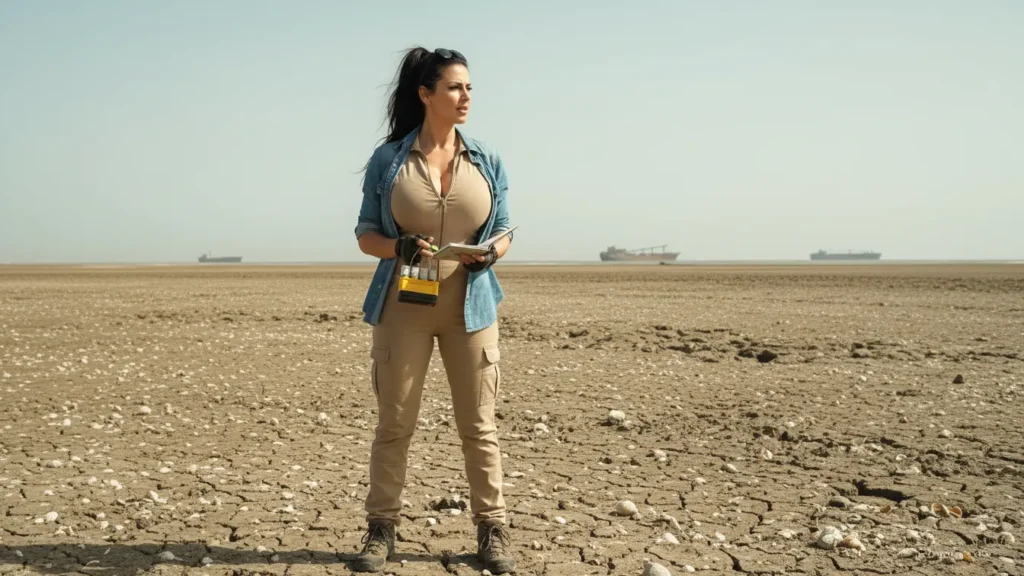
Where oceans once stretched endlessly, there is now a vast, cracked landscape—deep trenches, towering ridges, and salt-covered plains exposed to the open air.
No waves.
No tides.
No horizon of water meeting sky.
It’s an unsettling thought. But it’s also a powerful way to understand just how deeply oceans shape our planet.
This article explores what would happen if Earth’s oceans suddenly evaporated, step by step—calmly, scientifically, and without exaggeration.
First, Can Oceans Actually Evaporate Instantly?
In reality, oceans cannot suddenly evaporate.
Evaporation is a slow process that requires enormous energy. Earth’s oceans contain so much water that fully evaporating them would require conditions far beyond anything our planet experiences.
So this is a thought experiment—a scientific “what if” used to explore cause and effect.
By imagining the impossible, we better understand what normally keeps Earth stable.
What Oceans Really Are: More Than Just Water
Oceans are not just large bodies of liquid.
They are:
- Massive heat storage systems
- Climate regulators
- Chemical buffers
- Structural supports for Earth’s crust
Covering about 71% of Earth’s surface, oceans interact constantly with the atmosphere, land, and life.
Removing them would be like removing the engine from a moving vehicle—not just losing one feature, but destabilizing the whole system.
Immediate Visual Changes: A Very Different Earth
If oceans vanished, the planet’s surface would look unfamiliar.
You would see:
- Vast ocean basins up to 11 km (7 miles) deep
- Mid-ocean ridges taller than most mountain ranges
- Thick layers of salt, minerals, and sediments
- Entirely new “continents” exposed
Most of Earth’s surface lies underwater today. Without oceans, land would dominate—but it wouldn’t be friendly land.
Atmospheric Chaos: Where Did All the Water Go?
If oceans evaporated, the water wouldn’t disappear—it would enter the atmosphere as vapor.
This would cause:
- An atmosphere saturated with water vapor
- Intense cloud formation
- Extreme pressure and density changes
Water vapor is a powerful greenhouse gas.
With that much vapor in the air, Earth’s temperature would rise rapidly, creating a feedback loop where heat causes more evaporation—if any water remained.
The Water Cycle Would Collapse
The water cycle depends on balance.
Normally:
- Oceans evaporate slowly
- Clouds form
- Rain falls
- Rivers return water to the sea
Without oceans:
- There is no stable evaporation source
- Rain patterns become chaotic
- Freshwater systems collapse
Rivers, lakes, and groundwater all ultimately depend on ocean-fed cycles. Remove the oceans, and the entire system unravels.
Climate Extremes: From One End to the Other
Oceans act like thermal shock absorbers.
They:
- Store heat during the day and summer
- Release it slowly at night and winter
Without oceans:
- Days become extremely hot
- Nights become extremely cold
- Seasonal swings intensify dramatically
Coastal regions—which currently have mild climates—would experience extreme temperature fluctuations similar to deserts.
Why Oceans Keep Earth’s Climate Stable
Think of oceans as a giant thermal battery.
They:
- Absorb solar energy
- Distribute heat via currents
- Moderate global temperatures
Without them, Earth’s climate would become unstable and unpredictable, even without considering other changes.
What Happens to Oxygen and the Atmosphere?
A surprising amount of Earth’s oxygen is linked to ocean life.
Microscopic organisms in oceans contribute significantly to:
- Oxygen production
- Carbon cycling
- Atmospheric balance
Without oceans:
- Oxygen production would drop over time
- Carbon dioxide regulation would fail
- Atmospheric composition would slowly shift
This wouldn’t happen overnight—but it would be inevitable.
Life on Earth: A Chain Reaction, Not an Instant End
Life wouldn’t vanish instantly—but it would unravel.
Immediate effects:
- Marine ecosystems disappear completely
- Food chains collapse
- Coastal ecosystems fail
Gradual effects:
- Terrestrial life struggles with climate extremes
- Plant growth declines as cycles destabilize
- Biodiversity drops sharply
Even life far from the ocean depends on the systems oceans support.
Geological Changes: The Planet Would Respond
Oceans exert immense pressure on Earth’s crust.
Removing that pressure would cause:
- Crustal rebound in ocean basins
- Increased tectonic activity
- Changes in volcanic behavior
The planet’s surface would slowly adjust to this sudden imbalance.
Earth is not static—it responds to changes in load and pressure.
A Comparison: Earth With Oceans vs Without
| Feature | With Oceans | Without Oceans |
|---|---|---|
| Climate stability | High | Extremely unstable |
| Temperature swings | Moderate | Extreme |
| Water cycle | Balanced | Broken |
| Atmospheric regulation | Stable | Disrupted |
| Biodiversity | High | Rapid decline |
Oceans are not optional features. They are foundational.
Common Misunderstanding: “Land Would Just Expand”
It’s tempting to imagine that removing oceans simply gives us more land.
In reality:
- The exposed land would be harsh and inhospitable
- Salt and minerals would dominate
- Temperature extremes would make survival difficult
More land does not mean more livable space.
Why This Happens — In One Clear Explanation
Oceans regulate heat, atmosphere, chemistry, and life itself—removing them destabilizes nearly every system that makes Earth habitable.
Why This Matters Today
You don’t need to imagine oceans disappearing to appreciate their role.
This thought experiment highlights:
- How interconnected Earth’s systems are
- Why small changes can have large effects
- How oceans quietly stabilize daily life
Understanding this builds respect—not fear—for the systems that support us.
Key Takeaways
- Oceans are central to climate regulation
- They stabilize temperature and weather
- They support the water cycle and atmosphere
- Removing them would destabilize Earth rapidly
- Earth’s habitability depends deeply on ocean systems
Frequently Asked Questions
Would Earth become a desert planet without oceans?
Yes, much of the surface would resemble extreme deserts with massive temperature swings.
Would rain still fall?
Rain might occur briefly from atmospheric water vapor, but stable rainfall patterns would not last.
Could humans survive without oceans?
Long-term survival would be extremely difficult due to climate instability and ecological collapse.
Would gravity or Earth’s orbit change?
No. Oceans affect climate and surface systems, not gravity or orbit.
Has any planet experienced this before?
Some planets lack surface water, but Earth’s unique balance depends on its oceans.
A Calm, Educational Conclusion
Oceans don’t just sit on Earth’s surface.
They breathe with the atmosphere, steady the climate, feed the land, and support life in quiet, constant ways.
Imagining a world without them reveals a simple truth:
Earth works because its systems work together—and oceans are one of the most important connections of all.
Disclaimer: This article explains scientific concepts for general educational purposes and is not intended as professional or medical advice.