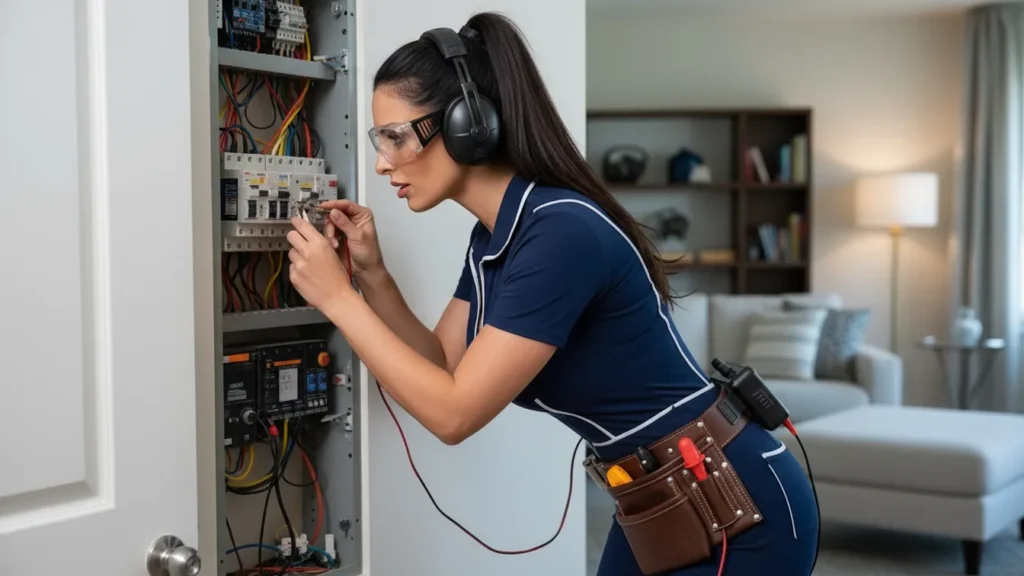
The Silent World That Isn’t Really Silent
Your room feels quiet.
But it isn’t.
Electricity flows through walls, cables, devices, and screens around you every second. Signals pulse through chargers. Currents hum inside appliances. Data moves as tiny electrical changes inside machines.
You just can’t hear any of it.
Now imagine if you could.
Imagine that every powered object produced a faint sound — a buzz, a whisper, a shifting tone — simply because electricity was moving through it.
The world wouldn’t explode with noise.
But it would never be truly quiet again.
What Are Electrical Signals, Really?
Electricity isn’t a substance rushing through wires like water through a pipe.
It’s the movement of charged particles creating energy flow and information transfer.
Electrical signals:
- Power lights and motors
- Carry data in electronics
- Control machines and networks
- Appear naturally in lightning and atmospheric activity
These signals don’t produce sound on their own. Sound requires vibrating air. Electrical flow usually vibrates too subtly — or in places we can’t perceive.
That’s why electricity feels silent.
Why Humans Can’t Hear Electricity
Human hearing evolved to detect pressure waves in air, not electromagnetic activity.
Our ears are tuned to:
- Vibrations between specific frequencies
- Changes in air movement
- Mechanical sound sources
Electrical signals move as:
- Charges along conductors
- Fields through space
- Microscopic changes far outside hearing range
Some animals detect electricity, but not through hearing.
Humans simply never evolved a sensory bridge between electric flow and sound perception.
What “Hearing Electrical Signals” Would Mean
If humans could hear electrical signals, it wouldn’t be like hearing voices or music.
It would feel more like:
- A background hum
- Shifting tonal patterns
- Subtle changes in pitch and intensity
Each electrical source might have:
- A unique “sound signature”
- A recognizable rhythm
- A detectable presence
Electricity wouldn’t shout.
It would murmur constantly.
Everyday Life Would Gain a New Sound Layer
Think about your current environment.
If you could hear electricity:
- Power outlets might emit a low steady tone
- Chargers could produce rising and falling sounds
- Wi-Fi routers might hum softly
- Elevators, trains, and streetlights would have audible signatures
Silence would exist only where electricity didn’t.
Nature would sound quieter than cities — not because nature is silent, but because it uses far less electrical flow.
Homes Would Feel Very Different
Modern homes are saturated with electrical activity.
With electrical hearing:
- Nighttime wouldn’t feel silent
- Idle devices would still “sound alive”
- Standby power would become noticeable
People might:
- Arrange homes to reduce electrical noise
- Prefer unplugged spaces
- Design architecture around sound-dampening electricity
Quiet would become a design goal, not an assumption.
Technology Would Become More Intuitive
One surprising benefit would be awareness.
Hearing electricity could help people:
- Notice faulty wiring
- Sense overloaded circuits
- Detect energy waste
- Recognize active vs inactive devices
A failing appliance might:
- Sound strained
- Change tone
- Become audibly irregular
Instead of indicators and alerts, electricity itself would announce its state.
Cities Would Sound Completely Different
Urban life already feels noisy.
Add electrical sound, and cities would gain a new acoustic identity.
Cities might:
- Have a constant low-frequency hum
- Sound brighter during peak usage
- Quiet down during blackouts instantly
Power outages wouldn’t need announcements.
You’d hear the city go silent.
Common Misconception: “This Would Be Overwhelming”
It sounds overwhelming at first — but perception adapts.
Humans already filter:
- Background noise
- Constant smells
- Visual clutter
Over time:
- The brain would tune out stable electrical sounds
- Sudden changes would stand out
- Awareness would become selective
Electric hearing wouldn’t feel like chaos.
It would feel like context.
How This Sense Would Change Human Awareness
Perception shapes understanding.
If humans heard electricity:
- Energy would feel tangible
- Consumption would feel real
- Infrastructure would feel alive
Electricity would stop being abstract.
People might:
- Respect power systems more
- Notice inefficiencies intuitively
- Develop emotional responses to energy use
Invisible systems shape behavior most when they become perceptible.
Comparing Today vs a World With Electrical Hearing
| Today’s World | World With Electrical Hearing |
|---|---|
| Electricity feels invisible | Electricity feels present |
| Silence is common indoors | True silence is rare |
| Devices appear inactive | Devices sound alive |
| Energy use is abstract | Energy use is sensory |
| Faults require indicators | Faults announce themselves |
Why Humans Never Evolved This Sense
Evolution favors usefulness.
Humans already developed:
- Vision for navigation
- Hearing for communication
- Touch for manipulation
- Cognition for tool-making
Electrical hearing:
- Offered little advantage before technology
- Didn’t aid survival in natural environments
- Became relevant only very recently
Evolution doesn’t anticipate the future.
It responds to the past.
Why This Matters Today
Modern life runs on electricity.
Yet most people interact with it blindly:
- We don’t feel it working
- We don’t notice waste
- We don’t sense strain
This thought experiment highlights how much of modern reality operates outside human perception.
Understanding that gap helps explain:
- Why energy feels cheap
- Why infrastructure failures feel sudden
- Why awareness lags behind dependence
Key Takeaways
- Electrical signals are everywhere but normally silent
- Humans can’t hear electricity because it doesn’t move air
- Hearing electricity would add a constant background layer to life
- Awareness of energy use would increase naturally
- Perception shapes responsibility as much as knowledge
Frequently Asked Questions
Would this make life noisier?
Yes, but not overwhelmingly. The brain would adapt to constant electrical sounds.
Would nature sound quieter than cities?
Yes. Natural environments use far less electrical energy.
Would this help with safety?
Likely. Electrical problems could become audible before becoming serious.
Would people still enjoy silence?
Silence would exist mainly in places without electrical activity.
Could technology simulate this sense?
Some tools already convert electrical signals into sound, but natural perception would be far more intuitive.
A Calm Conclusion
Electricity already surrounds us.
It powers our homes, carries our words, and shapes our cities — all without making a sound.
If humans could hear electrical signals, the world wouldn’t feel louder.
It would feel more honest.
More alive.
More responsive.
More connected to the systems that quietly sustain modern life.
And perhaps hearing electricity would remind us that the most powerful forces are often the ones we never notice — until we learn how to listen.
Disclaimer: This article explains scientific concepts for general educational purposes and is not intended as professional or medical advice.