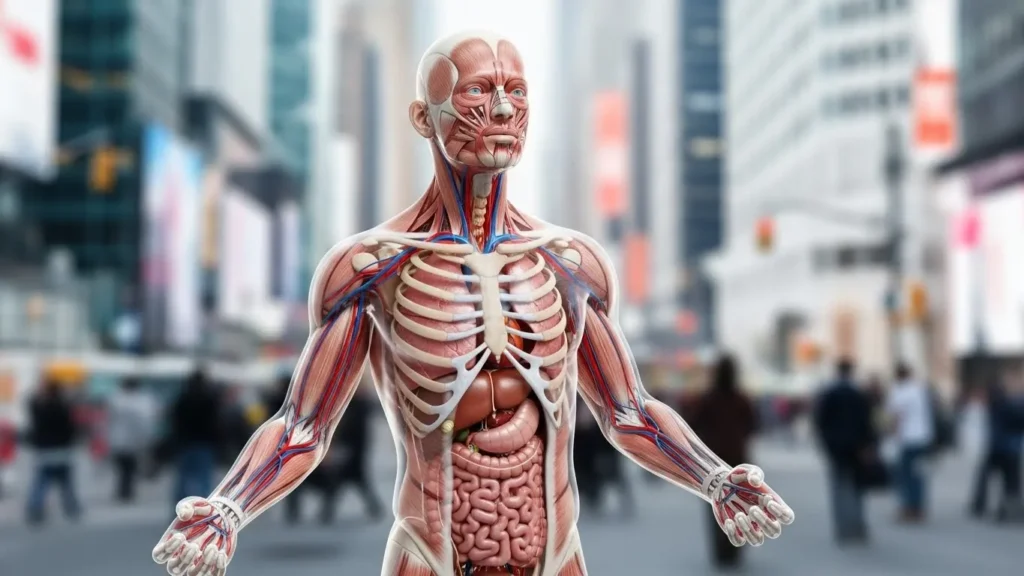
Imagine Seeing the Human Body—All the Time
You look at your hands.
Instead of skin, you see muscles flex.
Blood vessels pulse gently.
Bones provide structure beneath it all.
No injury.
No special equipment.
Just everyday life.
Transparent skin sounds like science fiction—but thinking about it reveals something deeply real: skin is far more than a covering.
Exploring what would happen if humans had transparent skin helps explain why skin exists, why it looks the way it does, and how biology balances protection, perception, and identity.
What Does “Transparent Skin” Actually Mean?
Transparent skin would allow light to pass through it instead of absorbing or scattering it.
In nature, transparency exists—but rarely in large land animals.
Some small creatures have semi-transparent bodies because:
- They live in water
- They don’t rely on sun protection
- They have minimal surface exposure
Human skin, however, evolved for a very different environment.
Why Human Skin Is Normally Opaque
Skin is not designed for visibility.
It is designed for survival.
Human skin performs multiple jobs at once:
- Protects internal organs
- Blocks harmful radiation
- Prevents dehydration
- Regulates temperature
- Enables touch and sensation
- Acts as a barrier against the environment
Transparency would interfere with many of these roles.
How Skin Blocks Light—and Why That Matters
Human skin contains pigments and structures that absorb and scatter light.
The most well-known is melanin, but it’s only part of the story.
Skin layers:
- Epidermis – outer barrier
- Dermis – blood vessels, nerves, connective tissue
- Subcutaneous layer – fat, insulation, energy storage
These layers aren’t transparent by accident.
They manage how much energy enters the body.
What Would Happen to Temperature Control?
Skin helps regulate heat.
Blood vessels expand and contract near the surface to release or retain warmth.
With transparent skin:
- Sunlight would penetrate deeper
- Internal tissues would absorb more heat
- Cooling systems would be overwhelmed more easily
In simple terms, the body would struggle to keep a stable temperature.
It’s like removing insulation from a house.
Seeing Blood Flow Would Become Normal
One immediate difference would be visual.
You would constantly see:
- Blood moving through vessels
- Muscles tightening and relaxing
- Organs shifting with movement
This might sound fascinating—but it would also be overwhelming.
The human brain evolved to filter unnecessary information.
Transparent skin would flood the senses with signals that normally stay hidden.
A Comparison: Opaque vs. Transparent Human Skin
| Function | Opaque Skin | Transparent Skin |
|---|---|---|
| Light protection | High | Very low |
| Temperature control | Stable | Difficult |
| Sensory focus | External world | Internal distractions |
| Physical privacy | Preserved | Constantly exposed |
| Environmental defense | Strong | Weakened |
Skin’s invisibility is part of its strength.
How Would Injury and Healing Appear?
With transparent skin, even small internal changes would be visible.
- Bruising would appear instantly
- Swelling would be obvious at early stages
- Healing processes would be constantly on display
While this sounds informative, it could also create constant concern over normal internal changes that are usually harmless.
Not everything visible is meaningful.
Why Transparency Works in Some Animals—but Not Humans
Some animals are partially transparent because:
- They live in water where light behaves differently
- Their bodies are small
- They face fewer radiation challenges
Humans evolved on land, under direct sunlight, with large surface areas exposed for long periods.
Transparency in that environment would be a disadvantage.
Skin Is Also a Social Interface
Beyond biology, skin plays a social role.
It communicates:
- Health cues
- Emotional responses (blushing, paling)
- Age and experience
- Identity and variation
Transparent skin would remove many of these signals—or replace them with unfamiliar ones.
Human interaction would feel very different.
Common Misconception: “Transparent Means Fragile”
Transparency doesn’t automatically mean weakness.
But in humans, transparency would conflict with multiple survival needs at once.
Our bodies evolved for balance, not visibility.
Skin’s opacity is not a flaw—it’s a feature.
Why This Matters Today
Understanding skin helps us appreciate:
- Why sun exposure matters
- Why pigmentation evolved differently across regions
- Why internal processes are hidden
- Why the body prioritizes protection over visibility
This thought experiment highlights how evolution favors function over aesthetics.
What seems limiting often turns out to be essential.
Key Takeaways
- Human skin evolved to protect, regulate, and filter—not reveal
- Transparency would disrupt temperature control and protection
- Seeing internal processes constantly would overwhelm perception
- Opaque skin supports both biology and social interaction
- Evolution balances visibility, safety, and efficiency
Frequently Asked Questions
Would transparent skin make humans healthier?
Not necessarily. Visibility doesn’t improve function and could create new challenges.
Do any humans naturally have transparent skin?
No. Human skin always contains structures that block or scatter light.
Could technology make transparent skin possible?
Technologically visualizing the body is possible—but natural transparent skin would conflict with biology.
Would transparent skin affect aging?
Aging processes would be more visible, but the biological timeline would remain similar.
Is skin color related to transparency?
Skin color affects light absorption, not transparency. All human skin is structurally opaque.
A Calm Conclusion
Transparent skin sounds intriguing because it promises clarity.
But biology isn’t designed for constant exposure—it’s designed for balance.
Human skin quietly shields us, regulates us, and lets us focus outward rather than inward.
Sometimes, what we don’t see is exactly what allows life to work smoothly.
Disclaimer: This article explains scientific concepts for general educational purposes and is not intended as professional or medical advice.