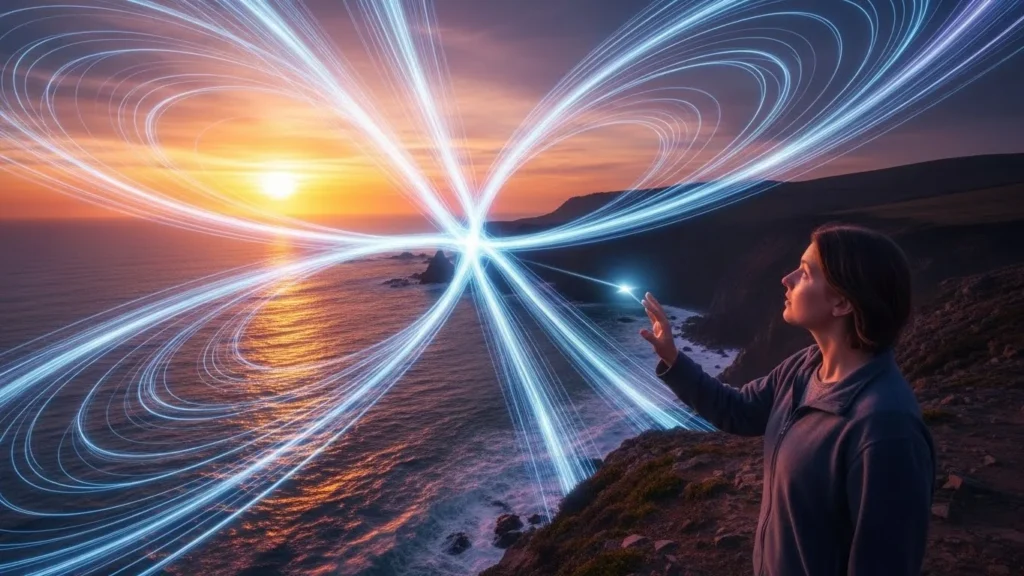
An Invisible Signal We’ve Never Felt
Every moment of your life, a powerful force passes silently through your body.
It doesn’t make noise.
It doesn’t have a smell.
You can’t see it or feel it.
Yet it stretches from the Earth’s core into space and protects the planet from cosmic radiation.
This is Earth’s magnetic field.
Many animals can sense it. Humans cannot.
But what if we could?
What if, alongside sight, hearing, and touch, humans had a quiet internal sense that always knew which way was north — and felt subtle shifts in the invisible structure of the planet itself?
What Is Earth’s Magnetic Field (In Simple Terms)?
Earth’s magnetic field is created deep inside the planet.
Molten metal moving in the core generates electric currents, and those currents create a vast magnetic field surrounding Earth — much like a giant, invisible bubble.
This field:
- Guides compass needles
- Deflects solar particles
- Provides directional consistency across the planet
It doesn’t push or pull us noticeably.
But it’s always there.
Animals That Already Sense Magnetic Fields
Humans aren’t unique in lacking this sense — but many animals possess it.
Examples include:
- Migratory birds navigating thousands of kilometers
- Sea turtles returning to the same beaches
- Fish orienting themselves in open water
- Insects maintaining directional paths
This ability is often called magnetoreception — the capacity to detect magnetic fields.
For these animals, direction is not guessed. It’s felt.
How Magnetic Sensing Works in Nature
Scientists believe animals sense magnetic fields through two main mechanisms:
- Chemical reactions influenced by magnetism, especially in the eyes
- Tiny magnetic particles embedded in certain tissues
These systems don’t provide maps or images.
Instead, they create a subtle directional awareness — similar to balance or spatial orientation.
It’s not conscious navigation.
It’s instinctive alignment.
What “Sensing Magnetic Fields” Would Mean for Humans
If humans gained this ability, it wouldn’t feel like seeing arrows or numbers.
It would feel more like:
- A constant sense of orientation
- Subtle internal alignment
- A background awareness of direction
You wouldn’t “think” about north.
You would know it — the way you know when you’re upright or leaning.
Everyday Life With a Built-In Compass
Daily activities would quietly change.
You might:
- Never feel lost in unfamiliar places
- Instinctively orient yourself in buildings
- Sense direction even underground or indoors
- Navigate cities with fewer signs
Maps would still exist — but reliance on them would drop.
Getting lost wouldn’t feel frightening.
It would feel unlikely.
How Travel and Exploration Would Shift
Exploration shaped human history — but it relied heavily on tools.
If humans sensed magnetic fields:
- Early navigation might have evolved faster
- Long-distance travel could feel more intuitive
- Orientation at sea or in open land would feel natural
Direction would become a felt experience, not a learned skill.
Exploration would rely less on landmarks and more on inner alignment.
Perception Would Gain a New Layer
Human perception is layered.
We don’t just see — we interpret.
We don’t just hear — we locate.
Magnetic sensing would add a background spatial layer, subtly influencing:
- How we imagine spaces
- How we remember routes
- How environments “feel”
Places might feel different not just visually — but directionally.
A room facing north might feel subtly distinct from one facing south.
Common Misconception: “This Would Be a Superpower”
Sensing magnetic fields wouldn’t be dramatic.
It wouldn’t:
- Predict events
- Grant control
- Override decision-making
It would simply add context — like having depth perception instead of flat vision.
Useful. Quiet. Constant.
Most of the time, you’d forget it was there.
Would Technology Still Matter?
Yes — but differently.
GPS provides:
- Exact positioning
- Distance measurement
- Route optimization
Magnetic sensing would provide:
- Orientation
- Directional confidence
- Spatial intuition
The two would complement each other.
Technology gives precision.
Biology gives intuition.
Comparing Humans With and Without Magnetic Sensing
| Humans Today | Humans With Magnetic Sense |
|---|---|
| Use maps and GPS | Feel orientation naturally |
| Can get lost easily | Rarely feel disoriented |
| Direction learned cognitively | Direction felt intuitively |
| Navigation requires attention | Navigation feels automatic |
| Orientation is external | Orientation is internal |
Why Humans Likely Don’t Have This Sense
Evolution favors efficiency.
Humans developed:
- Advanced vision
- Language
- Tool use
- Social cooperation
Magnetic sensing may not have provided enough advantage once:
- Landmarks became common
- Group navigation improved
- Tools replaced instinct
So the trait never developed — or faded over time.
Not because it was bad.
Because it wasn’t necessary.
Why This Matters Today
Understanding magnetic sensing helps explain:
- How animals navigate so precisely
- How perception can exist without awareness
- How senses shape experience, not just survival
It reminds us that reality contains layers we don’t experience — not because they’re weak, but because we evolved differently.
Human perception is not incomplete.
It’s specialized.
Key Takeaways
- Earth’s magnetic field is a constant, invisible force
- Many animals naturally sense magnetic direction
- Humans lack this sense but rely on tools instead
- Magnetic sensing would feel intuitive, not dramatic
- Perception depends as much on evolution as on physics
Frequently Asked Questions
Would humans become better navigators instantly?
Navigation would feel easier, but learning and experience would still matter.
Would this sense work indoors or underground?
Yes. Magnetic fields pass through most materials.
Would people still need compasses?
Rarely. The body itself would act as a compass.
Would magnetic sensing affect emotions or thoughts?
No. It would influence orientation, not decision-making.
Could humans ever evolve this sense?
Evolution works over very long timescales. It’s theoretically possible, but not predictable.
A Calm Conclusion
Humans live inside a magnetic world they never feel.
We cross continents, oceans, and cities guided by tools — while other species follow invisible lines woven into the planet itself.
If humans could sense magnetic fields, life wouldn’t feel magical.
It would feel steadier.
Less lost.
More grounded.
More quietly aligned with the Earth beneath our feet.
And that idea reminds us that reality holds far more signals than we’re built to notice.
Disclaimer: This article explains scientific concepts for general educational purposes and is not intended as professional or medical advice.