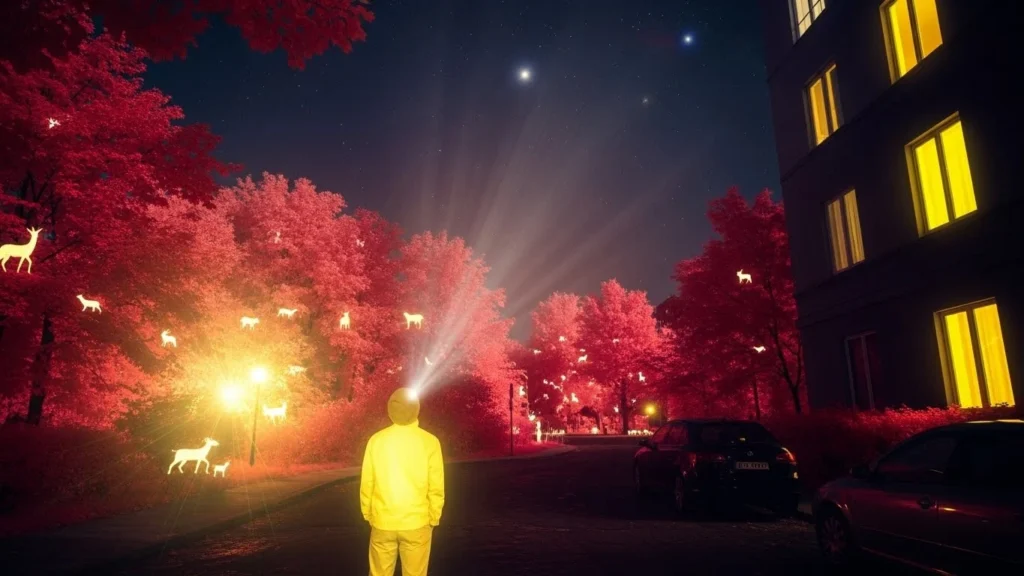
A World That Suddenly Looks… Warm
Imagine stepping outside at night and seeing the world softly glowing.
Buildings shimmer with leftover heat.
Animals stand out clearly against cooler backgrounds.
Footprints linger on the ground as fading heat signatures.
Nothing supernatural is happening.
You’re simply seeing infrared light — a form of light that already surrounds you but normally stays invisible.
Infrared light is not rare, dangerous, or mysterious.
It’s the same light used in remote controls, thermal cameras, and night-vision systems.
The real question isn’t whether infrared exists.
It’s why humans can’t see it — and what would change if we could.
First, What Is Infrared Light?
Light is more than just the colors we see.
The visible rainbow — red, orange, yellow, green, blue, violet — is only a tiny slice of a much larger system called the electromagnetic spectrum.
Just beyond red lies infrared light.
Infrared has:
- Longer wavelengths than visible light
- Lower energy than visible light
- A close connection to heat
Every warm object emits infrared light — including:
- People
- Animals
- Buildings
- Roads
- Even the Earth itself
You’re glowing in infrared right now.
You just can’t see it.
Why Humans Can’t See Infrared (But Some Animals Can)
Human eyes evolved to detect a narrow range of light because it was most useful for survival.
Visible light:
- Reflects well off objects
- Provides sharp detail
- Works efficiently in sunlight
Infrared vision requires different biological hardware.
Some animals already have versions of it:
- Snakes sense infrared to detect warm prey
- Certain insects detect heat differences
- Other species combine thermal cues with vision
Humans, however, rely on retinal cells (rods and cones) tuned only to visible wavelengths.
Infrared simply passes through our eyes unnoticed.
What Would Change If Humans Could See Infrared?
The most immediate difference would be how the world looks at night.
Darkness wouldn’t disappear — but it would feel different.
Warm objects would stand out automatically:
- People would glow softly
- Animals would be unmistakable
- Recently used objects would still shine
Cold objects would fade into darker tones.
The world would no longer be defined only by color — but by temperature contrast.
Everyday Life Would Look Radically Different
Infrared vision wouldn’t just affect science.
It would quietly change daily experiences.
You might notice:
- Which walls retain heat longest
- Whether food is truly hot or cooling
- Footprints left minutes earlier
- Electronics warming during use
Even emotions might feel visible.
Blushing, exertion, stress, and excitement all slightly change skin temperature.
Infrared vision would reveal these subtle shifts instantly.
Seeing Heat vs Seeing Color: A Simple Comparison
| Feature | Visible Light Vision | Infrared Vision |
|---|---|---|
| What it detects | Reflected color | Emitted heat |
| Works in darkness | No | Yes |
| Shows temperature | No | Yes |
| Sharp detail | High | Moderate |
| Emotional cues | Indirect | Subtle heat changes |
Infrared vision wouldn’t replace normal sight.
It would add another layer of information to reality.
The Sky, Nature, and Cities Would Look Different
🌌 The Sky
Clouds would glow based on temperature.
Clear skies and warm air currents would become visible patterns.
🌿 Nature
Animals would stand out clearly against cooler surroundings.
Plants would show temperature differences based on water flow and sunlight.
🏙 Cities
Urban heat islands would be obvious.
Recently driven cars, active buildings, and crowded areas would glow brighter.
Cities wouldn’t just look busy.
They’d look energetically alive.
Common Misunderstanding: Infrared Vision Is Not X-Ray Vision
One of the biggest misconceptions is that infrared vision would let humans see through objects.
It wouldn’t.
Infrared:
- Detects surface heat
- Does not penetrate walls or skin
- Does not reveal internal structures
You wouldn’t see bones or organs.
You’d see temperature patterns on surfaces only.
Infrared vision is about energy, not transparency.
Why This Has Everything to Do With Physics
Infrared light is a reminder of a deeper truth:
Reality isn’t limited to what human senses evolved to detect.
Our eyes sample a small slice of what exists.
Technology expands that slice.
Thermal cameras don’t create new information — they translate invisible light into visible colors.
If humans naturally saw infrared, we wouldn’t feel like we gained a superpower.
We’d simply think, “This is how the world looks.”
Why This Matters Today (Even Without Infrared Eyes)
Even though humans can’t see infrared naturally, infrared already shapes modern life:
- Climate science uses infrared to study Earth’s temperature
- Space telescopes map invisible heat across galaxies
- Engineers detect energy loss in buildings
- Wildlife researchers track animals without disturbance
Understanding infrared reminds us that seeing is not the same as knowing.
The universe contains far more information than our senses reveal.
A Thought Experiment That Changes Perspective
If humans had evolved infrared vision from the start:
- Art would use heat gradients instead of color palettes
- Language would include words for thermal brightness
- Beauty might include warmth patterns, not just shapes
What we call “normal vision” would feel incomplete.
This thought experiment doesn’t predict the future.
It explains the present — by showing how limited perception shapes understanding.
Key Takeaways
- Infrared light is real, natural, and everywhere
- Humans can’t see it due to biological limits, not absence
- Infrared vision reveals heat, not hidden interiors
- Daily life, nature, and cities would look dramatically different
- Technology already allows us to translate infrared into visible form
- Reality extends far beyond what human senses evolved to detect
Frequently Asked Questions
Can humans ever naturally evolve infrared vision?
Natural evolution depends on survival advantage. In modern environments, technology already fills that role.
Is infrared light dangerous to see?
Infrared itself is not harmful at everyday levels; it’s simply another form of light.
Would infrared vision replace normal vision?
No. It would likely complement visible vision rather than replace it.
Do cameras actually “see” infrared like animals do?
Cameras translate infrared into colors we can see; they don’t experience it the way biology would.
Is heat the same thing as infrared light?
Heat causes infrared emission, but they’re not identical. Infrared is how heat energy often travels.
A Calm Conclusion
If humans could see infrared light, the world wouldn’t become stranger.
It would become more honest.
We’d see energy moving, heat fading, and life glowing quietly against cooler surroundings.
Not magic.
Not mystery.
Just a deeper layer of reality that was always there — waiting beyond the limits of our eyes.
Disclaimer: This article explains scientific concepts for general educational purposes and is not intended as professional or medical advice.