The World You Know — Suddenly Covered in Patterns
Imagine stepping outside on a normal morning.
The sky looks the same.
Buildings stand still.
Cars move down the street.
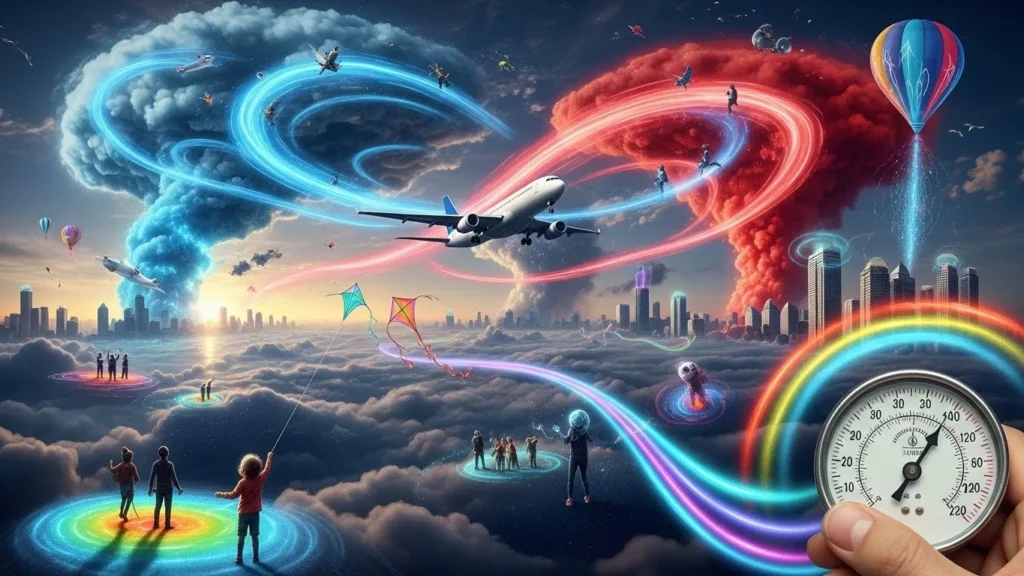
But now, the air itself is visible.
You see soft waves rolling across the road.
Dense pockets pressing down like invisible blankets.
Ribbons of motion sliding around corners and rooftops.
Nothing new has been added to the world.
You’re simply seeing something that was always there.
Air pressure surrounds you every moment of your life. It shapes weather, allows flight, moves wind, and even helps your lungs work. Yet it remains completely unseen—detected only through instruments or indirect effects.
So what would actually change if humans could see air pressure?
First, What Is Air Pressure Really?
Air pressure is not a substance.
It is a force.
It comes from countless air molecules moving, colliding, and pressing against surfaces. Even though individual air molecules are tiny, together they create measurable pressure.
At sea level:
- Air presses down from all directions
- The force is constant and balanced
- You don’t feel it because your body is adapted to it
Air pressure is everywhere, even in “still” air.
Why Air Pressure Is Invisible to Us
Human vision evolved to detect:
- Light
- Color
- Motion
- Contrast
Pressure doesn’t emit light.
It doesn’t have color.
It doesn’t have edges.
The brain prioritizes signals that help with survival—like predators, food, and terrain. Pressure changes are slow, widespread, and usually non-threatening.
So evolution didn’t wire us to see them.
Instead, we perceive pressure indirectly:
- Wind on skin
- Ears popping
- Weather changes
The force is real. The visibility isn’t.
What Seeing Air Pressure Might Look Like
If humans could see air pressure, it likely wouldn’t look like solid objects.
It might appear as:
- Gradients of brightness or color
- Flowing layers like heat shimmer
- Compression zones around moving objects
High-pressure areas might look denser or heavier.
Low-pressure zones might appear thinner or hollowed.
The world would gain an extra visual layer—like an overlay constantly shifting around you.
Why This Happens: Pressure Is Always in Motion
Air pressure is never static.
Even on a calm day:
- Warm air rises
- Cool air sinks
- Air slides to fill gaps
These movements create pressure differences, and pressure differences create motion.
Wind is simply air moving from:
higher pressure → lower pressure
If you could see pressure, you would see wind before it moves.
Everyday Life Would Become Instantly More Predictable
Seeing air pressure would make many daily experiences clearer.
You would immediately notice:
- Where gusts will form
- How air moves around buildings
- Why doors slam or resist opening
Simple actions would feel different.
Opening a car door on a windy day wouldn’t be surprising—you’d see the pressure wall pushing back.
Flying debris, swirling dust, and sudden drafts would no longer seem random.
Weather Would Become Visually Obvious
Weather forecasts rely heavily on pressure maps.
High-pressure systems bring:
- Clear skies
- Stable air
Low-pressure systems bring:
- Clouds
- Rain
- Storms
If pressure were visible:
- Storm systems would appear days in advance
- Cloud formation would make visual sense
- Weather wouldn’t feel mysterious
The sky wouldn’t just look different—it would explain itself.
How Birds, Planes, and Insects Would Suddenly Make Sense
Flight depends entirely on pressure differences.
Wings work by:
- Creating lower pressure above
- Maintaining higher pressure below
If you could see air pressure:
- You’d see wings carving invisible valleys in the air
- Birds would appear to ride pressure slopes
- Aircraft would move through sculpted airfields
Flight wouldn’t seem magical.
It would look engineered—because it is.
Comparison Table: Life Without vs With Visible Air Pressure
| Aspect | Air Pressure Invisible | Air Pressure Visible |
|---|---|---|
| Weather understanding | Abstract | Instantly visual |
| Wind prediction | Reactive | Anticipatory |
| Flight perception | Counterintuitive | Intuitive |
| Daily surprises | Common | Reduced |
| Environmental awareness | Limited | Expanded |
Seeing pressure wouldn’t change physics—only understanding.
The Brain Would Face a Sensory Overload
More information isn’t always better.
If air pressure were visible:
- Visual scenes would become busier
- Motion would feel constant
- Stillness would rarely exist
The brain already filters massive sensory input. Adding pressure visualization could overwhelm attention, making it harder to focus on objects that matter.
Evolution often removes information—not because it’s unimportant, but because it’s too much.
A Common Misunderstanding: “Pressure Is Just Wind”
Pressure and wind are related—but not the same.
Pressure is the cause.
Wind is the effect.
You can have:
- High pressure without wind
- Wind without dramatic pressure changes
Seeing pressure would reveal the setup, not just the result.
How Buildings and Cities Would Look Different
Cities would become pressure landscapes.
You would see:
- Compression zones at corners
- Tunnels of fast-moving air between buildings
- Calm pockets behind structures
Urban design would feel alive.
Architectural choices would visually reveal how they shape airflow—something engineers already calculate but humans rarely notice.
Why This Matters Today
Modern life depends heavily on understanding invisible forces.
From:
- Weather prediction
- Aviation safety
- Climate modeling
Air pressure quietly supports systems we rely on every day.
Imagining it as visible helps explain why:
- Forecasts focus on pressure maps
- Aircraft routes avoid certain regions
- Sudden weather shifts feel dramatic
What’s unseen often has the greatest influence.
Would Seeing Air Pressure Change Human Behavior?
Likely, yes—but subtly.
People might:
- Choose routes based on airflow comfort
- Anticipate weather shifts intuitively
- Feel more connected to the atmosphere
Nature wouldn’t feel empty.
It would feel structured.
Key Takeaways
- Air pressure is a force created by moving air molecules
- It shapes weather, wind, and flight
- Humans can’t see pressure because it lacks visual features
- Seeing pressure would make invisible systems obvious
- Evolution prioritizes simplicity over total awareness
Frequently Asked Questions
Would seeing air pressure be useful?
Yes, for understanding weather, wind, and movement—but it could also be overwhelming.
Is air pressure always changing?
Yes. Even “still” air contains constant motion and pressure shifts.
Why don’t humans feel air pressure directly?
Because internal and external pressure are balanced most of the time.
Would weather become easier to predict visually?
Absolutely. Pressure patterns reveal weather behavior early.
Do animals sense air pressure better than humans?
Some animals are more sensitive to pressure changes, especially those affected by weather patterns.
A Calm Ending for an Invisible Force
Air pressure is one of the most powerful forces in your life.
It lifts planes.
Shapes storms.
Moves oceans of air above your head.
You don’t see it—but you live inside it.
If humans could see air pressure, the world wouldn’t become stranger.
It would become more honest, revealing the quiet currents that have always carried us forward.
Disclaimer: This article explains scientific concepts for general educational purposes and is not intended as professional or medical advice.