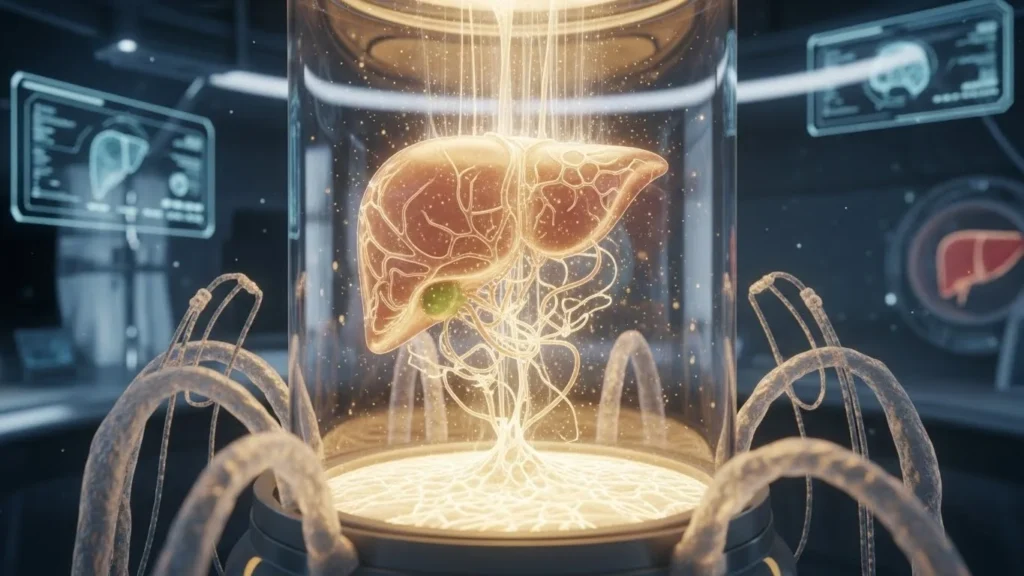
“The Ability Humans Have Always Imagined”
A cut heals.
A bone mends.
Skin renews itself quietly every day.
These small repairs feel ordinary — so ordinary that we forget how remarkable they are.
Now imagine that same ability extended further.
A damaged organ slowly rebuilds itself.
Lost tissue reforms with precision.
Function returns, not through replacement, but through regrowth.
This isn’t fantasy in nature. Some organisms already do this with ease.
The real question isn’t why regeneration exists — it’s why humans only have part of it.
Regeneration Is Not Healing — It’s Rebuilding
Healing and regeneration are often confused.
Healing closes wounds.
Regeneration restores structure.
When humans heal:
- Scar tissue forms
- Structure is simplified
- Function is preserved, but not fully restored
Regeneration is different.
It means:
- Cells know what was lost
- Growth follows a precise blueprint
- The original form returns
This requires extraordinary coordination between cells, signals, and timing.
Nature Already Shows What’s Possible
Some animals regenerate complex structures effortlessly.
They don’t just survive damage — they reverse it.
These organisms can:
- Rebuild limbs
- Restore internal tissues
- Regrow complex structures with nerves and blood supply
The instructions already exist in biology.
Humans didn’t lose them entirely — we scaled them back.
Why Humans Regenerate a Little — But Not a Lot
Humans regenerate constantly at the microscopic level.
Every day:
- Skin cells renew
- Blood cells are replaced
- The lining of the gut rebuilds
But large-scale regeneration stopped being favored in human evolution.
Why?
Because regeneration competes with:
- Stability
- Energy efficiency
- Cancer prevention
Rapid, flexible growth is powerful — but risky.
Evolution often chooses control over capability.
What Would Change First If Humans Could Regenerate Organs
The earliest changes wouldn’t be dramatic.
They’d be psychological.
If humans knew organs could regenerate:
- Fear of permanent damage would decrease
- Risk assessment would subtly shift
- Recovery would feel expected, not exceptional
This doesn’t mean recklessness.
It means a different relationship with injury, time, and patience.
Regeneration would change how humans think about vulnerability.
Daily Life Would Become More Forgiving — Not Invincible
A common misconception is that regeneration means invulnerability.
It doesn’t.
Regeneration takes time and energy.
Even in animals that regenerate:
- Growth is slow
- Resources are redirected
- The body prioritizes rebuilding over other functions
Humans with regeneration would still need rest, nutrition, and protection.
Life wouldn’t become careless — just more resilient.
How Learning and Memory Would Be Affected
Organs don’t regenerate in isolation.
They’re wired into systems — especially the brain.
If humans could regenerate organs:
- Structural rebuilding would need to preserve memory and identity
- Neural connections would require extreme precision
- Learning systems would need stability during regrowth
This is one reason regeneration is rare in complex organisms.
The more information a system stores, the harder it is to rebuild without loss.
Energy Costs Would Shape Human Behavior
Regeneration isn’t free.
Growing tissue requires enormous energy.
If humans regenerated organs:
- Metabolism would adjust during regrowth
- Energy would be diverted from growth, reproduction, or endurance
- Periods of rebuilding would slow other activities
Life would likely adopt cycles of restoration, similar to how some animals enter low-activity phases during regrowth.
A Common Misunderstanding: “Humans Would Live Forever”
Regeneration does not equal immortality.
It repairs structure — not time itself.
Even organisms that regenerate extensively still age.
Why?
Because aging involves:
- Accumulated molecular changes
- Long-term cellular stress
- System-wide regulation shifts
Regeneration improves resilience.
It does not eliminate biological limits.
Society Would Redesign Safety and Responsibility
If humans regenerated organs, systems around them would adapt.
Likely changes include:
- Different safety standards
- Longer recovery-focused timelines
- New cultural norms around risk
Responsibility wouldn’t disappear.
It would shift.
Instead of preventing all damage, society would focus on preventing irreversible damage.
Comparing Humans With and Without Organ Regeneration
| Aspect | Current Humans | Regenerating Humans |
|---|---|---|
| Injury recovery | Limited, scar-based | Slow but structural |
| Fear of damage | High | Reduced but present |
| Energy use | Stable | High during regrowth |
| Lifespan | Fixed biological limits | Improved resilience |
| Evolutionary risk | Low uncontrolled growth | Higher growth control needs |
Why Evolution Didn’t Choose Full Regeneration for Humans
Evolution favors balance, not maximum ability.
Full regeneration increases:
- Growth flexibility
- Repair capacity
But it also increases:
- Risk of uncontrolled cell growth
- Energy demands
- Developmental errors
For large, long-lived, highly complex organisms, precision matters more than speed.
Humans evolved toward control, not regrowth.
Why This Matters Today
Thinking about regeneration reveals something important.
The human body isn’t poorly designed.
It’s selectively designed.
We heal enough to survive.
We regenerate enough to adapt.
But we stop short of rebuilding everything — because stability keeps complex systems functional.
Understanding this helps us appreciate:
- Why healing works the way it does
- Why limits exist for a reason
- Why resilience doesn’t mean invulnerability
Frequently Asked Questions
1. Do humans already regenerate any organs?
Humans regenerate some tissues continuously, but not full organs.
2. Would regeneration replace healing?
No. Healing and regeneration would work together.
3. Would pain still exist?
Yes. Regeneration doesn’t remove sensory warning systems.
4. Could regeneration increase population size?
Possibly, by improving survival — but other limits would still apply.
5. Is regeneration always beneficial?
Not without control. Growth must be tightly regulated.
Key Takeaways
- Regeneration rebuilds structure, not just function
- Humans already regenerate at small scales
- Full organ regeneration requires extreme biological control
- Energy, stability, and complexity limit regeneration
- Resilience matters more than invincibility
A Calm Look at a Powerful Ability
Organ regeneration sounds like a superpower.
But biology rarely gives superpowers without trade-offs.
Humans didn’t evolve to rebuild everything — we evolved to balance repair, stability, and control.
Imagining regeneration doesn’t reveal what humans lack.
It reveals how carefully the body chooses when to grow — and when not to.
Sometimes, limits aren’t weaknesses.
They’re the reason complex life works at all.
Disclaimer: This article explains scientific concepts for general educational purposes and is not intended as professional or medical advice.