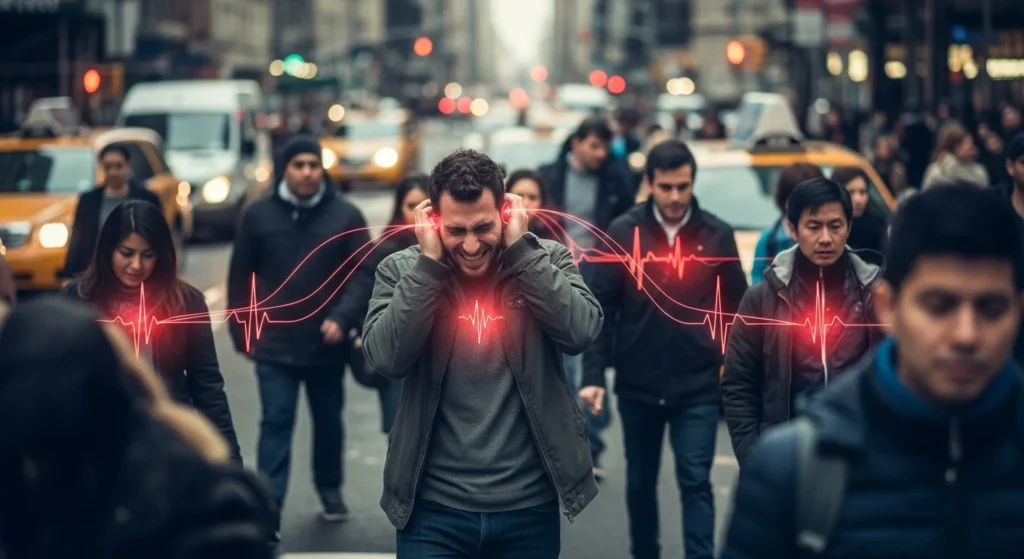
Imagine a World Filled With Heartbeats
You walk into a quiet room.
But it isn’t quiet.
Instead, you hear a soft, rhythmic thumping—not one sound, but many. Faster pulses. Slower ones. Overlapping rhythms from every person nearby.
These aren’t machines.
They’re heartbeats.
Today, the human heart works silently, hidden inside the body. But what if it didn’t? What if humans could naturally hear the heartbeats of people around them, just as clearly as footsteps or breathing?
This idea sounds strange, even unsettling—but exploring it reveals something fascinating about how hearing, biology, and social behavior are deeply connected.
Why Humans Normally Can’t Hear Heartbeats
The human heart does produce sound. Each beat creates vibrations as valves open and close.
So why don’t we hear it?
Because biology filters it out.
Several factors keep heartbeats silent:
- The sound is low in volume
- Much of the vibration stays inside the chest
- Human hearing evolved to focus on external threats
- The brain suppresses internal noise to prevent overload
If we heard every internal sound constantly, the brain would struggle to focus on the outside world.
Silence, in this case, is not absence—it’s protection.
How Human Hearing Actually Works
Hearing begins when sound waves travel through air and enter the ear.
From there:
- The outer ear collects sound
- The middle ear amplifies vibrations
- The inner ear converts them into nerve signals
- The brain interprets those signals as meaning
Human ears are tuned for speech, environmental sounds, and danger cues, not subtle internal rhythms.
Heartbeats fall outside this priority range—not because they don’t exist, but because evolution decided they weren’t useful to hear.
What Would Change If Heartbeats Became Audible?
If humans could hear nearby heartbeats, everyday life would sound very different.
Crowded spaces would feel alive with rhythm.
Quiet moments would disappear entirely.
But more importantly, social awareness would change.
People would unconsciously pick up information from heart sounds, such as:
- Emotional arousal
- Physical exertion
- Stress responses
- Calm or excitement
Without anyone saying a word, bodies would be communicating constantly.
Heartbeats as an Unspoken Social Signal
Today, we rely on facial expressions, tone of voice, and posture to read others.
Audible heartbeats would add a new layer.
Imagine:
- A fast heartbeat during a conversation
- A slow, steady rhythm during calm moments
- Sudden changes during surprises or tension
Heartbeats would become a biological broadcast, revealing internal states that are currently private.
This could increase empathy—but also reduce emotional privacy.
Why the Brain Values Sensory Limits
It might seem useful to hear heartbeats, but biology often favors less information, not more.
The brain already processes:
- Visual data
- Sounds
- Smells
- Body position
- Internal signals
Adding constant heartbeat noise would increase cognitive load.
Just as background noise makes thinking harder, nonstop biological sound could reduce focus, sleep quality, and mental clarity.
Evolution tends to eliminate sensory overload—not create it.
How Animals Use Internal Sounds Differently
Some animals detect internal rhythms—but usually their own, not others’.
For example:
- Certain species sense internal pressure changes
- Others detect vibrations through the ground
- Some animals feel, rather than hear, biological rhythms
These systems evolved for survival, not social awareness.
Humans evolved language, facial cues, and emotional expression instead—far more efficient tools for communication.
Comparing Our World vs. a Heartbeat-Audible World
| Feature | Current Human Hearing | Hearing Nearby Heartbeats |
|---|---|---|
| Ambient silence | Common | Rare |
| Emotional privacy | High | Reduced |
| Sensory load | Balanced | Increased |
| Social cues | Visual + verbal | Visual + verbal + biological |
| Cognitive focus | Stable | More easily disrupted |
This comparison highlights why silence plays such an important role in human life.
Common Misunderstanding: “More Senses Are Always Better”
It’s easy to assume that gaining new sensory abilities would improve life.
But biology often works the opposite way.
Each sense comes with a cost:
- More data to process
- More distractions
- Higher energy demands
- Increased stress on attention systems
The absence of heartbeat sound isn’t a limitation—it’s a design choice that supports clarity and focus.
Why Hearing Heartbeats Could Change Relationships
If heartbeats were audible, emotional dynamics would shift.
People might:
- Feel exposed without speaking
- Become more self-conscious
- Struggle to hide nervousness
- Feel stronger emotional connection during shared calm moments
Some relationships might deepen.
Others might feel overwhelming.
Silence currently gives people space to choose what to share and when.
Why This Matters Today
Understanding this thought experiment helps explain something important:
Human perception is shaped as much by what we can’t sense as by what we can.
In a world filled with constant information, the brain depends on boundaries.
The fact that we don’t hear heartbeats reminds us that:
- Perception is selective
- Silence is functional
- Privacy is partly biological
- Not all information improves understanding
Sometimes, what the brain hides is just as important as what it reveals.
Key Takeaways
- The human heart produces sound, but biology filters it out
- Hearing evolved to prioritize external information
- Audible heartbeats would change social interaction
- Sensory limits protect focus and mental clarity
- Silence plays a critical role in human cognition
- Perception is shaped by evolutionary trade-offs
Frequently Asked Questions (FAQ)
1. Do human hearts actually make sound?
Yes. The sounds exist, but they are mostly contained within the body.
2. Could humans evolve to hear heartbeats?
In theory, but it would require strong survival benefits—which currently don’t exist.
3. Would hearing heartbeats improve empathy?
Possibly, but it would also reduce emotional privacy and increase sensory overload.
4. Why doesn’t the brain amplify internal sounds?
Because constant internal noise would interfere with attention and survival.
5. Do any animals hear others’ heartbeats?
No known species relies on hearing heartbeats for communication; other cues are more efficient.
Conclusion: Silence Is Part of Human Design
If humans could hear nearby heartbeats, the world would be louder—but not necessarily better.
Biology doesn’t aim for maximum awareness.
It aims for useful awareness.
The quiet chest, the silent rhythm, the hidden beat—
these are not flaws.
They are features that allow thought, connection, and choice to exist.
Sometimes, the most important sound is the one we never hear.
Disclaimer: This article explains scientific concepts for general educational purposes and is not intended as professional or medical advice.