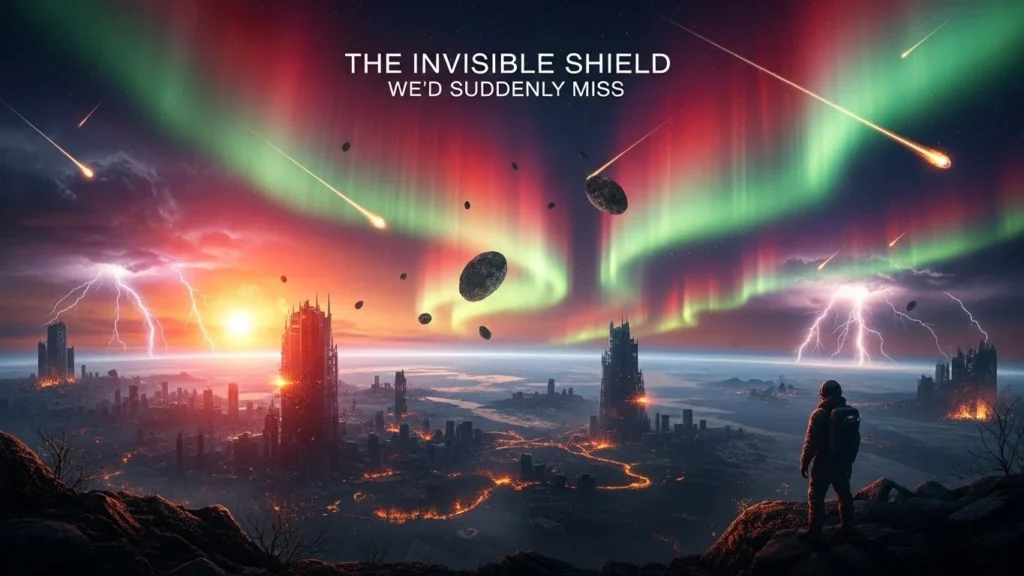
“The Shield You’ve Never Seen — But Always Lived Inside”
You’ve never seen Earth’s magnetic field.
You’ve never felt it push or pull.
Yet right now, it is quietly wrapping around the planet like an invisible cocoon — deflecting charged particles, shaping auroras, and protecting the atmosphere from space.
If that magnetic field collapsed, Earth wouldn’t explode or shatter.
Instead, something subtler — and far more revealing — would happen:
Earth would slowly lose its protection against space itself.
To understand why that matters, we first need to understand what the magnetic field actually does.
First, What Is Earth’s Magnetic Field?
Deep beneath your feet, Earth’s core is in motion.
At the center:
- A solid inner core
- A liquid outer core made mostly of molten iron
As Earth rotates, this moving metal creates electric currents.
Those currents generate a magnetic field — a process called the geodynamo.
The result is a vast magnetic bubble extending tens of thousands of kilometers into space, known as the magnetosphere.
This field isn’t decoration.
It’s defense.
What the Magnetic Field Does Every Single Day
Every moment, the Sun releases a stream of charged particles called the solar wind.
Without protection, these particles would slam directly into Earth.
The magnetic field:
- Deflects most solar wind around the planet
- Channels some particles toward the poles
- Prevents direct atmospheric erosion
- Shields surface life from intense radiation
Auroras are the visible reminder of this protection — energy guided safely away from most of the planet.
What Does “Magnetic Field Collapse” Actually Mean?
A collapse wouldn’t be a sudden switch-off.
It would mean:
- The magnetic field weakens dramatically
- The magnetosphere shrinks
- Solar wind reaches closer to Earth
Importantly, this is not pure fantasy.
Earth’s magnetic field has weakened, shifted, and even flipped polarity many times over geological history.
But a full collapse would be an extreme version — one worth understanding.
The First Noticeable Change: Space Reaches Lower
With a weak or collapsed magnetic field:
- Solar particles penetrate deeper into Earth’s surroundings
- The upper atmosphere absorbs more energy
- Space weather effects intensify
Satellites would experience stronger exposure to charged particles.
This wouldn’t instantly destroy them — but it would make their environment harsher and less predictable.
Space would feel closer.
What Happens to the Atmosphere?
One of the magnetic field’s most important roles is atmospheric protection.
Solar wind can slowly strip away gases from a planet over time.
Without a strong magnetic field:
- Atmospheric particles escape more easily
- Lighter gases are lost first
- The process happens gradually, not suddenly
Why this matters:
- Atmospheres help regulate temperature
- They enable liquid water
- They protect surface chemistry
Mars provides a real-world example: it lost most of its magnetic field long ago — and its atmosphere thinned dramatically over time.
Would Life Immediately Be in Danger?
No.
Life would not vanish overnight.
Earth has other protective systems:
- A thick atmosphere
- Ozone layers
- Gravity holding gases in place
However, over long periods:
- Radiation exposure at the surface would increase slightly
- High-altitude environments would be more affected
- Long-term atmospheric loss would alter climate stability
The key word is slow.
The danger is not instant collapse — it’s gradual change.
Technology Would Notice Before Biology
Modern civilization relies heavily on systems sensitive to magnetic conditions.
A weakened magnetic field would affect:
- Satellites
- Navigation systems
- Power grids during solar storms
- Long-distance radio communication
Why this happens:
- Charged particles induce electrical currents
- Strong solar events interact more directly with Earth
The magnetic field acts like a surge protector for the planet.
Without it, technology feels the strain first.
A Simple Comparison: With vs Without a Strong Magnetic Field
| Feature | Strong Magnetic Field | Collapsed Magnetic Field |
|---|---|---|
| Solar wind deflection | High | Low |
| Atmospheric loss | Minimal | Gradual increase |
| Auroras | Polar regions | Spread wider |
| Satellite safety | Stable | Riskier |
| Surface life | Protected | Slowly exposed |
The difference isn’t chaos — it’s exposure.
Common Misunderstanding: The Magnetic Field Holds Us to Earth
This is a widespread myth.
The magnetic field:
- Does NOT create gravity
- Does NOT keep oceans in place
- Does NOT stop Earth from breaking apart
Gravity comes from Earth’s mass, not magnetism.
People wouldn’t float away.
Earth wouldn’t crack open.
The effects are environmental — not structural.
Why Auroras Would Become More Common
With a weaker magnetic field:
- More charged particles reach the atmosphere
- Auroras spread to lower latitudes
Instead of rare polar lights:
- They could appear closer to the equator
- Skies would glow more often during solar activity
Beautiful — but also a sign of reduced shielding.
Auroras are proof that the field is interacting with space.
Why This Matters Today
Understanding Earth’s magnetic field helps scientists:
- Predict space weather
- Protect satellites and power systems
- Study other planets and their habitability
- Understand Earth’s deep interior
It also reminds us of something important:
Not all protection is visible.
Some of the most critical systems work silently, constantly, and without notice — until they weaken.
Earth Has Faced Magnetic Changes Before
Earth’s magnetic field has:
- Shifted position
- Weakened
- Flipped polarity many times
Life survived all of it.
That doesn’t mean the field is unimportant.
It means Earth is resilient — because of multiple layered protections.
The magnetic field is one layer.
A vital one.
The Invisible Partnership That Sustains Earth
Earth stays livable through cooperation:
- Core dynamics generate magnetism
- Magnetism protects atmosphere
- Atmosphere regulates climate
- Climate supports life
Remove one piece, and the system strains — but doesn’t instantly fail.
This is how planets endure.
Key Takeaways
- Earth’s magnetic field is generated by its molten core
- It deflects harmful solar wind and radiation
- A collapse would weaken Earth’s space protection
- Atmosphere loss would increase gradually over time
- Technology would be affected before biology
- Earth would remain intact, but more exposed
Frequently Asked Questions
Has Earth’s magnetic field ever collapsed before?
It has weakened and reversed many times, but a full collapse is rare and extreme.
Would gravity change if the magnetic field collapsed?
No. Gravity is unrelated to magnetism.
Would humans feel the magnetic field disappear?
No. The effects would be indirect and gradual.
Would compasses stop working?
Yes. Navigation based on magnetism would become unreliable.
Is the magnetic field weakening today?
It fluctuates naturally, but Earth still maintains a strong magnetic field overall.
A Calm Conclusion
If Earth’s magnetic field collapsed, the planet wouldn’t end.
But its shield would thin.
The Sun would reach closer.
Space would press in more firmly.
The atmosphere would face a slow, persistent challenge.
The magnetic field doesn’t make headlines because it doesn’t need to.
It protects quietly — every second — whether we notice it or not.
Disclaimer: This article explains scientific concepts for general educational purposes and is not intended as professional or medical advice.