A Change So Small You’d Never See It — But You’d Feel It
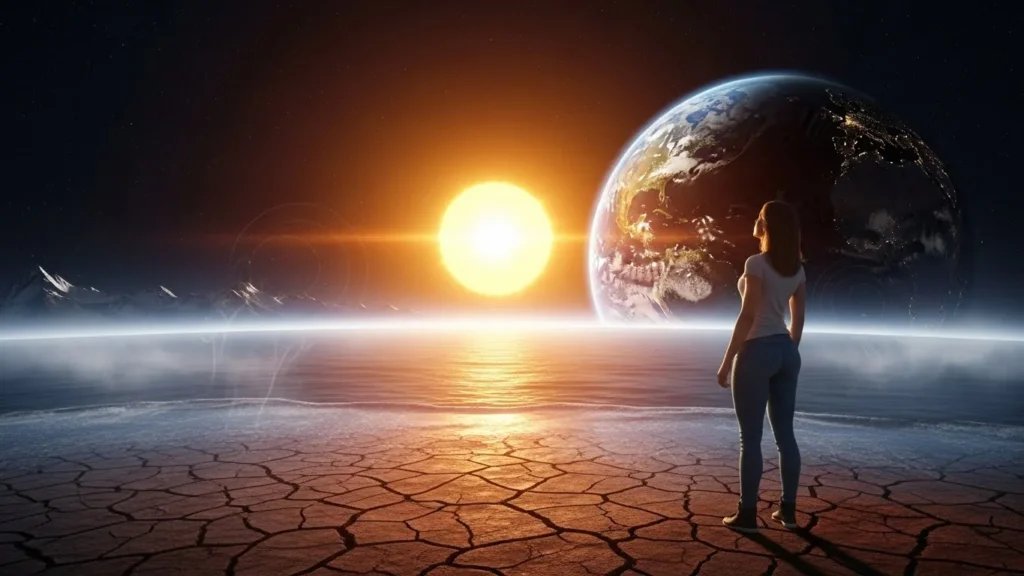
Imagine Earth shifting closer to the Sun.
Not crashing.
Not spiraling.
Just… drifting inward slightly.
So slightly that from space, it would look almost the same.
But on Earth?
The seasons would feel different.
Heat would linger longer.
Ice would retreat quietly.
This thought experiment reveals something surprising:
Earth’s comfort zone is incredibly narrow.
And life exists not because the Sun is gentle — but because Earth’s distance is precise.
First, How Far Is Earth From the Sun?
Earth orbits the Sun at an average distance of about 150 million kilometers.
That number sounds enormous — and it is.
But in cosmic terms, it’s a fine-tuned position.
Earth already moves slightly closer and farther during its orbit:
- Closest point (perihelion)
- Farthest point (aphelion)
These small variations are normal and safe.
The question here is different:
What if Earth’s entire orbit shifted inward?
Why Distance Matters More Than Size
The Sun’s energy spreads out as it travels.
The closer you are:
- The more energy you receive per square meter
This follows a simple physical rule:
- Small distance changes can cause noticeable energy increases
It’s like standing near a campfire.
One step closer doesn’t double the flames —
but it feels much hotter.
Earth works the same way.
A Slightly Closer Earth Means More Heat — Everywhere
If Earth moved closer by even a few percent:
- Average global temperatures would rise
- Heat waves would become more frequent
- Polar ice would melt faster
- Oceans would absorb more energy
This wouldn’t feel like a sudden disaster.
It would feel like:
- Longer summers
- Shorter winters
- Warmer nights
- Less seasonal contrast
Change would be gradual — but persistent.
Why Oceans Would Respond First
Oceans act like Earth’s heat storage system.
They absorb sunlight slowly and release it slowly.
With extra solar energy:
- Surface waters warm first
- Heat spreads downward
- Evaporation increases
Why this matters:
- Warm water expands
- Ice melts faster
- Currents shift subtly
Oceans don’t overreact — they accumulate change.
That makes them powerful climate drivers.
The Atmosphere Would Amplify the Change
Earth’s atmosphere doesn’t just let sunlight in.
It also traps some heat — a natural process that keeps Earth livable.
With more incoming energy:
- The atmosphere holds onto more heat
- Nights cool less efficiently
- Temperature extremes soften, but overall warmth rises
Think of it like adding a slightly thicker blanket.
Not suffocating — just warmer, everywhere, all the time.
A Simple Comparison: Earth Now vs Slightly Closer
| Feature | Current Earth | Slightly Closer Earth |
|---|---|---|
| Solar energy received | Balanced | Increased |
| Average temperature | Stable range | Gradually higher |
| Polar ice | Persistent | Shrinking |
| Ocean heat | Regulated | Accumulating |
| Seasons | Familiar | Shifted |
Small orbital changes create system-wide effects.
Would Life Instantly Be in Danger?
No.
Life wouldn’t vanish overnight.
Plants, animals, and ecosystems are adaptable.
But adaptation has limits.
Over time:
- Heat-sensitive species struggle
- Ecosystems shift locations
- Biodiversity patterns change
Life wouldn’t disappear —
but where life thrives would change.
Common Misunderstanding: “A Little Closer Would Barely Matter”
This is one of the biggest misconceptions.
People often think:
“Earth is so far away — a little closer won’t matter.”
In reality:
- Climate systems are sensitive
- Feedback loops amplify small changes
- Ice, water vapor, and clouds respond dynamically
Earth’s stability comes from balance, not distance alone.
Why Earth Isn’t Already Closer or Farther
- The Sun’s gravity
- The distribution of mass in the solar system
- Long-term orbital stability
These forces keep Earth remarkably steady over long timescales.
When scientists talk about “habitable zones,” they’re not guessing.
They’re describing regions where:
- Liquid water can persist
- Energy input stays balanced
Earth sits comfortably — but not loosely — in that zone.
What Would Happen to Seasons?
Seasons are caused by Earth’s tilt, not distance.
But distance influences intensity.
Closer to the Sun:
- Summers would become hotter
- Winters would be milder
- Seasonal contrast could decrease
The calendar wouldn’t change.
But how seasons feel would.
Why This Matters Today
This question helps explain something crucial:
Earth’s climate isn’t fragile — but it is sensitive.
Understanding solar distance helps scientists:
- Study other planets
- Understand climate feedbacks
- Explain why Earth supports life
It also reminds us that habitability isn’t guaranteed.
It’s maintained — moment by moment — by physical balance.
A Planet Balanced on Precision
Earth doesn’t survive because the Sun is calm.
Earth survives because:
- Distance moderates intensity
- Atmosphere regulates heat
- Oceans absorb change
- Life adapts within limits
Move Earth slightly inward, and the balance shifts.
Not dramatically.
But decisively.
Key Takeaways
- Earth’s distance from the Sun is finely balanced
- Small orbital shifts can cause large climate effects
- Increased solar energy raises global temperatures
- Oceans and atmosphere amplify gradual warming
- Life adapts, but ecosystems shift over time
- Earth’s habitability depends on precision, not luck
Frequently Asked Questions
Would Earth burn up if it moved closer to the Sun?
No. A slight shift would cause warming, not destruction.
How much closer is “slightly”?
Even a few percent change in distance can noticeably affect climate.
Would seasons disappear?
No. Seasons come from Earth’s tilt, but their intensity would change.
Is Earth already moving closer to the Sun?
No. Earth’s average orbital distance is stable over long periods.
Are there planets too close to their stars?
Yes. Many planets receive too much energy to support liquid water.
A Calm Conclusion
If Earth were slightly closer to the Sun, the planet wouldn’t end.
It would warm.
Slowly.
Steadily.
Relentlessly.
This thought experiment isn’t about fear.
It’s about appreciation.
Earth isn’t safe because space is forgiving —
it’s safe because physics is precise.
And our planet sits, remarkably, right where it needs to be.
Disclaimer: This article explains scientific concepts for general educational purposes and is not intended as professional or medical advice.