“The Question That Sounds Simple — But Isn’t”
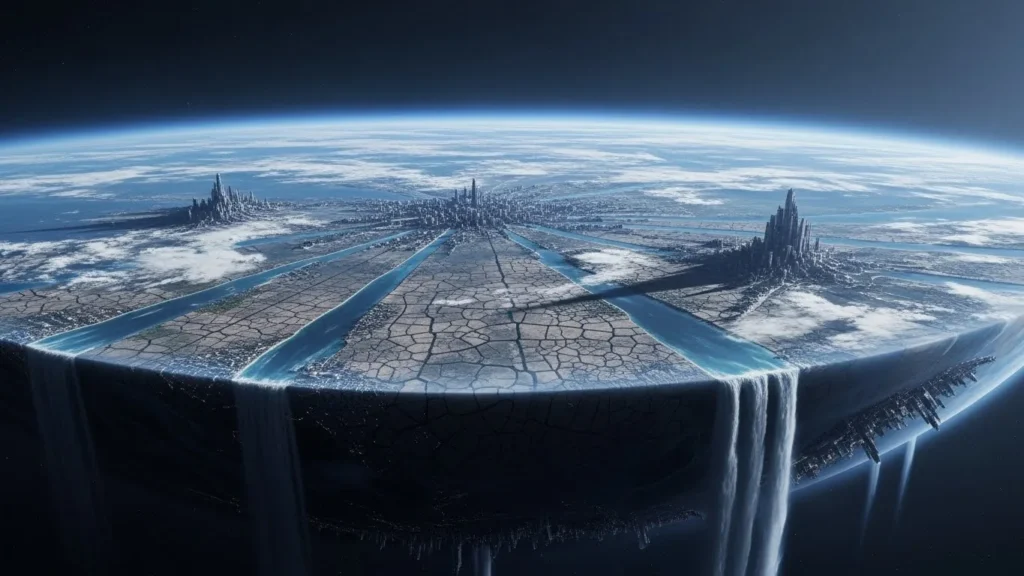
Picture standing on an endless, perfectly flat surface.
No horizon curve.
No drop-off.
Just land stretching forever in all directions.
At first, it feels stable — even comforting.
But Earth’s round shape isn’t a cosmetic detail. It’s the natural result of gravity acting on massive objects. That shape quietly determines how oceans stay put, how air clings to the planet, how sunlight spreads, and how life survives.
If Earth were perfectly flat, the consequences wouldn’t be dramatic explosions.
They would be fundamental breakdowns of systems we rely on every day.
Why Planets Naturally Become Round
Gravity always pulls toward mass.
On a large enough object, gravity pulls material inward from all directions. Over time, this creates a sphere — the shape where gravity balances evenly.
That’s why:
- Planets are round
- Stars are round
- Moons are round
A perfectly flat Earth would be gravitationally unstable.
Gravity would constantly try to collapse it into a more compact shape.
A flat planet could only exist if unknown forces continuously opposed gravity — and even then, everything on its surface would behave strangely.
How Gravity Would Work on a Flat Earth
On our real Earth, gravity pulls toward the planet’s center.
On a flat Earth:
- Gravity could not point “down” everywhere
- Near the center, gravity would feel mostly downward
- Near the edges, gravity would pull inward toward the center
This means gravity wouldn’t feel vertical across the surface.
Walking near the edge wouldn’t feel like standing on level ground — it would feel like standing on a slope angled toward the middle of the world.
A Common Misunderstanding: “Everything Would Just Fall Down”
On a flat Earth, “down” wouldn’t mean the same thing everywhere.
Objects would naturally slide or drift toward the center of the disk.
Over time:
- Water would flow inward
- Air would concentrate inward
- Loose material would migrate toward the middle
The edges wouldn’t be stable places to live — or even exist.
Oceans Could Not Stay Spread Out
Oceans exist because gravity pulls water evenly toward Earth’s center.
On a flat Earth:
- Water would not spread evenly
- Seas would drain toward the center
- The middle would become a massive global ocean
Edges would dry out.
There would be no balanced coastlines — just one central basin holding most of the planet’s water.
The Atmosphere Would Behave the Same Way
Air obeys gravity just like water does.
On a flat Earth:
- Air pressure would be highest near the center
- The atmosphere would thin toward the edges
- Breathing conditions would vary dramatically
Near the center, pressure could be overwhelming.
Near the edges, the air could become too thin to support familiar life.
The atmosphere wouldn’t wrap the planet evenly — it would pool.
Sunlight and Temperature Would Become Uneven
On a spherical Earth, sunlight spreads across curved surfaces, creating predictable climate zones.
On a flat Earth:
- The center would receive more consistent sunlight
- Edges would receive sunlight at shallow angles
- Temperature differences would be extreme
This would produce:
- A hot, pressurized central region
- Cold, thin-atmosphere outer regions
Stable, planet-wide climate systems would be nearly impossible.
Day and Night Would Be Difficult to Explain
Earth’s rotation creates day and night evenly across the globe.
A flat Earth rotating like a disk would face major challenges:
- Rotation would destabilize the structure
- Different regions would experience inconsistent motion
- Mechanical stress would tear the planet apart
If the flat Earth didn’t rotate, then:
- Day–night cycles wouldn’t work naturally
- Temperature regulation would collapse
The familiar rhythm of time would break.
Life Would Struggle to Organize
Life depends on environmental consistency.
On a flat Earth:
- Gravity direction varies
- Water distribution collapses
- Air pressure varies drastically
- Temperature zones become extreme
Complex ecosystems require stability.
Without it, life would be limited to narrow regions — if it could exist at all.
Comparing a Spherical Earth vs a Flat Earth
| Feature | Spherical Earth | Perfectly Flat Earth |
|---|---|---|
| Gravity direction | Toward center everywhere | Inward toward disk center |
| Ocean distribution | Even global spread | Central pooling |
| Atmosphere | Evenly retained | Thick center, thin edges |
| Climate | Stable zones | Extreme gradients |
| Habitability | Global | Severely limited |
Why “Perfectly Flat” Is the Real Problem
Small objects can be flat.
Large objects cannot.
Once an object reaches planetary mass:
- Gravity overwhelms material strength
- Irregular shapes collapse
- Spheres naturally form
A perfectly flat Earth would violate well-tested physical principles — not opinions or assumptions.
It wouldn’t just be unusual.
It would be physically impossible under known laws.
Why This Matters Today
This thought experiment isn’t about debate.
It’s about understanding why Earth works.
Earth’s shape explains:
- Why oceans don’t drain
- Why air stays close
- Why gravity feels consistent
- Why life can exist across continents
The round shape isn’t a belief.
It’s the reason the planet functions.
Frequently Asked Questions
1. Could a flat Earth exist with different physics?
Only if gravity behaved completely differently from everything we observe.
2. Would people fall off the edge?
Gravity would pull inward, not outward — making edges unstable long before that.
3. Could technology stabilize a flat Earth?
Not at planetary scale. The forces involved are too large.
4. Why do small objects stay flat?
Their gravity is too weak to reshape them.
5. Does Earth’s roundness affect daily life?
Yes — from breathing to weather to ocean levels.
Key Takeaways
- Large planets naturally become spherical due to gravity
- A flat Earth would have unstable gravity directions
- Oceans and air would pool toward the center
- Climate and habitability would collapse
- Earth’s shape is essential, not cosmetic
A Calm Look at a Flat World That Can’t Hold Together
The idea of a flat Earth feels simple.
But simplicity doesn’t equal stability.
Earth works because gravity pulls evenly, oceans balance naturally, air wraps gently, and energy spreads predictably.
A perfectly flat Earth wouldn’t be mysterious.
It would be unlivable.
Sometimes, the shape of things isn’t just how they look —
it’s why they survive.
Disclaimer: This article explains scientific concepts for general educational purposes and is not intended as professional or medical advice.