A Sky That Looks Perfect… and Feels Wrong
Imagine stepping outside to a flawless blue sky.
No drifting clouds.
No grey horizons.
No shifting shadows.
At first, it feels peaceful—almost ideal.
But within days, something feels off.
Temperatures swing more sharply.
The air feels drier.
Rain becomes strangely absent.
Clouds may look decorative, but they are one of the most powerful regulators of life on Earth. Losing them wouldn’t just change the sky—it would quietly reshape the planet’s balance.
Let’s explore why.
What Clouds Actually Are (Beyond White Fluff)
Clouds are not gas or smoke.
They are collections of tiny water droplets or ice crystals suspended in the air. Each droplet is so small it can float, carried by rising air currents.
Clouds form when:
- Warm, moist air rises
- The air cools as it expands
- Water vapor condenses into droplets
This process links clouds directly to temperature, air movement, and moisture—three pillars of Earth’s climate system.
Without clouds, these systems don’t stop working.
They just stop working together.
Clouds as Earth’s Natural Temperature Regulators
One of the biggest misconceptions is that clouds only cool the planet.
They actually do both.
- During the day: Clouds reflect sunlight back into space
- At night: Clouds trap heat, slowing cooling
This balancing act stabilizes surface temperatures.
Without clouds:
- Days become much hotter
- Nights become much colder
- Temperature swings grow extreme
Think of clouds as a thermal blanket that also works like a mirror—adjusting warmth depending on time and location.
A Clear Sky Means Stronger Sunlight
With no clouds to scatter or reflect sunlight:
- More solar energy reaches the ground
- UV exposure increases
- Surface heating intensifies
This doesn’t mean instant disaster—but it changes how quickly land, oceans, and cities warm.
Dark surfaces like asphalt and soil absorb more heat, while reflective surfaces struggle to compensate without cloud cover above.
Over time, this creates regional heat imbalances, especially in already warm areas.
Rain Doesn’t Just Fall — It’s Engineered by Clouds
Rain doesn’t exist without clouds.
No clouds means:
- No condensation
- No droplet growth
- No precipitation
The water cycle doesn’t break—but it stalls.
Water would still evaporate from oceans and lakes, but without clouds, it can’t return to land efficiently.
This leads to:
- Drying soils
- Shrinking freshwater availability
- Collapsing natural rainfall patterns
Why Deserts Would Expand Quietly
Many regions rely on cloud-driven rain systems that operate invisibly above us.
Without clouds:
- Wet regions slowly dry
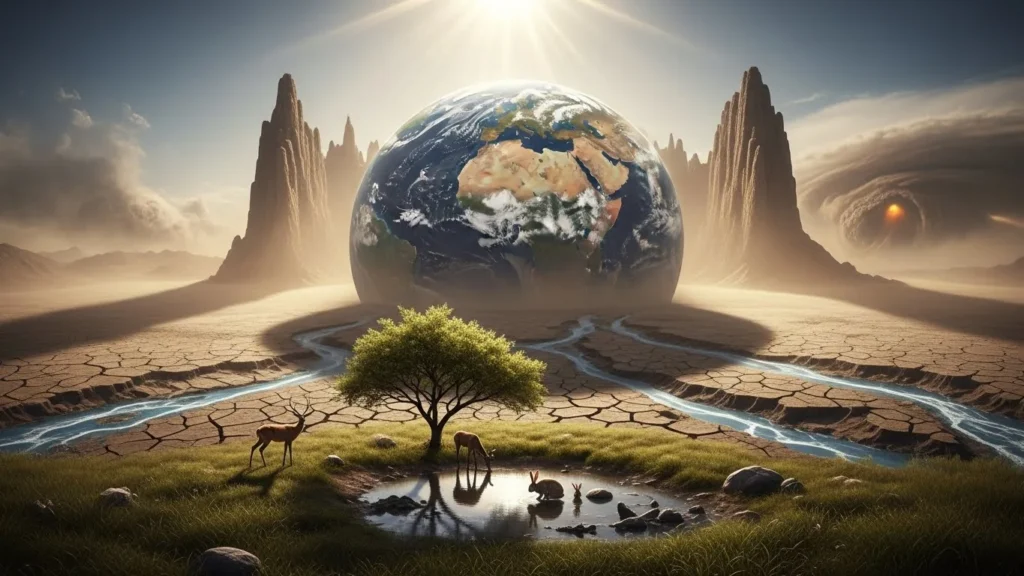
- Semi-arid zones become deserts
- Rivers lose replenishment
This wouldn’t happen overnight.
It would happen gradually, which makes it more disruptive—not less.
Ecosystems depend on predictable moisture, not just temperature.
Clouds and the “Mirror Effect” Most People Miss
Clouds play a huge role in Earth’s albedo—its reflectivity.
High, bright clouds reflect sunlight efficiently.
Low, thick clouds trap warmth.
Together, they fine-tune how much energy Earth keeps versus releases.
Without clouds:
- Earth absorbs more solar radiation overall
- The planet warms unevenly
- Climate feedback loops become unstable
This is why scientists study clouds so carefully—they’re one of the least visible but most influential climate variables.
Comparison: Earth With Clouds vs Without Clouds
| System | With Clouds | Without Clouds |
|---|---|---|
| Temperature | Moderated day & night | Extreme swings |
| Rainfall | Continuous water cycle | Severely reduced |
| Sunlight | Filtered & diffused | Direct & intense |
| Ecosystems | Stable moisture patterns | Gradual drying |
| Climate balance | Self-regulating | Increasingly unstable |
Why Oceans Would Feel the Change First
Oceans absorb most of Earth’s heat.
Without clouds:
- More sunlight heats surface waters
- Evaporation increases
- Weather patterns shift
But without clouds, that evaporated water can’t form rain, breaking the feedback loop oceans rely on to cool and redistribute energy.
This affects:
- Ocean currents
- Coastal climates
- Marine ecosystems
Common Misunderstanding: “Clear Skies Are Better”
Clear skies feel pleasant—but only in moderation.
Permanent clarity removes:
- Shade
- Thermal buffering
- Moisture recycling
It’s similar to removing insulation from a house. You still have walls—but comfort disappears.
Clouds don’t block life.
They protect it.
Why This Matters Today (Even Without a Cloudless Earth)
We’re not losing all clouds—but cloud behavior is changing.
Shifts in altitude, thickness, and location already affect:
- Regional temperatures
- Rainfall reliability
- Seasonal patterns
Understanding clouds helps us understand why small atmospheric changes matter so much.
Key Takeaways
- Clouds regulate both heat and cold
- They are essential to the water cycle
- Clear skies increase temperature extremes
- Rain cannot exist without cloud formation
- Clouds quietly stabilize life-supporting systems
Frequently Asked Questions
Q1: Would Earth freeze without clouds at night?
Nights would cool much faster, especially in dry regions, creating extreme temperature drops.
Q2: Would plants survive without clouds?
Not long-term. Reduced rainfall and moisture stress would affect growth and ecosystems.
Q3: Do clouds cause global warming?
They can both cool and warm—depending on type, height, and thickness.
Q4: Could technology replace clouds?
Not at a planetary scale. Cloud systems are too complex and widespread.
Q5: Why do some planets lack clouds?
Different atmospheres, temperatures, and chemistry prevent cloud formation like Earth’s.
A Quiet System Worth Noticing
Clouds don’t demand attention.
They drift.
They shade.
They return water.
And by doing almost nothing visibly, they keep everything working.
A cloudless Earth wouldn’t look broken—but it would slowly become one.
Disclaimer: This article explains scientific concepts for general educational purposes and is not intended as professional or medical advice.