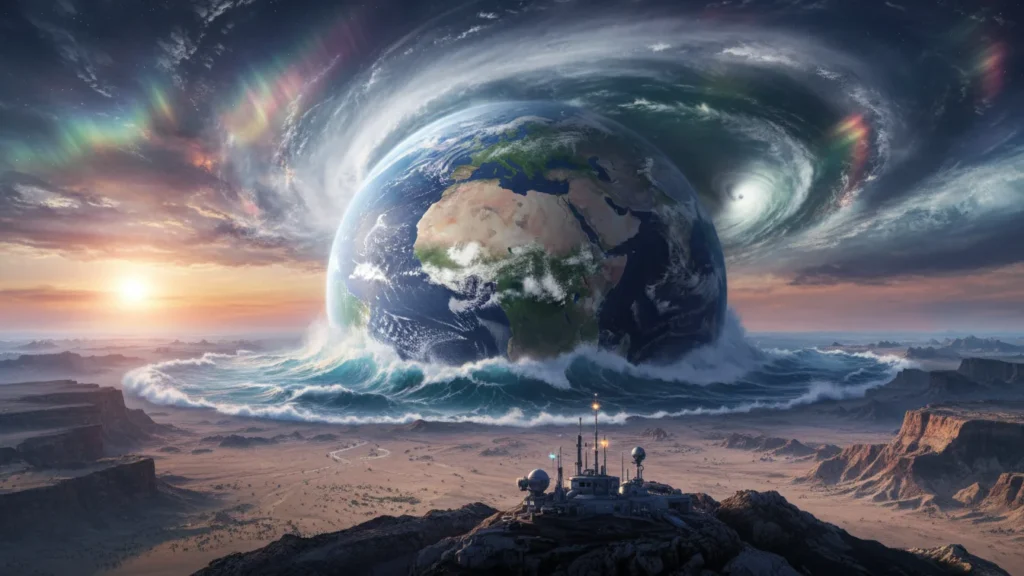
“A Morning Where the Sun Rises in the West”
Imagine waking up tomorrow and noticing something strange.
The Sun rises — but not in the east.
It climbs into the sky from the west, arcs overhead, and sets in the east by evening.
Clocks still tick.
The length of the day feels familiar.
Gravity feels unchanged.
Yet the direction of Earth’s spin has reversed.
This single change wouldn’t shatter the planet or throw people into space.
But it would quietly rewire the systems that shape weather, oceans, and climate.
To understand why, we need to look at what Earth’s rotation actually does.
First, How Earth Rotates Right Now
Earth spins once every 24 hours, rotating from west to east.
This rotation:
- Creates day and night
- Determines where the Sun appears to rise and set
- Influences winds and ocean currents
- Helps shape climate patterns
Importantly, rotation isn’t just about time.
It’s about motion interacting with air, water, and heat.
If the direction reversed — east to west — the speed could remain the same.
Only the direction would change.
That difference matters more than it sounds.
Day and Night Would Still Exist — Just Reversed
A backward-rotating Earth would still spin once per day.
That means:
- Days wouldn’t become longer or shorter
- Seasons would still occur
- The planet would remain stable
The most visible change:
- Sunrise in the west
- Sunset in the east
This alone wouldn’t affect biology dramatically.
Life adapts easily to where light comes from.
But the deeper changes happen inside the atmosphere and oceans.
Why Rotation Controls Wind Direction
Air doesn’t just move randomly.
As Earth rotates, moving air is deflected — a result of motion on a spinning planet.
This deflection shapes:
- Trade winds
- Jet streams
- Storm paths
When Earth spins west to east, winds curve in familiar patterns.
Reverse the spin, and the deflection reverses too.
That means:
- Global wind belts flip direction
- Weather systems move opposite ways
- Storm tracks change paths
The sky wouldn’t look different — but weather would behave differently.
The Coriolis Effect: The Quiet Rule-Changer
This deflection of moving air and water is known as the Coriolis effect.
It doesn’t create motion.
It redirects it.
On a backward-spinning Earth:
- Winds curve the opposite way
- Ocean currents reverse direction
- Atmospheric circulation reorganizes
Think of it like walking on a spinning carousel.
Change the direction of spin, and your path curves differently — even if you walk the same way.
Oceans Would Rearrange Their Great Currents
Earth’s oceans are constantly moving.
These movements distribute heat around the planet.
On today’s Earth:
- Warm water flows toward certain coasts
- Cold water circulates elsewhere
- Climate zones are stabilized
With reversed rotation:
- Major ocean currents flip direction
- Warm and cold water redistribute
- Coastal climates change
Some regions would become:
- Warmer than before
- Cooler than expected
Not because the Sun changed — but because water moved differently.
A Simple Comparison: Normal vs Backward Rotation
| Feature | Current Rotation | Backward Rotation |
|---|---|---|
| Sunrise direction | East | West |
| Wind patterns | Current global flow | Reversed flow |
| Ocean currents | Familiar circulation | Flipped circulation |
| Climate zones | Established | Rearranged |
| Day length | ~24 hours | ~24 hours |
The planet remains intact — but its patterns shift.
Would Weather Become More Extreme?
Not automatically.
Weather depends on:
- Heat from the Sun
- Moisture in the air
- Planetary rotation
A backward spin wouldn’t add extra energy.
Instead, it would:
- Move storms along new routes
- Shift rainfall zones
- Change where deserts and forests form
Some regions might see:
- More rain
- Less rain
- Different seasonal timing
But Earth wouldn’t become chaotic or violent by default.
Common Misunderstanding: Earth Would Spin Out of Control
A frequent myth is that reversing rotation would:
- Tear continents apart
- Throw oceans into space
- Cause massive destruction
That would only happen if the speed suddenly changed.
This thought experiment assumes:
- Same rotation speed
- Same gravity
- Same mass
Only the direction differs.
Physics allows that — even if nature never does it suddenly.
What Happens to Climate Over Long Periods?
Climate is the long-term average of weather.
With reversed rotation:
- Heat transport changes
- Ocean-atmosphere interaction shifts
- Climate belts slowly move
Over thousands of years:
- Ice coverage might redistribute
- Vegetation zones migrate
- Ecosystems adapt
Life wouldn’t vanish.
It would relocate.
Earth has undergone climate rearrangements many times before — rotation direction would be another driver.
Would Humans Notice Right Away?
Yes — but not instantly in daily comfort.
People would notice:
- The Sun rising in the “wrong” direction
- Weather systems moving unusually
- Long-term climate trends shifting
But:
- Gravity would feel the same
- Timekeeping could adapt
- Daily routines would continue
The disruption would be scientific and environmental — not immediately personal.
Why Earth’s Actual Rotation Direction Matters
Earth didn’t randomly choose its spin.
Its direction comes from:
- How the solar system formed
- Early collisions
- Conservation of angular momentum
Once set, rotation direction becomes deeply embedded in:
- Atmospheric circulation
- Ocean patterns
- Climate stability
Changing it changes how energy flows across the planet.
Why This Matters Today
This thought experiment highlights a powerful idea:
Earth’s habitability isn’t just about distance from the Sun.
It’s about:
- Motion
- Balance
- Interconnected systems
Small changes in physical rules can lead to large environmental differences.
Understanding rotation helps scientists:
- Model climate
- Study other planets
- Explain why Earth works the way it does
A Planet That Still Works — Just Differently
A backward-rotating Earth wouldn’t be broken.
It would be reorganized.
Day and night still alternate.
Seasons still cycle.
Life still adapts.
But winds would blow differently.
Oceans would carry heat along new paths.
Climate zones would slowly redraw themselves.
The planet would remind us that direction matters — even when speed stays the same.
Key Takeaways
- Earth rotating backwards wouldn’t destroy the planet
- Day and night would still occur, but sunrise would be in the west
- Wind patterns and storm paths would reverse
- Ocean currents would flip direction
- Climate zones would slowly rearrange
- Life would adapt over time
Frequently Asked Questions
Would gravity change if Earth rotated backwards?
No. Gravity depends on mass, not rotation direction.
Would days become longer or shorter?
No. Day length would remain about the same.
Would seasons disappear?
No. Seasons depend on Earth’s tilt, not rotation direction.
Would earthquakes increase?
No. Plate tectonics are independent of rotation direction.
Does any planet rotate backwards?
Yes. Some planets in our solar system rotate opposite to most others, showing it’s physically possible.
A Calm Conclusion
If Earth rotated backwards, the world wouldn’t end.
It would relearn its patterns.
The Sun would rise from a new horizon.
Winds would trace new paths.
Oceans would carry warmth to different shores.
This thought experiment isn’t about danger.
It’s about appreciation.
Earth feels stable not because it’s simple — but because countless physical rules work together, quietly, every day.
Disclaimer: This article explains scientific concepts for general educational purposes and is not intended as professional or medical advice.