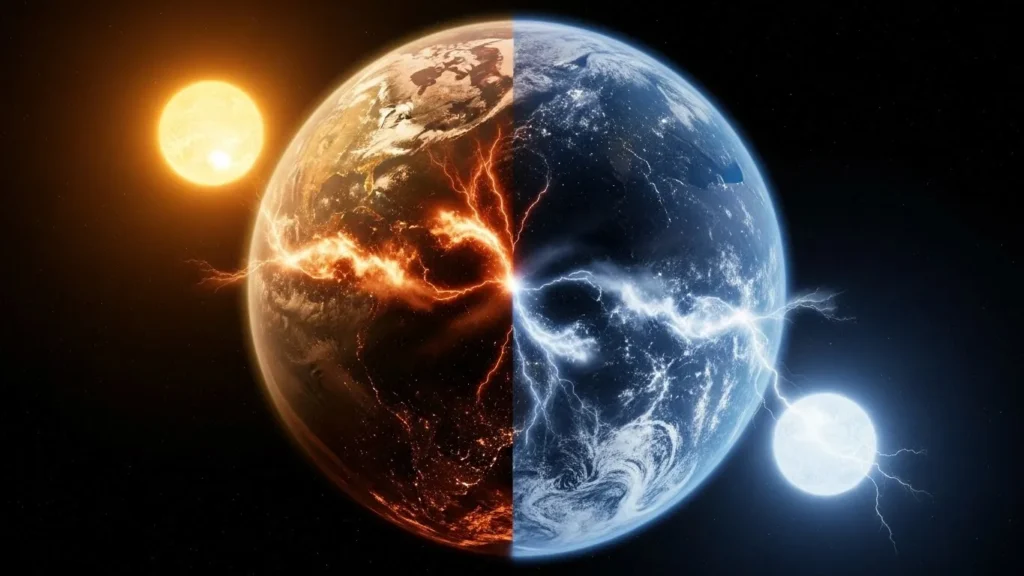
“The Change You’d Notice Slowly — Then Everywhere”
Imagine waking up one year from now.
The weather feels familiar.
So does the next year.
And the year after that.
No summer shift.
No winter chill.
No spring bloom or autumn fade.
At first, it might feel convenient — predictable weather, fewer extremes, no seasonal disruption.
But seasons are not decorative features of Earth.
They are the result of a precise planetary alignment — and they quietly organize climate, ecosystems, agriculture, and even human culture.
If Earth had no seasons, life would still exist.
But it would exist very differently.
Why Earth Has Seasons in the First Place
A common misconception is that seasons happen because Earth moves closer to or farther from the Sun.
That’s not true.
Seasons exist because Earth is tilted about 23.5 degrees on its axis.
This tilt causes different parts of the planet to receive varying angles and durations of sunlight throughout the year.
When a hemisphere tilts toward the Sun:
- Sunlight hits more directly
- Days are longer
- Temperatures rise
When it tilts away:
- Sunlight spreads out
- Days shorten
- Temperatures fall
Remove the tilt — and seasons disappear.
What “No Seasons” Actually Means
If Earth had no seasons, its axis would be perfectly upright.
The consequences would be simple in principle:
- Every location would receive the same sunlight pattern year-round
- Day length would not change with the calendar
- Solar intensity would remain constant
There would still be day and night.
But there would be no seasonal rhythm.
Climate would stabilize — but not evenly.
Climate Zones Would Become Permanent
Today, climate zones shift slightly with seasons.
Without seasons, those zones would lock into place.
This means:
- The equator would stay consistently warm
- Polar regions would remain consistently cold
- Mid-latitude variability would disappear
There would be no “summer heatwave” or “winter cold snap.”
Weather would still exist — storms, rain, winds — but temperature cycles would flatten.
Earth would feel less dynamic, but more rigid.
A Common Misunderstanding: “No Seasons Means Mild Weather”
This sounds appealing — but it’s misleading.
Without seasons:
- Cold regions wouldn’t get warmer months to recover
- Hot regions wouldn’t get cooler periods to release heat
- Climate extremes could become more entrenched
Some places might become more challenging to live in, not less.
Seasons act like a reset button for temperature balance.
How Plants Would Respond Without Seasons
Plants are deeply seasonal organisms.
They rely on:
- Day length changes
- Temperature shifts
- Seasonal rainfall patterns
Without seasons:
- Deciduous trees would lose their cue to shed leaves
- Many plants would struggle to time growth and reproduction
- Evergreen plants might dominate more regions
Agriculture would need to adapt completely.
Farming calendars, crop cycles, and food diversity would change.
Animal Behavior Would Be Reshaped
Many animals synchronize life events with seasons.
Examples include:
- Migration
- Breeding cycles
- Hibernation
Without seasons:
- Migration would lose its trigger
- Breeding might occur year-round or become irregular
- Population balances could shift
Some species would thrive.
Others would lose the environmental signals they depend on.
Human Life Would Feel Less Rhythmic
Humans plan around seasons more than we realize.
Seasons influence:
- Clothing and architecture
- Food availability and traditions
- Work cycles and school calendars
- Cultural rituals and celebrations
Without seasons, time would feel less segmented.
The year would blur.
Life wouldn’t stop — but it would lose a natural sense of progression.
Comparing Earth With and Without Seasons
| Feature | Earth With Seasons | Earth Without Seasons |
|---|---|---|
| Temperature patterns | Cyclical | Constant |
| Day length | Changes yearly | Constant |
| Plant growth | Seasonal timing | Disrupted or continuous |
| Animal behavior | Migration, hibernation | Reorganized or absent |
| Human culture | Season-based rhythms | More uniform routines |
Why Seasons Help Stabilize Earth
Seasons don’t just add variety.
They help redistribute energy.
Seasonal shifts:
- Move heat between regions
- Prevent long-term temperature buildup
- Support diverse ecosystems
Without them, Earth’s climate system would rely solely on atmospheric and ocean circulation to balance energy.
That balance would be harder to maintain.
Why Earth Didn’t “Choose” a Perfectly Upright Axis
Planetary tilts aren’t designed.
They’re the result of:
- Early collisions
- Gravitational interactions
- Long-term orbital dynamics
Earth’s tilt is stable — largely thanks to the Moon — and that stability has allowed life to adapt to predictable seasons.
A tilt-free Earth wouldn’t be broken.
But it would be less forgiving.
Why This Matters Today
Understanding seasons helps us understand Earth’s habitability.
Seasons explain:
- Why food grows where it does
- Why ecosystems are diverse
- Why climate balance works at all
They are not inconveniences.
They are part of the system that keeps Earth livable across latitudes.
When we talk about climate, we’re really talking about how this delicate balance operates.
Frequently Asked Questions
1. Would Earth be warmer or cooler without seasons?
Neither overall — but regional temperatures would become more fixed and extreme.
2. Would ice caps disappear without seasons?
No. Polar regions would still receive low sunlight and remain cold.
3. Would farming become easier?
Some regions might benefit, others would struggle without seasonal cues.
4. Would humans still have years and calendars?
Yes, but time would feel less naturally segmented.
5. Do any planets have no seasons?
Yes. Planets with little or no axial tilt experience minimal seasonal change.
Key Takeaways
- Seasons are caused by Earth’s axial tilt, not distance from the Sun
- Without seasons, climates would become permanent and rigid
- Ecosystems rely on seasonal signals to function
- Human culture and agriculture are shaped by seasonal cycles
- A small planetary tilt has massive consequences
A Calm Look at a Predictable World
A seasonless Earth might sound simpler.
But simplicity comes at a cost.
Seasons add challenge — but they also add balance, renewal, and rhythm.
They remind us that change, when predictable, is not disruption.
It’s structure.
And sometimes, the things that make life more complex are the same things that make it possible.
Disclaimer: This article explains scientific concepts for general educational purposes and is not intended as professional or medical advice.







Pingback: What If All Ice Melted at Once — How Earth Would Quietly Transform