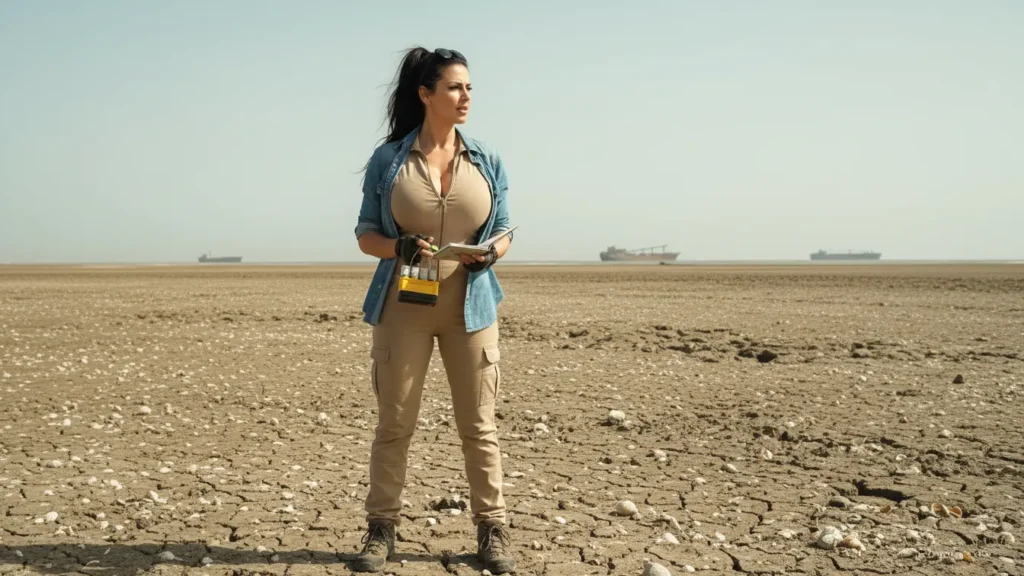
The Ocean You Know — Missing Its Darkest Half
When most people imagine the ocean, they picture waves, beaches, coral reefs, and sunlight dancing on the surface.
But that familiar world is only a thin skin.
Below it lies the deep sea—a vast, dark region that makes up the majority of Earth’s ocean volume. It’s cold, pressurized, and hidden from everyday experience.
Now imagine it never existed.
No abyssal plains.
No deep trenches.
No endless darkness beneath the blue.
The ocean would still be there—but it would behave very differently. And so would the planet.
What Counts as the “Deep Sea”?
The deep sea begins where sunlight fades.
Roughly speaking, it includes:
- Waters below about 200 meters
- Regions where photosynthesis no longer works
- Cold, high-pressure environments
This zone is not rare or fringe.
It makes up most of the ocean by volume.
Removing it wouldn’t just change marine life—it would rewrite how Earth functions as a system.
Why the Deep Sea Exists at All
Earth’s deep oceans are shaped by gravity, plate tectonics, and time.
As continents shifted and seafloors spread:
- Basins deepened
- Water pooled into low regions
- Pressure and cold created stable deep layers
This depth allowed the ocean to develop vertical structure, not just horizontal spread.
That vertical structure is crucial.
Without it, the ocean becomes a shallow bowl instead of a layered engine.
The Deep Sea as Earth’s Storage System
The deep ocean acts like a massive storage warehouse.
It holds:
- Cold water
- Dissolved gases
- Nutrients
- Heat absorbed over long periods
Think of it as a savings account.
Surface waters interact quickly with the atmosphere. The deep sea, by contrast, moves slowly—on timescales of centuries.
This slow movement smooths out extremes.
Without deep storage, changes at the surface would echo faster and harder across the planet.
Why This Happens: Ocean Circulation Needs Depth
Global ocean circulation depends on differences in:
- Temperature
- Density
- Salinity
Cold, dense water sinks.
Warm water rises.
This vertical motion is only possible when the ocean is deep enough to allow layers to form.
Without a deep sea:
- Sinking currents weaken
- Heat redistribution becomes uneven
- Climate patterns lose stability
The ocean wouldn’t stop moving—but it would lose its long-term memory.
How Climate Would Behave in a Shallow-Ocean World
The deep sea helps regulate Earth’s climate by absorbing excess heat.
When surface temperatures rise:
- Some heat is transferred downward
- The deep ocean buffers rapid swings
Without that buffer:
- Surface temperatures would fluctuate more
- Seasonal extremes would sharpen
- Climate patterns would become more volatile
Not catastrophic—but less forgiving.
Depth adds patience to the climate system.
Marine Life Would Be Less Diverse Than You Expect
It’s easy to assume life thrives mainly in sunlit waters.
But the deep sea hosts:
- Unique ecosystems
- Slow-growing organisms
- Entire food webs independent of sunlight
Many species rely on:
- Falling organic matter from above
- Chemical energy sources
- Long, stable conditions
Without deep habitats:
- Biodiversity would shrink
- Evolutionary pathways would narrow
- The ocean would become biologically simpler
Shallower doesn’t mean richer—it often means more crowded and less varied.
Everyday Analogy: A City With No Basements
Imagine a city where every building has no basement, no storage, no foundations below ground.
Everything must fit on the surface.
It might work—but:
- Space becomes limited
- Temperature control worsens
- Stability suffers
The deep sea is Earth’s basement, foundation, and storage room all in one.
Nutrient Cycling Would Change Significantly
The deep ocean plays a key role in recycling nutrients.
Organic matter sinks from surface waters and:
- Decomposes slowly
- Releases nutrients back into circulation
- Supports long-term productivity
Without depth:
- Nutrients would cycle faster
- Blooms would be shorter and more intense
- Long-term balance would weaken
Surface productivity might spike—but then crash more often.
Comparison Table: Earth With vs Without a Deep Sea
| Feature | With Deep Sea | Without Deep Sea |
|---|---|---|
| Ocean volume | Very large | Greatly reduced |
| Heat storage | Strong | Limited |
| Climate buffering | Stable | More variable |
| Marine biodiversity | High | Reduced |
| Nutrient recycling | Slow and steady | Faster, less balanced |
The difference is subtle—but cumulative.
A Common Misunderstanding About the Deep Sea
Many people think the deep sea is mostly empty.
In reality:
- It’s one of the largest habitats on Earth
- Life there is slow, specialized, and resilient
- Its influence extends far beyond its darkness
The deep sea isn’t isolated—it’s integrated into everything above it.
How Human History Might Have Been Different
If Earth had no deep sea:
- Ocean temperatures would differ
- Weather patterns would shift
- Marine resources would evolve differently
Coastal environments—the cradle of many human civilizations—depend indirectly on deep-ocean processes.
Even if humans never see it, the deep sea quietly supports the conditions we rely on.
Why This Matters Today
Understanding the deep sea helps explain a bigger idea:
Planetary systems depend on hidden layers.
Not everything important is visible.
Not everything essential is fast.
Depth, slowness, and storage are stabilizing forces—not inefficiencies.
This insight applies far beyond oceans.
Would Earth Still Be Habitable?
Yes.
Earth without a deep sea would still support life. Oceans would still exist. Weather would still function.
But the planet would feel:
- Less buffered
- More reactive
- Less diverse
The deep sea doesn’t make Earth livable—it makes it stable.
What Would Be Lost Emotionally and Scientifically
Beyond function, the deep sea represents:
- Mystery
- Scale
- The unknown
A world without it would be more understandable—but also more limited.
Sometimes, what we don’t see gives a system its strength.
Key Takeaways
- The deep sea makes up most of Earth’s ocean volume
- It stores heat, nutrients, and gases over long periods
- Depth supports climate stability and biodiversity
- Without it, Earth would be more variable and less resilient
- Hidden systems often do the most important work
Frequently Asked Questions
Would oceans still exist without a deep sea?
Yes, but they would be shallower and less layered.
Is the deep sea important for climate?
Yes. It helps absorb and redistribute heat over long timescales.
Does most marine life live in the deep sea?
Not by numbers—but by volume and diversity, it’s significant.
Would weather become extreme?
Not extreme in a dramatic sense, but more variable and less buffered.
Is the deep sea still poorly understood?
Yes. Much of it remains unexplored, despite its importance.
A Calm Ending From the Planet’s Deepest Place
The deep sea doesn’t shout its importance.
It moves slowly.
It stays dark.
It rarely changes.
Yet through that quiet depth, Earth gains balance, memory, and resilience.
If the deep sea never existed, the planet would still turn—but it would do so without one of its most patient stabilizers.
Sometimes, the deepest parts matter most.
Disclaimer: This article explains scientific concepts for general educational purposes and is not intended as professional or medical advice.