What Causes Solar Flares? The Explosive Science Behind the Sun’s Most Powerful Outbursts
The Sun feels constant.
Every morning it rises, steady and predictable, warming our world like a dependable heartbeat.
But beneath that calm glow is a star that is anything but quiet.
Sometimes, the Sun releases sudden explosions so powerful they can send energy racing across the solar system at the speed of light.
These events are called solar flares.
And they are among the most dramatic outbursts of energy in our entire cosmic neighborhood.
So what causes solar flares?
Why does the Sun suddenly erupt?
And what do these bursts tell us about how stars work?
Let’s explore the science behind solar flares in a clear, engaging way—from the basics to the deeper forces at play.
Solar Flares Are Sudden Explosions of Energy
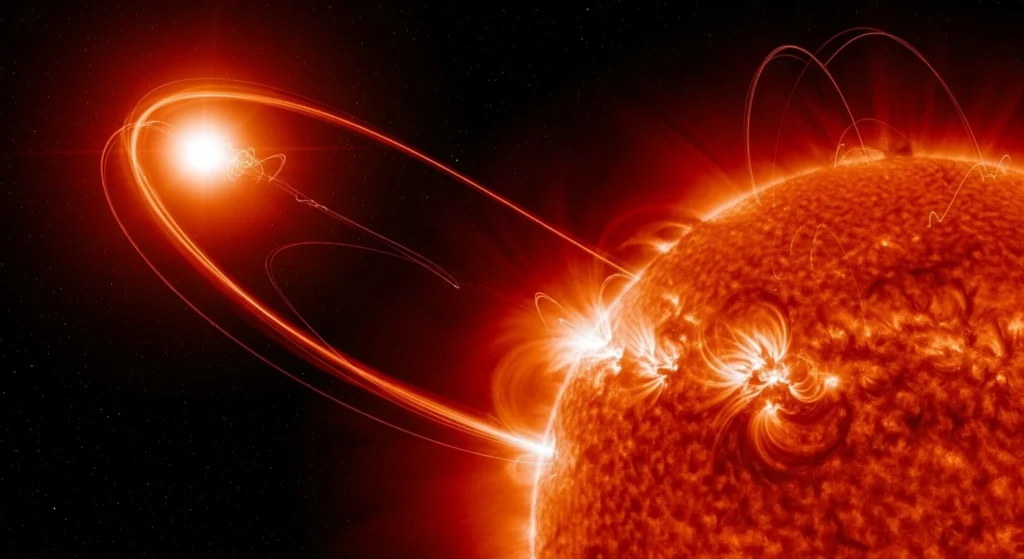
A solar flare is a rapid release of energy from the Sun’s surface and atmosphere.
It can unleash:
- Intense radiation
- Powerful light bursts
- High-energy particles
- Massive electromagnetic waves
Solar flares often occur near sunspots, where the Sun’s magnetic field is especially active.
Real-life analogy
A solar flare is like a stretched rubber band snapping.
Energy builds up slowly…
Then releases all at once.
The Sun Is a Giant Ball of Moving Plasma
To understand solar flares, we need to understand what the Sun is made of.
The Sun is not solid.
It is made of plasma—a superheated gas where electrons are separated from atoms.
Plasma behaves differently from normal gas because it is strongly influenced by magnetic fields.
The Sun is basically:
- Hot
- Electrically charged
- Constantly moving
This creates intense magnetic complexity.
The True Cause of Solar Flares: Magnetic Fields
Solar flares are not caused by “fire.”
They are caused by magnetism.
The Sun’s magnetic field is generated by motion inside the star.
Deep within the Sun, hot plasma rises, cools, and sinks again in vast rolling currents.
This churning motion acts like a dynamo, creating magnetic fields that twist and stretch over time.
Key point:
Solar flares happen when magnetic energy is suddenly released.
Sunspots: Where Solar Flares Often Begin
Sunspots are darker, cooler patches on the Sun’s surface.
They are cooler only relative to the surrounding area—still extremely hot.
Sunspots form where magnetic fields punch through the surface, creating concentrated magnetic regions.
These areas often become flare zones because:
- Magnetic fields are stronger
- Magnetic lines become tangled
- Energy builds up rapidly
Sunspots are like stress points on the Sun’s surface.
Magnetic Reconnection: The Trigger Event
The most important process behind solar flares is called:
Magnetic reconnection
This happens when magnetic field lines become twisted, cross, and suddenly snap into a new configuration.
When this happens, stored magnetic energy is converted into:
- Heat
- Light
- Motion
- Radiation
Everyday comparison
Imagine twisting two rubber bands together until they suddenly break and whip into a new shape.
That sudden release is reconnection.
Magnetic reconnection is the immediate trigger behind most solar flares.
Step-by-Step: How a Solar Flare Forms
Here’s the basic sequence:
- Plasma motion builds magnetic stress
- Field lines twist around sunspots
- Energy accumulates like pressure in a spring
- Magnetic reconnection occurs
- Radiation and particles explode outward
Solar flares can happen in minutes, but the buildup may take days.
How Powerful Are Solar Flares?
Solar flares release staggering amounts of energy.
A major flare can equal:
- Millions of volcanic eruptions
- Billions of nuclear bombs
They are classified by strength:
- A, B, C-class (small)
- M-class (medium)
- X-class (largest)
X-class flares are the most intense and can influence Earth’s space environment.
Solar Flares vs Coronal Mass Ejections (Common Confusion)
People often mix up flares and CMEs.
They are related but different:
- Solar flare: Burst of radiation and light
- CME: Giant cloud of plasma thrown into space
A flare is like lightning.
A CME is like the storm cloud itself being launched outward.
Sometimes flares happen without CMEs, and sometimes both occur together.
Why Solar Flares Matter to Earth
Solar flares don’t burn Earth, but they do affect space weather.
Possible effects include:
- Radio signal disruption
- GPS interference
- Satellite stress
- Auroras near the poles
Large solar events can also affect power grids, which is why space agencies monitor solar activity carefully.
Mistake to avoid
Solar flares are not “Earth-ending events.”
They are natural solar processes that we study and prepare for.
The Sun’s Activity Cycle and Solar Flares
The Sun goes through an approximately 11-year cycle of activity.
During solar maximum:
- More sunspots appear
- More flares occur
- More CMEs occur
During solar minimum:
- Fewer sunspots
- Fewer flares
Solar flares are part of the Sun’s natural rhythm.
Hidden Tips: How to Understand Solar Flares Better
Here are simple mental anchors:
- Solar flares are magnetic, not fiery explosions
- Sunspots are magnetic stress zones
- Magnetic reconnection is the trigger
- The Sun’s plasma is always moving
- Flares are part of an 11-year cycle
Understanding these concepts makes solar flares far less mysterious.
Why This Matters Today (Evergreen)
Studying solar flares helps us:
- Protect satellites and astronauts
- Understand space weather
- Learn how stars release energy
- Improve communication resilience on Earth
- Predict solar storm risk
Solar flares remind us that Earth lives within the atmosphere of a star.
Space is not separate from us.
The Sun shapes our technological world more than we realize.
Key Takeaways
- Solar flares are sudden energy bursts from the Sun
- They are caused by magnetic field stress and reconnection
- Sunspots are common flare birthplaces
- Flares release radiation, not “fire”
- Strong flares can disrupt communications and satellites
- Solar activity rises and falls in an 11-year cycle
- Studying flares improves space weather understanding
FAQ: Solar Flares Explained
1. What causes solar flares?
Solar flares are caused by sudden releases of magnetic energy through magnetic reconnection near sunspots.
2. Are solar flares dangerous to humans?
On Earth’s surface, we are protected by the atmosphere and magnetic field. Satellites and astronauts are more affected.
3. How often do solar flares happen?
They occur more often during solar maximum, but smaller flares happen regularly.
4. What is magnetic reconnection?
It’s when twisted magnetic field lines snap into a new configuration, releasing enormous energy.
5. Do solar flares cause auroras?
Flares can contribute, especially when paired with CMEs that send particles toward Earth.
Conclusion: The Sun’s Magnetic Power on Full Display
Solar flares are one of the clearest reminders that the Sun is an active, dynamic star.
They are powered not by flames…
But by magnetism.
Deep inside the Sun, plasma motion twists magnetic fields like invisible springs.
And when those springs snap, the result is a solar flare—an explosive burst of energy that races across space.
By studying these events, we don’t just learn about the Sun.
We learn about how stars behave, how space weather works, and how connected Earth truly is to its cosmic environment.