Are We Really Alone in the Universe? The Science Behind One of Humanity’s Biggest Questions
Look up at the night sky for a moment.
Every star you see is a sun.
Many of those suns have planets.
Some of those planets may have oceans, atmospheres, and chemistry.
So a question naturally rises in the human mind:
Are we really alone in the universe?
It’s one of the oldest and most emotionally powerful questions we’ve ever asked.
And for the first time in history, science is finally able to explore it with real evidence—not just imagination.
We haven’t found confirmed alien life yet.
But what we have discovered is deeply fascinating:
The universe is far more habitable-looking than we once believed.
Let’s explore what modern astronomy, biology, and planetary science reveal about the possibility of life beyond Earth—calmly, clearly, and accurately.
The Universe Is Almost Unimaginably Large
To understand the odds of life elsewhere, we first need to understand scale.
Our galaxy, the Milky Way, contains about:
- 100–400 billion stars
And the observable universe contains:
- Hundreds of billions of galaxies
That means there are likely:
Trillions upon trillions of planets
For most of human history, we didn’t even know planets around other stars existed.
Today, we’ve confirmed over 5,000 exoplanets, and that number keeps growing.
The universe is not empty real estate.
It’s full of worlds.
Earth Doesn’t Seem as Unique as It Once Did
For a long time, Earth felt like a miracle.
Liquid water.
Oxygen.
A stable climate.
But now we know Earthlike ingredients are surprisingly common.
Scientists have found planets that are:
- Rocky like Earth
- Located in “habitable zones”
- Similar in size to Earth
- Possibly capable of holding atmospheres
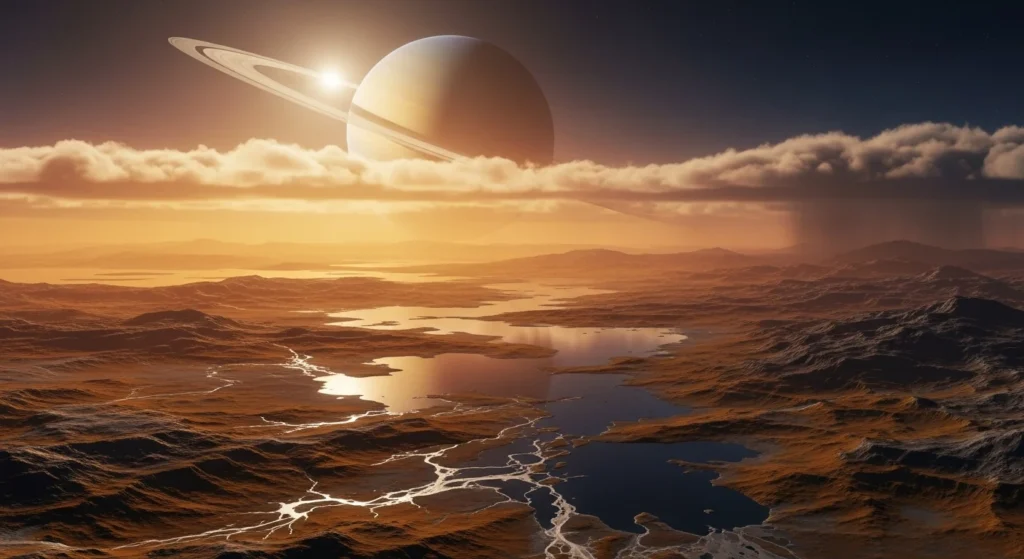
Even moons in our own solar system may have oceans under ice, such as:
- Europa
- Enceladus
- Titan
So the real surprise is not that life might exist…
It’s that the universe seems filled with places where life could exist.
What Does “Life” Actually Mean in Science?
When people hear “aliens,” they often imagine:
- Spaceships
- Intelligent creatures
- Science fiction civilizations
But in science, the first search is much simpler:
Microbial life
Life that could look like:
- Bacteria
- Simple ocean organisms
- Chemical ecosystems underground
On Earth, life thrives in extreme places:
- Deep ocean vents
- Acidic lakes
- Antarctic ice
- Underground caves
- Hot volcanic springs
That teaches us something powerful:
Life is tougher and more adaptable than we once assumed.
So alien life may not look like movies.
It may look like microbes in strange oceans under ice.
The Drake Equation: A Framework, Not a Prediction
Scientists sometimes use the Drake Equation to think about the number of civilizations that might exist.
It considers factors like:
- How many stars exist
- How many have planets
- How many planets are habitable
- How often life begins
- How often intelligence evolves
The equation doesn’t give an answer.
It gives us a structured way to ask:
How rare or common might life be?
Right now, our uncertainty is enormous because we still have a sample size of one:
Earth.
The Fermi Paradox: If Life Is Common… Where Is Everyone?
Here’s one of the biggest puzzles:
If the universe is so large, and planets are so common…
Why haven’t we found anyone yet?
This is called the Fermi Paradox.
There are many possible explanations, such as:
- Intelligent life is extremely rare
- Civilizations don’t last long
- Space travel is harder than imagined
- Life exists, but not in ways we can detect
- We may not be listening correctly
- The universe could be full of quiet microbial life, not radio signals
The silence is part of the mystery.
But silence is not proof of emptiness.
What Scientists Are Actually Searching For
We are not scanning the universe randomly.
There are specific scientific methods being used.
1. Searching for Habitable Worlds
Telescopes look for planets with:
- Water potential
- Atmospheres
- Stable temperatures
The James Webb Space Telescope is beginning to study exoplanet atmospheres in detail.
2. Looking for Biosignatures
A biosignature is a chemical sign that life might be present.
For example:
- Oxygen + methane together
- Unusual atmospheric imbalance
- Organic molecules in certain patterns
These are not proof, but clues.
3. Exploring Ocean Moons
Some of the most promising places for life may be close to home:
- Europa’s subsurface ocean
- Enceladus’s water plumes
- Titan’s complex chemistry
NASA and ESA missions are preparing to explore these worlds further.
4. Listening for Signals (SETI)
The Search for Extraterrestrial Intelligence listens for patterns in radio waves.
So far, no confirmed signals have been found.
But the search has only covered a tiny fraction of the cosmic ocean.
Mistakes to Avoid When Thinking About Alien Life
Let’s clear up common misunderstandings:
- ✅ “No evidence” does not mean “evidence of no life”
- ✅ Most alien life, if it exists, would likely be simple
- ✅ Finding microbes would still be revolutionary
- ✅ Space is vast — contact could be incredibly difficult
- ✅ Intelligence is not guaranteed in evolution
Life may be common.
Civilizations may be rare.
We simply don’t know yet.
Why This Matters Today (Evergreen)
This question isn’t only about aliens.
It’s about understanding life itself.
Studying life beyond Earth helps us ask:
- How did life begin?
- What conditions make life possible?
- Is Earth fragile or typical?
- Could life exist in forms we haven’t imagined?
The search reshapes our perspective.
Even if we never find life, the process teaches us more about our own planet and place in the cosmos.
Key Takeaways
- The universe contains trillions of planets, many potentially habitable
- Earth’s ingredients for life may not be rare
- Scientists are primarily searching for microbial life first
- The Fermi Paradox highlights the mystery of cosmic silence
- Missions are exploring Mars, Europa, Titan, and distant exoplanets
- No confirmed alien life has been found yet—but the search is just beginning
- The question helps us understand life, evolution, and planetary futures
FAQ: Are We Alone in the Universe?
1. Have we found alien life yet?
No confirmed extraterrestrial life has been discovered so far.
2. Are there Earthlike planets?
Yes, many rocky planets in habitable zones have been found, though habitability is complex.
3. What is the most likely form of alien life?
Microbial life is considered most likely, especially in oceans beneath ice or underground environments.
4. Why haven’t we heard from civilizations?
Civilizations may be rare, short-lived, too distant, or using communication methods we can’t detect.
5. Where is the best place to look for life nearby?
Mars (past habitability) and ocean moons like Europa and Enceladus are top candidates.
Conclusion: The Universe Is Quiet… But Not Necessarily Empty
Are we alone?
Science does not yet have a final answer.
But what we’ve learned so far is profound:
The universe is filled with planets.
Earth is not the only world with potential.
Life’s ingredients are widespread.
The silence of space is mysterious…
But the story is still unfolding.
We are not done searching.
And one day, the universe may surprise us.