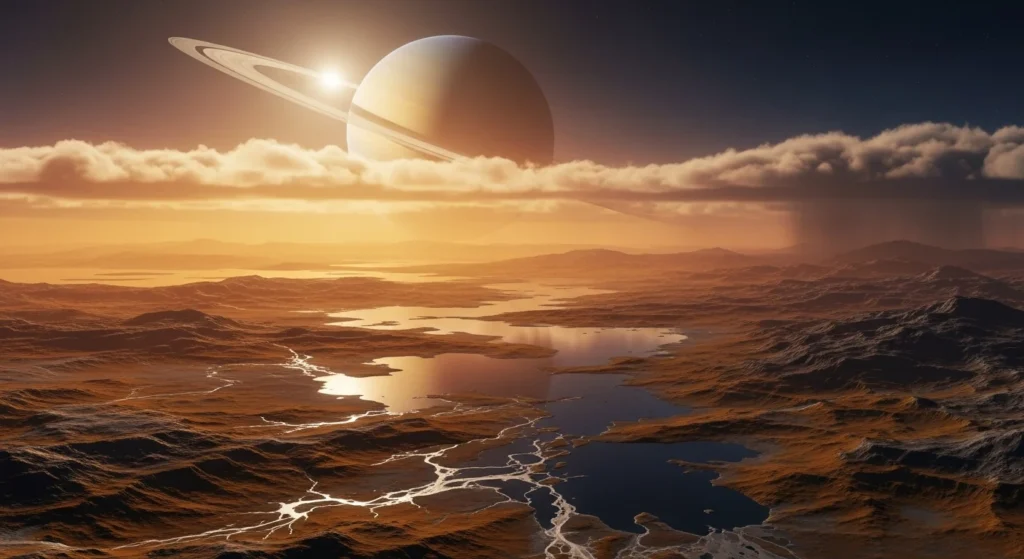
Imagine standing on a shoreline.
A river flows nearby.
Clouds hang above.
Rain has carved valleys into the ground.
It feels like Earth…
But it isn’t.
You’re standing on Titan, Saturn’s largest moon—one of the strangest and most fascinating places in the solar system.
For decades, Titan was just “that hazy moon.”
Now, scientists believe it may be one of the most Earthlike worlds we’ve ever found, just with one shocking twist:
Instead of water…
Titan runs on liquid methane.
The deeper we look, the more Titan feels less like an alien moon and more like a mirror version of our own planet.
So what makes Titan so special?
Let’s explore what scientists are discovering—and why Titan may change our understanding of Earth, life, and habitable worlds forever.
Titan at a Glance: Why This Moon Stands Out
Titan is not a typical moon.
It’s enormous, mysterious, and unlike anything else orbiting a planet.
Here’s what makes it instantly unique:
- Titan is larger than Mercury
- It has a thick atmosphere
- It has clouds, rain, rivers, and lakes
- It has seasons and weather cycles
- It has complex organic chemistry
That combination is extremely rare.
In many ways, Titan is the only place besides Earth where we see familiar planetary processes happening right now.
Titan’s Thick Atmosphere Feels Surprisingly Earthlike
One of Titan’s most Earthlike features is its atmosphere.
Titan is the only moon in the solar system with a dense, layered atmosphere, mostly made of nitrogen—just like Earth.
Key similarities include:
- A nitrogen-rich sky
- Weather patterns
- Wind-driven landscapes
- A protective atmospheric blanket
If you could visit Titan, the sky wouldn’t be black like the Moon.
It would be hazy, orange, and deep—more like a smoggy sunset world.
Practical comparison
Think of Earth wrapped in fog.
That’s Titan’s vibe.
This atmosphere also shields the surface from radiation, making Titan one of the safest outer solar system environments.
Titan Has Rivers, Lakes, and Seas… Just Not of Water
Here’s where Titan becomes truly mind-bending:
Titan has stable liquid on its surface.
But because Titan is extremely cold (around -180°C), water is frozen solid like rock.
Instead, Titan’s rivers and lakes are made of:
- Liquid methane
- Liquid ethane
NASA has mapped entire seas near Titan’s poles, including:
- Kraken Mare
- Ligeia Mare
These are massive bodies of liquid, comparable in size to Earth’s Great Lakes.
Real-life analogy
Imagine Earth…
But the oceans are gasoline-like hydrocarbons instead of water.
That’s Titan.
Titan’s Weather Cycle Works Like Earth’s Water Cycle
Earth has the water cycle:
Evaporation → Clouds → Rain → Rivers → Oceans
Titan has something eerily similar:
Methane evaporation → Methane clouds → Methane rain → Methane rivers → Methane seas
Scientists call this the methane cycle.
On Titan:
- Clouds form in the atmosphere
- Rainstorms reshape the surface
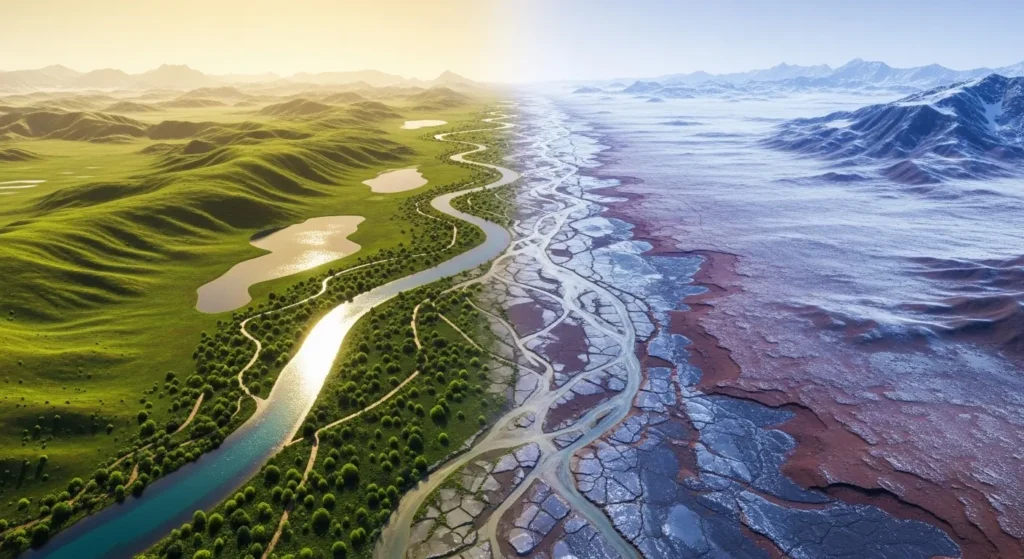
- River channels cut through icy terrain
- Lakes fill and evaporate over seasons
It’s one of the closest parallels to Earth’s climate system anywhere in the solar system.
Titan’s Surface Looks Like a Frozen Earth
When NASA’s Cassini spacecraft studied Titan, it revealed landscapes that were shockingly familiar.
Titan has:
- Sand dunes larger than Sahara dunes
- Mountain ranges
- River valleys
- Ice “bedrock”
- Shorelines and coast-like edges
But Titan’s ground isn’t made of soil or stone.
It’s made of water ice as hard as rock, mixed with hydrocarbons.
Mistake to avoid
Many people assume Titan is just a frozen ball.
In reality, it’s an active world with geology, erosion, and changing weather.
Titan May Have an Ocean Beneath Its Surface
Titan is Earthlike not just on the outside.
Beneath its icy crust, scientists strongly suspect something remarkable:
A global underground ocean of liquid water.
Cassini data suggests Titan’s interior may contain:
- Water
- Ammonia
- Salts
This hidden ocean could be hundreds of kilometers deep.
Why that matters
On Earth, wherever there is liquid water, chemistry, and energy…
Life finds a way.
Titan’s buried ocean makes it one of the most intriguing targets in the search for habitable environments.
Titan Is a Chemistry Laboratory for Life’s Ingredients
Titan’s atmosphere is rich in organic molecules.
Sunlight and radiation break apart methane and nitrogen, triggering complex reactions.
This creates compounds called tholins, which form Titan’s orange haze.
These organics may be similar to the chemical building blocks that existed on early Earth.
Actionable insight for understanding science
Studying Titan helps scientists answer:
- How did Earth develop its pre-life chemistry?
- What conditions create complex molecules?
- Could life begin in environments unlike Earth?
Titan is like a natural experiment running for billions of years.
Titan vs Earth: A Quick Comparison
Here’s a clear look at why Titan is so fascinating:
| Feature | Earth | Titan |
|---|---|---|
| Atmosphere | Nitrogen + Oxygen | Nitrogen + Methane |
| Surface Liquid | Water oceans | Methane/ethane lakes |
| Weather Cycle | Water-based | Methane-based |
| Temperature | Mild | Extremely cold |
| Surface Ground | Rock and soil | Frozen water ice |
| Potential Ocean Below | Some regions | Likely global |
| Organic Chemistry | Life-driven | Pre-life chemistry rich |
Titan is Earthlike…
But rewritten in a different chemical language.
Why Titan Is More Earthlike Than We Expected
For years, Mars stole the spotlight.
But Titan offers something Mars doesn’t:
A living, active Earth-style system.
Titan has:
- A thick atmosphere
- Weather happening right now
- Liquids shaping landscapes
- Complex organic molecules
- A possible water ocean below
That combination makes Titan more planet-like than many actual planets.
Hidden Tips: How to Think About Titan Correctly
If you want to truly understand Titan, here are mental shifts that help:
- Don’t think of it as a “moon” — think of it as a mini planet
- Don’t imagine water — imagine methane instead
- Don’t assume frozen means lifeless — frozen worlds can hide oceans
- Don’t compare it only to Mars — Titan is in its own category
Titan challenges Earth-centered thinking.
The Next Big Mission: Visiting Titan Up Close
NASA is preparing one of the most exciting planetary missions ever:
Dragonfly
Dragonfly will be a rotorcraft drone sent to Titan to explore its surface.
It will study:
- Organic chemistry
- Possible habitable environments
- Surface composition
- Prebiotic building blocks
Unlike a stationary rover, Dragonfly can fly to different locations.
This mission could transform Titan from mystery to map.
Why This Matters Today (Evergreen)
Titan is not just interesting because it’s weird.
It matters because it expands our understanding of what a “world like Earth” can be.
Titan shows that:
- Earth isn’t the only planet with weather
- Life’s chemistry might begin in unexpected places
- Habitable environments may exist beneath icy surfaces
- The solar system is more diverse than we imagined
Titan reminds us that Earth is one version of a planetary story…
Not the only one.
Key Takeaways
- Titan is Saturn’s largest moon and more Earthlike than expected
- It has a thick nitrogen atmosphere, clouds, and rain
- Titan’s lakes and rivers are made of methane, not water
- Its surface has dunes, valleys, and coast-like landscapes
- Scientists believe Titan may hide a subsurface water ocean
- Titan’s chemistry may resemble early Earth’s pre-life conditions
- NASA’s Dragonfly mission will explore Titan in unprecedented detail
FAQ: Saturn’s Moon Titan Explained
1. Why is Titan considered Earthlike?
Because it has an atmosphere, weather, rivers, lakes, and seasonal cycles—features only Earth clearly shares.
2. Does Titan have water?
Yes, but it’s frozen solid on the surface. Scientists believe liquid water exists underground in a hidden ocean.
3. Could Titan support life?
Titan is extremely cold, but its organic chemistry and subsurface ocean make it one of the most promising environments to study habitability.
4. What are Titan’s lakes made of?
They are made of liquid methane and ethane, which behave like water does on Earth under Titan’s temperatures.
5. What mission will explore Titan next?
NASA’s Dragonfly mission will send a flying drone to Titan to study its surface and chemistry up close.
Conclusion: Titan Feels Like Earth’s Stranger Twin
Titan is one of the most extraordinary worlds in the solar system.
It is familiar…
Yet completely alien.
It has rain, rivers, seas, and clouds.
But made of methane.
It may hold an ocean beneath ice.
And it may preserve the chemistry that once shaped Earth’s earliest beginnings.
Titan is proof that Earthlike worlds don’t always look like Earth.
Sometimes…
They hide in the shadows of giant planets, waiting for us to notice how alive they truly are.