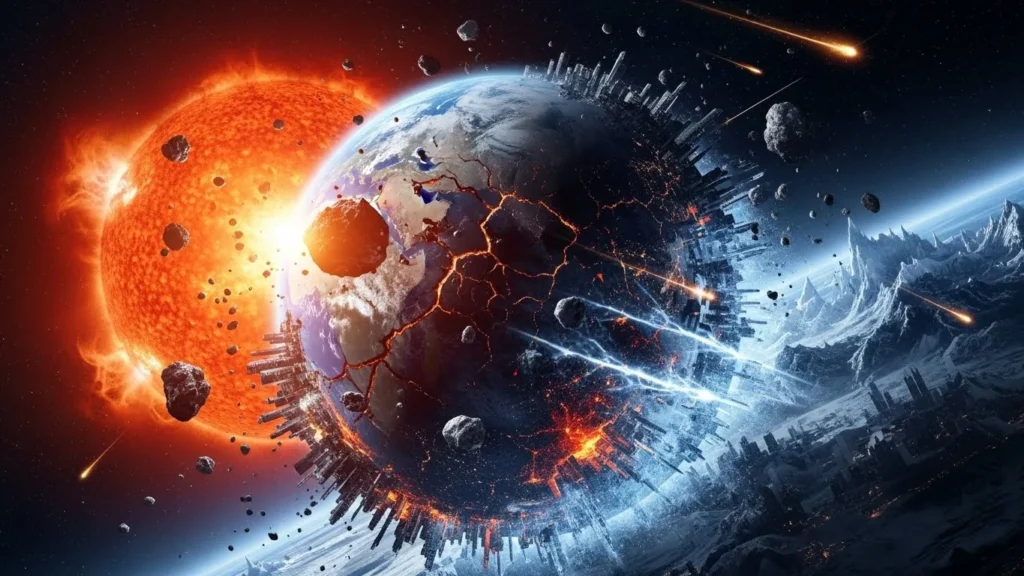
“When Motion You Never Feel Suddenly Matters”
Every moment of your life, Earth is moving at about 30 kilometers per second around the Sun.
Yet you never feel it.
No wind rushes past your face.
No ground vibrates beneath your feet.
No sense of speed at all.
This invisible motion is one of the most important conditions that makes life on Earth possible.
So what if that motion suddenly stopped?
Not slowly.
Not gradually.
Just… stopped.
Understanding the answer doesn’t require advanced astronomy. It starts with something much simpler: how motion works in everyday life.
Why Earth Orbits the Sun in the First Place
Earth doesn’t orbit the Sun because it’s being pulled straight inward.
It orbits because two forces are perfectly balanced:
- Forward motion — Earth is already moving sideways through space
- Gravity — the Sun pulls Earth inward
A helpful analogy is throwing a ball sideways.
Throw it gently, and it falls nearby.
Throw it harder, and it lands farther away.
Throw it fast enough, and it keeps missing the ground entirely — circling instead.
Earth is doing exactly that.
It’s constantly “falling” toward the Sun, but its sideways speed causes it to keep missing.
That miss is called an orbit.
What “Stopping Orbit” Actually Means
When people imagine Earth stopping its orbit, they often picture it simply freezing in place.
But orbiting isn’t a setting you can turn off.
Stopping Earth’s orbit would mean removing its sideways speed, instantly.
And motion, in physics, doesn’t disappear quietly.
If Earth suddenly lost its forward momentum:
- Gravity would still exist
- The Sun would still pull
- Earth would no longer miss
Instead, Earth would begin moving directly toward the Sun.
The Immediate Effect: Earth Would Fall Inward
Without its sideways motion, Earth would start accelerating straight toward the Sun.
Not drifting.
Not floating.
Falling.
At first, this wouldn’t feel like falling the way jumping off a building does.
Why?
Because everything on Earth — oceans, air, people, buildings — would be falling together.
Just like astronauts feel weightless while orbiting Earth, free-fall doesn’t feel dramatic from the inside.
But the environment would begin changing quickly.
What Happens to Day and Night?
Earth’s rotation (spinning on its axis) is separate from its orbit.
If orbit stopped but rotation continued:
- Day and night would still exist
- The Sun would grow larger in the sky each day
- Sunlight intensity would increase steadily
Days would feel warmer.
Then hotter.
Then extreme.
Eventually, Earth’s surface would receive far more solar energy than it does now.
How Temperature Would Change Over Time
Temperature wouldn’t spike instantly.
But as Earth fell closer:
- Sunlight would become more concentrated
- Oceans would absorb increasing heat
- Ice would melt rapidly
- Weather patterns would destabilize
Think of standing closer to a campfire.
At first, it’s pleasant.
Then uncomfortably warm.
Then unbearable.
Distance matters in space just as much as it does in everyday life.
What Happens to Earth’s Atmosphere?
As Earth accelerates toward the Sun:
- Gravity remains normal
- But solar radiation increases
- Atmospheric gases heat and expand
This expansion would cause:
- Strong atmospheric escape at upper layers
- Increasing loss of lighter gases
- Thinning protection from radiation
Earth’s atmosphere exists in a delicate balance — one strongly influenced by distance from the Sun.
A Simple Comparison: Normal Orbit vs. No Orbit
| Aspect | Earth in Normal Orbit | Earth Without Orbit |
|---|---|---|
| Motion | Sideways + inward balance | Straight inward fall |
| Distance from Sun | Stable | Rapidly decreasing |
| Sunlight | Moderate and steady | Increasing rapidly |
| Temperature | Life-supporting range | Rising uncontrollably |
| Atmospheric stability | Maintained | Gradual breakdown |
Why Earth Doesn’t “Crash” Immediately
A common misconception is that Earth would instantly slam into the Sun.
In reality:
- Earth would take weeks to months to reach the Sun
- Acceleration increases gradually
- Changes compound over time
The danger isn’t a sudden collision.
It’s the cascading environmental breakdown that occurs long before that.
Why This Matters Today (Even If It Sounds Hypothetical)
Understanding Earth’s orbit explains far more than a sci-fi scenario.
It helps us grasp:
- Why seasons exist
- Why climate depends on distance and tilt
- Why small orbital shifts can affect long-term climate
- Why planetary stability matters for habitability
Orbit isn’t just motion.
It’s environmental architecture.
Common Misunderstandings People Have
- “Earth could just stay in place.”
Space doesn’t allow stationary balance near massive objects. - “Gravity would turn off too.”
Gravity doesn’t depend on motion; motion counters gravity. - “We’d feel everything immediately.”
Many effects unfold subtly before becoming extreme.
Understanding physics often replaces fear with clarity.
Frequently Asked Questions
Would people feel the fall toward the Sun?
Not at first. Free-fall feels weightless when everything falls together.
Would Earth’s oceans spill into space?
No. Gravity remains the same initially; oceans would heat, not float away.
Could Earth escape the Sun instead?
Only if Earth gained speed, not lost it.
Would the Moon be affected?
Yes. The Earth–Moon system would destabilize as Earth’s path changed.
Is this scenario physically realistic?
No known natural event could stop Earth’s orbit instantly. It’s a thought experiment to explain physics.
Key Takeaways
- Earth’s orbit exists because motion and gravity balance perfectly
- Stopping orbit means removing sideways motion, not freezing in space
- Earth would fall inward toward the Sun, not hover
- Environmental changes would escalate gradually but relentlessly
- Orbit is essential for temperature, atmosphere, and stability
A Calm Way to Think About Cosmic Motion
The most important systems in the universe don’t announce themselves.
They work quietly.
Consistently.
In balance.
Earth’s orbit is one of them.
By understanding how it works — and what would happen if it didn’t — we gain a deeper appreciation for the invisible physics that make everyday life possible.
Not through fear.
Through understanding.
Disclaimer: This article explains scientific concepts for general educational purposes and is not intended as professional or medical advice.