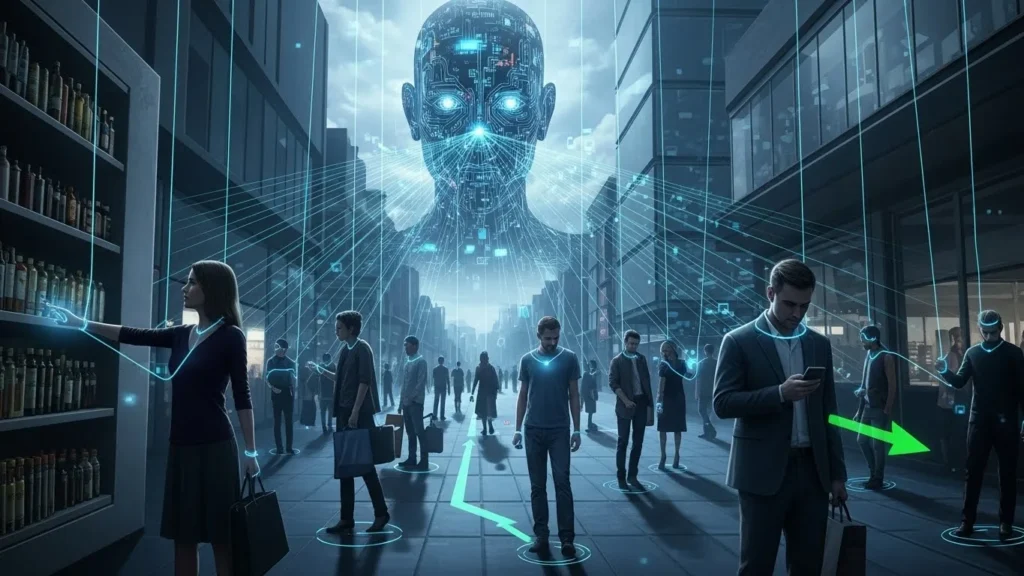
“The Question That Feels Uncomfortable for a Reason”
You open your phone without thinking.
A notification appears.
A headline catches your eye.
A video plays longer than expected.
Nothing forces you.
And yet, millions of people perform the same small actions every day — scrolling, clicking, reacting — often in similar patterns.
This raises a quiet question:
What if the internet didn’t just influence behavior…
What if it actively controlled it?
Not through force.
Not through commands.
But through design, feedback, and biology.
Control Doesn’t Always Look Like Control
When people hear “control,” they imagine commands and restrictions.
But in science, control often means something subtler:
- Shaping choices
- Nudging attention
- Reinforcing habits
Human behavior is not driven only by logic.
It is guided by:
- Attention
- Reward
- Repetition
- Social cues
The internet already interacts with all four.
How Human Behavior Is Normally Guided
Before the internet, behavior was shaped by:
- Physical environment
- Social groups
- Cultural norms
- Immediate feedback
If you spoke, you saw reactions.
If you acted, consequences followed.
Feedback was local and slow.
The internet changed that.
It made feedback:
- Instant
- Scaled
- Persistent
And that matters more than we realize.
The Brain’s Role: Why We Respond So Easily
Human brains evolved to notice patterns and rewards.
Every time something unexpected appears — a message, a like, a new piece of information — the brain pays attention.
This happens because:
- Novelty signals opportunity
- Feedback reinforces behavior
- Repetition strengthens habits
The internet delivers novelty and feedback at a scale no physical environment ever could.
This doesn’t hijack the brain.
It cooperates with how the brain already works.
A Common Misunderstanding: “People Are Being Mind-Controlled”
There is no switch flipping inside the brain.
Behavioral influence works differently.
It operates through:
- Probability, not certainty
- Preference, not orders
- Habit, not force
If the internet controlled behavior, people would still feel free.
That’s the key.
The most effective influence systems preserve the feeling of choice.
How Algorithms Would Become Behavioral Architects
Algorithms don’t decide what you must do.
They decide what you are most likely to see.
Over time, this shapes behavior by:
- Increasing exposure to certain ideas
- Reducing exposure to others
- Reinforcing familiar responses
The result isn’t uniform behavior.
It’s patterned diversity — different groups nudged in different directions.
Control emerges not from sameness, but from predictability.
Attention Would Become the Primary Currency
In a world where the internet controlled behavior, attention would matter more than money.
Why?
Because attention determines:
- What information enters the brain
- What emotions are activated
- What actions follow
If you control attention flow, you indirectly guide behavior.
This doesn’t require persuasion.
It requires placement.
Everyday Life Would Change Quietly
There would be no announcement.
No “control mode” turning on.
Instead, subtle shifts would appear:
- People check devices at the same moments
- Trends rise and fade faster
- Opinions cluster more tightly
- Decisions feel intuitive but patterned
Life would still feel personal.
But behaviors would align more than expected.
Learning, Curiosity, and Exploration
Curiosity would not disappear.
But it would be channeled.
Instead of open exploration:
- Discovery would follow recommendation paths
- Learning would be guided by relevance algorithms
- Interests would deepen rather than widen
This isn’t inherently negative.
It simply changes how knowledge grows — vertically instead of broadly.
Social Behavior Would Become More Synchronized
Humans are social learners.
We observe others to decide what’s acceptable, popular, or valuable.
The internet amplifies this.
If it controlled behavior:
- Social cues would scale instantly
- Group norms would form faster
- Deviations would stand out more clearly
This doesn’t eliminate individuality.
It makes conformity more visible — and sometimes more comfortable.
Comparing Natural Influence vs Internet-Controlled Influence
| Aspect | Traditional Influence | Internet-Controlled Influence |
|---|---|---|
| Speed | Slow | Instant |
| Scale | Local | Global |
| Feedback | Limited | Continuous |
| Behavior shaping | Cultural | Algorithmic |
| Awareness | High | Often low |
Why Humans Would Still Feel Autonomous
One of the most important points:
Control does not remove agency.
Humans would still:
- Make decisions
- Feel responsible
- Express preferences
The difference lies in which options feel natural to choose.
When certain behaviors are easier, faster, or more visible, they become common — without coercion.
Why Biology Makes This Possible
Human brains are adaptive.
They constantly adjust behavior based on:
- Feedback loops
- Social reinforcement
- Environmental structure
The internet is not separate from the environment anymore.
It is part of it.
Behavior changes not because humans are weak — but because they are flexible.
Why This Matters Today
This thought experiment isn’t about fear.
It’s about awareness.
Understanding how behavior can be shaped helps explain:
- Why habits feel automatic
- Why trends spread rapidly
- Why attention feels fragmented
The internet doesn’t need to control humans to influence them.
But influence grows strongest when it goes unnoticed.
Frequently Asked Questions
1. Is the internet already controlling behavior?
It influences behavior, but control would imply consistent, predictable shaping across contexts.
2. Would people lose free will?
No. Choices would still exist — but some options would feel more natural than others.
3. Can humans resist behavioral influence?
Awareness increases flexibility, but influence never disappears completely.
4. Would creativity decline?
Not necessarily. Creativity might cluster around trends rather than emerge randomly.
5. Is this unique to the internet?
No. All environments shape behavior. The internet simply does it faster and wider.
Key Takeaways
- Behavioral control doesn’t require force
- Attention and feedback shape choices
- The internet aligns with natural brain systems
- Influence can feel invisible and voluntary
- Awareness is the key difference between guidance and control
A Calm Look at an Invisible Force
The internet doesn’t shout instructions.
It whispers suggestions.
And humans, being adaptive creatures, often follow paths that feel easiest, most rewarding, or most familiar.
This doesn’t mean control is inevitable.
It means understanding matters.
Because the more clearly we see how behavior is shaped,
the more space we create to choose — deliberately.
Disclaimer: This article explains scientific concepts for general educational purposes and is not intended as professional or medical advice.