The Force You Never Question — Until It Changes
Right now, gravity feels obvious.
You drop your phone.
It falls down.
Rain falls from the sky.
Your feet stay planted on the ground.
We never ask why gravity pulls “down.” We simply accept it as part of life.
But gravity doesn’t actually pull “down” in a universal sense. It pulls toward mass — toward the center of Earth.
So what if something changed?
What if gravity still existed, still had the same strength — but its direction was sideways?
Not weaker.
Not stronger.
Just sideways.
The result wouldn’t be chaos in the way movies show — but it would quietly rewrite almost everything.
Why Gravity Feels Like It Has a Direction
Gravity has no preferred direction on its own.
“Down” exists only because you are standing on a planet.
Earth’s mass pulls everything toward its center. Wherever you stand, that direction becomes “down” for you.
Sideways gravity means imagining a world where the gravitational pull points horizontally across the surface, instead of toward the center.
This single change breaks many assumptions we rely on without thinking.
The First Seconds: Nothing Falls Down Anymore
If gravity suddenly worked sideways:
- Objects would no longer fall toward the ground
- Everything loose would begin sliding sideways
- Floors would stop being “support” surfaces
Your chair wouldn’t drop.
It would accelerate across the room.
Anything not anchored would begin drifting, then slamming into walls in the direction of gravity.
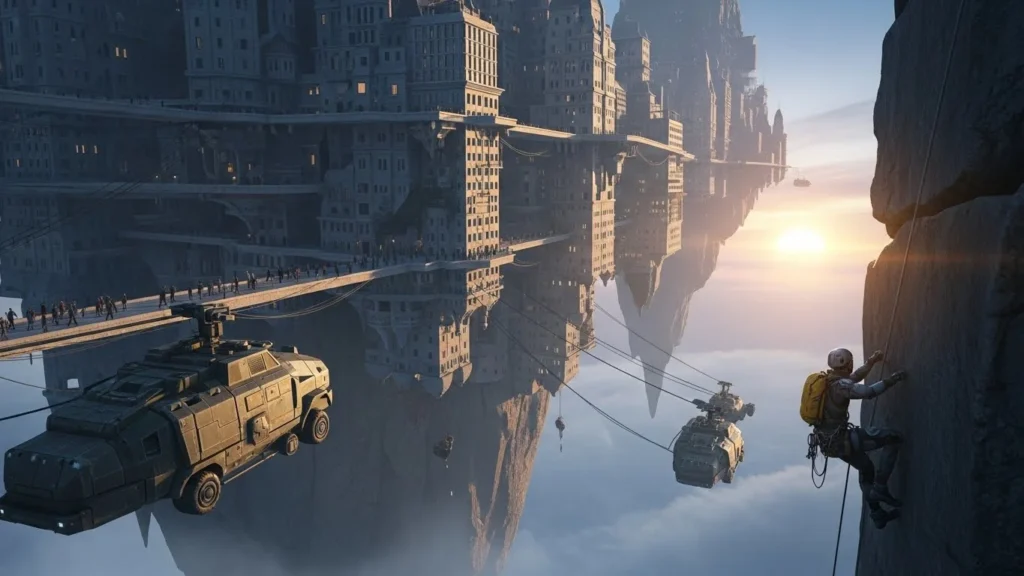
Walls would become the new “ground.”
Walking Would Become Pushing, Not Standing
Standing works because gravity presses your feet into the ground.
With sideways gravity:
- Your feet would no longer be pinned to the floor
- Walking would require constant pushing against surfaces
- Balance would be completely redefined
Movement would resemble rock climbing more than walking.
You wouldn’t stand anywhere.
You would brace yourself — always.
Buildings Would Immediately Stop Working as Designed
Modern buildings rely on vertical gravity.
Their entire structure assumes weight flows downward.
With sideways gravity:
- Walls would bear the full weight of buildings
- Floors would no longer support loads
- Tall structures would shear sideways
Most buildings would not collapse instantly — but they would fail structurally because forces would act in directions they were never designed to handle.
Architecture would need to be rebuilt from scratch around horizontal load-bearing.
Water Would No Longer Sit in Rivers or Lakes
Water obeys gravity with perfect honesty.
If gravity worked sideways:
- Rivers would flow sideways through landscapes
- Lakes would drain toward vertical barriers
- Oceans would pile up against continental edges
Instead of seas being shaped by coastlines, they would be shaped by gravity-facing walls.
The concept of “sea level” would disappear.
The Atmosphere Would Behave Very Differently
Earth’s atmosphere stays in place because gravity pulls gas toward the planet.
With sideways gravity:
- Air would accumulate against one side of Earth
- Pressure would increase in gravity-facing regions
- The opposite side could thin dramatically
Weather, wind, and climate patterns would reorganize around this new pressure gradient.
Breathing wouldn’t stop — but the air would no longer be evenly distributed.
The Planet Itself Would Change Shape Over Time
Gravity shapes planets.
It pulls mass inward, forming spheres.
Sideways gravity would disrupt this balance.
Over long timescales:
- Earth’s interior would redistribute
- The crust would experience extreme lateral stress
- The planet could deform rather than remain spherical
This wouldn’t happen overnight — but gravity always wins given enough time.
A Common Misunderstanding: “Everything Would Just Fall Over”
This sounds simple — but it’s incomplete.
Objects wouldn’t simply “fall.”
They would accelerate continuously sideways.
That means:
- Motion would keep increasing
- Collisions would be more energetic
- Friction would become the only braking force
Sideways gravity creates a world of constant horizontal pressure and motion.
How Life Would Be Forced to Adapt
Life is deeply shaped by gravity’s direction.
Bones, muscles, roots, and circulation evolved assuming gravity pulls downward.
With sideways gravity:
- Trees would grow along walls or cliffs
- Animals would evolve gripping and anchoring adaptations
- Body shapes would flatten or elongate
Life wouldn’t vanish — but it would become more like climbing organisms than standing ones.
Comparing Normal Gravity vs Sideways Gravity
| Aspect | Normal Gravity (Downward) | Sideways Gravity |
|---|---|---|
| Object motion | Falls toward ground | Accelerates horizontally |
| Walking | Standing and stepping | Bracing and pushing |
| Buildings | Vertical load-bearing | Horizontal load-bearing |
| Water behavior | Pools and flows downhill | Presses against barriers |
| Atmosphere | Evenly distributed | Piled in gravity direction |
Why Gravity’s Direction Matters More Than Its Strength
People often focus on how strong gravity is.
But direction is just as important.
Direction determines:
- Where structures can exist
- How fluids behave
- How organisms orient themselves
- How planets maintain shape
Same force.
Different direction.
Completely different world.
Why This Matters Today
This thought experiment reveals something subtle.
The laws of physics aren’t just about numbers — they’re about geometry.
Gravity’s direction quietly enables:
- Stable architecture
- Predictable motion
- Balanced ecosystems
- Planetary structure
We live in a world that feels “normal” not because physics is simple — but because it is consistent.
Frequently Asked Questions
1. Could gravity ever actually work sideways?
No known physical mechanism would cause gravity to change direction independently of mass.
2. Would sideways gravity feel stronger?
The strength would feel the same — only the direction would change.
3. Would people float without downward gravity?
No. They would be pulled sideways, not float.
4. Would the Sun and Moon be affected?
Yes. Orbital mechanics rely on gravitational direction and balance.
5. Could life survive long-term?
Life could adapt over time, but it would look very different from what we know.
Key Takeaways
- Gravity doesn’t pull “down” — it pulls toward mass
- Changing gravity’s direction reshapes motion, structures, and life
- Sideways gravity turns walls into floors
- Fluids, air, and planets depend on gravity’s orientation
- Direction matters as much as force
A Calm Look at an Unfamiliar World
Sideways gravity feels unsettling because it breaks something fundamental we never question.
But it also teaches us something important.
Our world works not because gravity is strong — but because it is reliable, directional, and consistent.
The ground beneath your feet isn’t guaranteed by chance.
It’s the quiet outcome of how the universe chose to pull.
Disclaimer: This article explains scientific concepts for general educational purposes and is not intended as professional or medical advice.