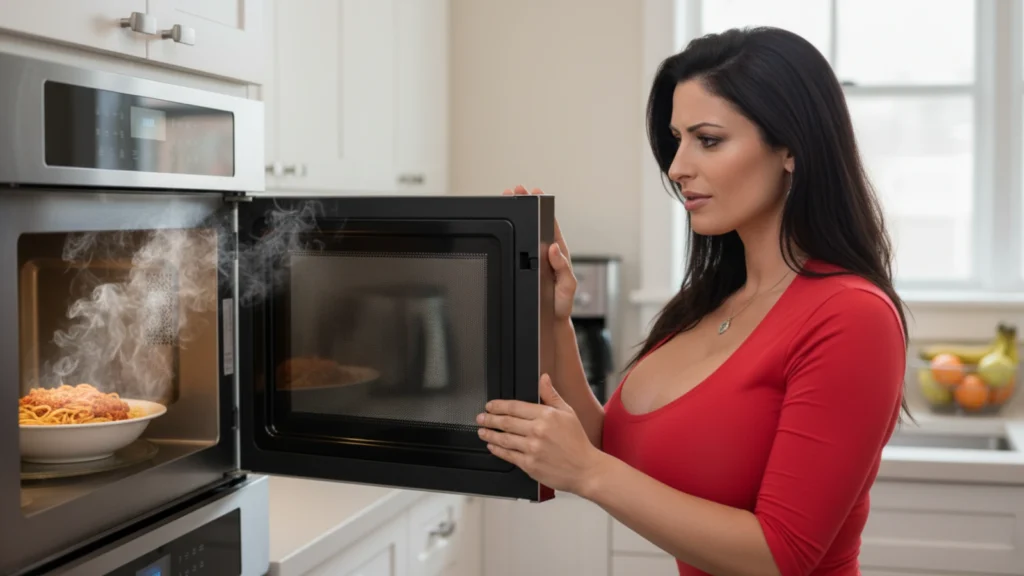
“The Everyday Mystery on Your Plate”
You take a plate out of the microwave.
One corner is scalding hot.
The center is lukewarm.
Another bite is still cold.
You stir, rotate, and heat again — but the problem keeps returning.
This isn’t a flaw in your microwave.
It’s not poor food quality.
And it’s not random bad luck.
👉 Uneven heating is a natural result of how microwave energy moves, interacts with food, and gets absorbed at the molecular level.
To understand why this happens, we need to look inside the invisible world of waves, water molecules, and energy patterns — all happening quietly inside your kitchen appliance.
First, What Does a Microwave Actually Do?
Despite the name, microwaves don’t cook food by making it “hot from the inside out.”
Instead, they use electromagnetic waves — a form of energy similar to radio waves and light, but tuned to a specific frequency.
Inside a microwave oven:
- Electrical energy creates microwave radiation
- These waves bounce around the metal chamber
- The waves interact with molecules in your food
- Certain molecules begin to move faster
- That motion becomes heat
The key molecule involved?
👉 Water
Why Water Molecules Matter So Much
Water molecules have a unique shape: one side slightly positive, the other slightly negative.
Microwave waves cause these molecules to:
- Rotate back and forth extremely fast
- Try to align with the changing electric field
- Collide with nearby molecules
These collisions generate thermal energy — what we experience as heat.
Foods with more water (soups, vegetables, sauces) heat faster.
Foods with less water (bread, fats, sugars) heat differently.
This uneven distribution of water is one reason heating isn’t uniform — but it’s only part of the story.
The Real Culprit: Invisible Wave Patterns
Inside the microwave chamber, energy doesn’t spread evenly like sunlight in a room.
Instead, microwaves behave like ripples in a pond.
When waves bounce off the metal walls, they interfere with each other, creating patterns of:
- High-energy zones (hot spots)
- Low-energy zones (cold spots)
These patterns are called standing waves.
So when food sits still:
- Parts of it land in high-energy zones
- Other parts sit where very little energy reaches
That’s why one edge burns while another stays cold.
Why the Turntable Exists (And Why It’s Not Perfect)
Most microwaves include a rotating plate for a reason.
The turntable:
- Moves food through different wave zones
- Reduces extreme hot and cold spots
- Averages out energy exposure
But rotation doesn’t eliminate uneven heating completely.
Why?
Because:
- Standing waves still exist
- Food shapes are irregular
- Some areas absorb energy faster than others
Rotation helps — it doesn’t guarantee uniformity.
Food Shape and Thickness Change Everything
Microwaves don’t penetrate food infinitely.
They typically heat:
- The outer layers first
- Then move inward gradually
Thicker foods create a problem:
- Outer regions absorb more energy
- Inner regions stay cooler
- Heat must spread inward by conduction
This is why:
- A thick lasagna heats unevenly
- A thin soup warms more evenly
- Dense foods heat slower than loose or liquid foods
Shape matters just as much as composition.
Comparison Table: Why Some Foods Heat Worse Than Others
| Food Type | Water Content | Shape & Density | Heating Result |
|---|---|---|---|
| Soup | Very high | Uniform liquid | Heats evenly |
| Vegetables | High | Irregular shapes | Uneven patches |
| Meat | Moderate | Dense structure | Hot outside, cool inside |
| Bread | Low | Air pockets | Dries before heating |
| Frozen food | Water locked in ice | Solid & dense | Extreme uneven heating |
This explains why microwaves struggle most with thick, dense, or frozen items.
Why Frozen Food Is Especially Uneven
Ice behaves differently than liquid water.
In frozen food:
- Water molecules are locked in place
- They respond less efficiently to microwaves
- Some areas thaw faster than others
As a result:
- Thawed sections heat rapidly
- Frozen sections remain cold
- Temperature contrast becomes extreme
That’s why frozen meals often instruct you to stir halfway through — not as a suggestion, but as a scientific necessity.
A Common Misconception: “Microwaves Heat From the Inside”
This idea is widespread — and incorrect.
Microwaves:
- Penetrate only a few centimeters
- Heat outer layers first
- Rely on heat conduction to warm the center
The reason food sometimes feels hot inside is simply because:
- Steam and moisture get trapped
- Heat spreads inward after microwaving
Understanding this clears up a lot of confusion about microwave cooking.
Why This Matters Today
Microwaves are one of the most used appliances in modern homes.
Understanding uneven heating helps explain:
- Why stirring improves results
- Why resting food after heating matters
- Why microwave-safe doesn’t mean microwave-perfect
It also helps us appreciate how everyday technology relies on invisible physics working constantly around us — even during something as simple as reheating leftovers.
Key Takeaways
- Microwaves heat food using electromagnetic waves
- Energy forms invisible hot and cold zones inside the oven
- Water molecules absorb energy and generate heat
- Food shape, thickness, and composition matter
- Turntables reduce but don’t eliminate uneven heating
- Frozen and dense foods heat the least evenly
Uneven heating isn’t a defect — it’s physics in action.
Frequently Asked Questions (FAQ)
1. Why is the center of food often colder?
Because microwaves heat outer layers first, and heat takes time to conduct inward.
2. Does stirring really help?
Yes. Stirring redistributes food through different energy zones, averaging heat exposure.
3. Why do microwaves struggle with bread?
Bread has low water content and many air pockets, which absorb microwave energy poorly.
4. Are newer microwaves better at even heating?
They’re improved, but standing wave patterns still exist in all microwave ovens.
5. Why does letting food rest after microwaving help?
Heat continues spreading internally, reducing temperature differences.
A Calm Conclusion
Microwave ovens don’t fail at heating food evenly — they simply obey the laws of physics.
Invisible waves bounce, interfere, and interact with food in complex ways.
Water molecules respond.
Energy concentrates in patterns.
What feels like inconsistency is actually predictable science happening at high speed.
The next time your meal comes out uneven, you’re not seeing a mistake —
you’re witnessing physics quietly at work inside your kitchen.
Disclaimer: This article explains scientific concepts for general educational purposes and is not intended as professional or medical advice.








Pingback: What If the Sun Suddenly Grew Larger — How Earth and Life Would Instantly Change