“A Daily Moment You’ve Never Fully Explained”
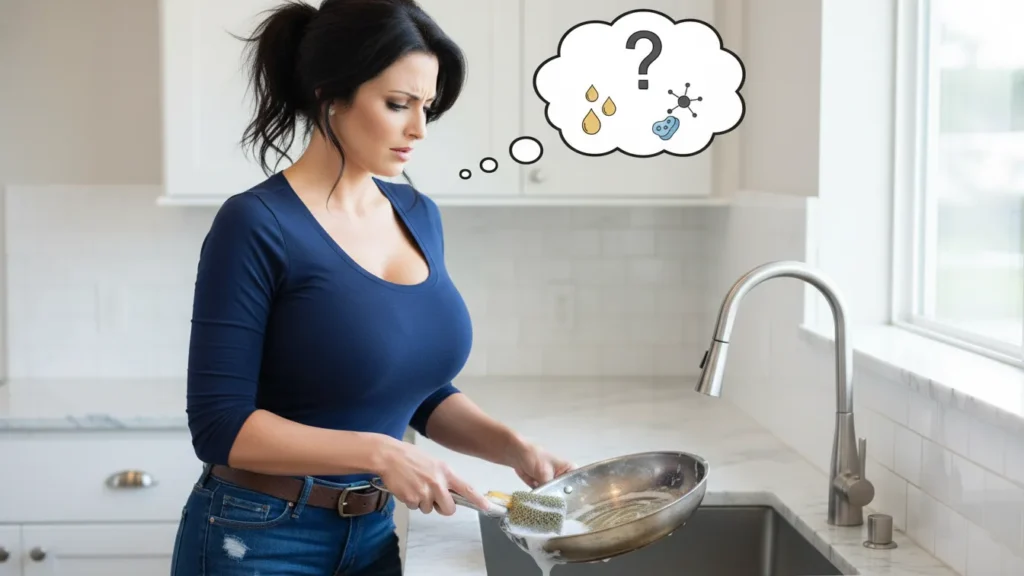
You rinse a greasy pan with water.
The oil smears.
The surface stays slippery.
Nothing really changes.
Then you add soap.
Suddenly, the grease lifts, breaks apart, and vanishes down the drain.
This transformation feels almost magical — but it isn’t.
It’s the result of one of the most elegant and useful ideas in chemistry: how certain molecules can connect two things that normally refuse to mix.
The First Truth: Water and Grease Don’t Get Along
To understand soap, we must start with a basic fact:
👉 Oil and water don’t mix.
You’ve seen this countless times:
- Oil floating on water
- Grease separating from soup
- Salad dressing splitting into layers
This happens because water and grease are built very differently at the molecular level.
What Makes Water So Selective
Water molecules have a unique structure that gives them a slight electrical charge.
This makes water excellent at:
- Dissolving salts
- Carrying sugars
- Mixing with similar substances
But it also makes water uncomfortable around oils and fats, which lack those charges.
So when you rinse grease with water:
- Water molecules stick to each other
- Grease molecules cling to themselves
- Neither wants to interact
The grease stays put.
Why Grease Sticks to Surfaces
Grease isn’t just oily — it’s sticky.
Grease molecules:
- Repel water
- Attract other greasy substances
- Cling to solid surfaces
This is why greasy pans, hands, and clothes feel slippery instead of clean after a water rinse.
Water alone simply slides past the grease.
Enter Soap: A Molecular Translator
Soap works because it is two things at once.
Each soap molecule has:
- One end that loves water
- One end that loves grease
This dual nature is what makes soap special.
In chemistry terms:
- The water-loving end is hydrophilic
- The grease-loving end is hydrophobic
Soap molecules act like tiny connectors between two incompatible worlds.
How Soap Attacks Grease Step by Step
When soap meets greasy water, something remarkable happens.
Here’s the process in simple terms:
- Soap molecules surround the grease
- Their grease-loving ends embed into the oil
- Their water-loving ends face outward
- The grease gets trapped inside a tiny bubble
These tiny bubbles are called micelles.
Once trapped, the grease can finally mix with water — and be washed away.
Why Water Alone Can’t Do This
Water molecules are all the same.
They don’t have:
- A grease-grabbing side
- A dual personality
Soap does.
That’s why soap doesn’t just push grease around — it repackages it into a form water can carry away.
A Simple Analogy That Makes It Clear
Imagine grease as a crowd that doesn’t speak your language.
Water tries to talk to them — nothing happens.
Soap molecules are translators:
- One hand speaks “grease”
- The other speaks “water”
They gather the grease into groups and escort them out.
Why Scrubbing Helps (But Isn’t the Main Actor)
Scrubbing doesn’t remove grease by force alone.
It helps by:
- Breaking grease into smaller pieces
- Increasing contact between soap and oil
- Speeding up micelle formation
Without soap, scrubbing mostly spreads grease.
With soap, scrubbing accelerates chemistry.
Why Soap Foams (And Why Foam Isn’t the Cleaner)
Foam looks like it’s doing the work.
But foam is mostly air.
The real cleaning happens:
- At the molecular level
- In the water, not the bubbles
Foam is simply a side effect of soap molecules stabilizing air pockets.
Less foam doesn’t mean less cleaning.
Soap vs Detergent: A Quick Clarification
Soap and detergents work on the same principle.
Both are surfactants — substances that reduce surface tension and trap grease.
The difference lies in:
- How they’re made
- How they behave in hard water
But the grease-removal mechanism is essentially the same.
A Side-by-Side Comparison
| Substance | Can Mix With Water | Can Grab Grease | Removes Oil |
|---|---|---|---|
| Water | Yes | No | ❌ |
| Oil | No | Yes | ❌ |
| Soap | Yes | Yes | ✅ |
| Detergent | Yes | Yes | ✅ |
This table shows why soap is uniquely effective.
Why Warm Water Helps (But Isn’t Required)
- Softens grease
- Makes it less sticky
- Speeds up molecular motion
This helps soap work faster — but soap still functions in cold water because its chemistry does the heavy lifting.
Common Misunderstandings About Soap
Many people think:
- Soap “dissolves” grease like sugar in water
- Soap breaks grease chemically
- Soap kills grease
In reality:
- Soap traps grease
- Soap rearranges it
- Soap allows water to carry it away
The grease isn’t destroyed — it’s relocated.
Why This Matters Beyond the Sink
This same principle explains:
- How shampoos remove oil from hair
- How laundry detergents clean clothes
- How cleaning sprays work
- How emulsions form in food
Soap chemistry is one of the most widely used scientific tools in daily life.
Why This Matters Today
In a world focused on hygiene, sustainability, and efficient cleaning, understanding soap helps us appreciate:
- Why simple solutions work
- Why overusing products isn’t necessary
- Why chemistry quietly improves daily comfort
Soap is a reminder that small molecular designs can solve big practical problems.
Everyday Examples You’ve Seen
- Oil separating from water in a pan
- Grease lifting instantly with dish soap
- Shampoo removing oily buildup
- Hands feeling clean only after soap
All are powered by the same invisible mechanism.
Key Takeaways
- Water and grease naturally repel each other
- Soap molecules connect water and grease
- One end grabs oil, the other loves water
- Grease gets trapped in micelles
- Water can then wash grease away
- Cleaning is chemistry, not magic
Frequently Asked Questions
Why doesn’t water remove grease on its own?
Because water molecules can’t interact with grease molecules.
Does soap destroy grease?
No. It traps grease so water can carry it away.
Is more soap always better?
Not necessarily. Enough soap to surround grease is sufficient.
Why does soap feel slippery?
Because soap reduces surface tension between water and surfaces.
Do natural and synthetic soaps work differently?
They use the same basic mechanism, even if their ingredients differ.
A Calm Way to Think About Soap
Soap doesn’t fight grease.
It understands it.
By bridging the gap between oil and water, soap turns an impossible task into an easy one — quietly demonstrating how chemistry solves problems not with force, but with clever design.
The next time grease disappears down the drain, you’re watching molecular teamwork in action.
Disclaimer: This article explains scientific concepts for general educational purposes and is not intended as professional or medical advice.