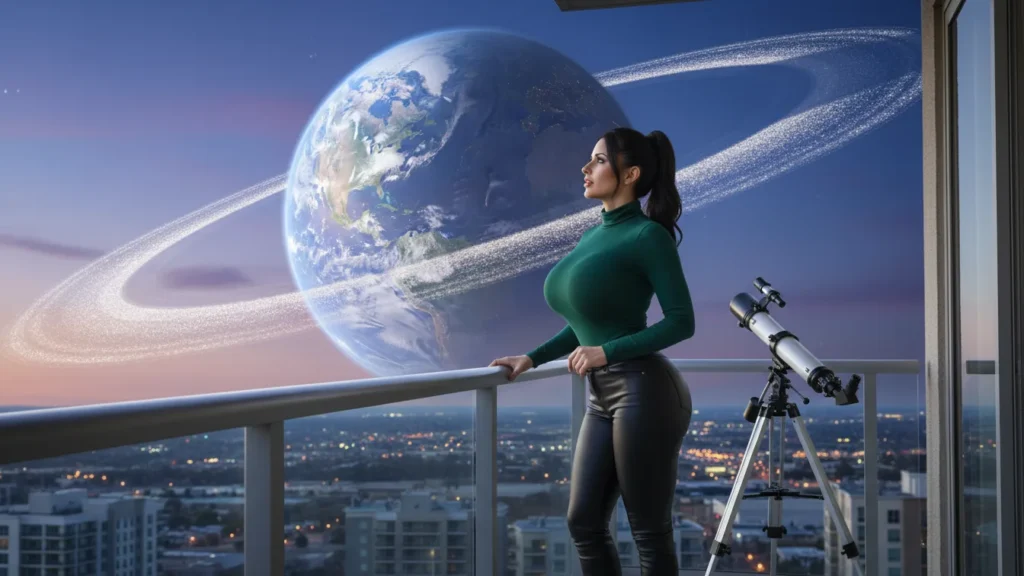
“Imagine Looking Up — and Seeing a Ringed Sky”
Step outside at dusk.
Instead of a plain blue or star-filled sky, a vast glowing arc stretches overhead—bright, layered, and impossible to ignore.
It doesn’t rise or set like the Sun or Moon.
It curves across the sky like a frozen rainbow made of light.
If Earth had rings like Saturn, the most dramatic change wouldn’t be in space.
It would be above our heads, every single day.
But beyond beauty, such rings would reshape gravity, climate, seasons, and even how humans understand time and space.
Let’s explore what science tells us would really happen.
First, What Are Planetary Rings?
Planetary rings are not solid hoops.
They are made of:
- Ice fragments
- Rock and dust
- Debris ranging from grains to boulders
Saturn’s rings formed from material that never became a moon—or from moons that broke apart long ago.
If Earth had rings, they would orbit within Earth’s gravitational control, forming a flat disk around the planet’s equator.
How Could Earth Even Get Rings?
For Earth to have rings, something major must have happened.
Possible scientific explanations include:
- A large moon breaking apart due to tidal forces
- A massive asteroid passing too close and disintegrating
- Debris left over from a violent collision
Importantly, rings don’t appear gently.
They are signs of cosmic disruption, not decoration.
The Sky Would Never Look the Same Again
The most immediate and emotional change would be visual.
Earth’s rings would be:
- Visible day and night
- Brighter than the Milky Way
- Changing angle with latitude
Near the equator, rings would appear as a thin glowing line.
Closer to the poles, they would arc dramatically across the sky.
For early humans, such rings would have shaped mythology, navigation, calendars, and belief systems.
Nights Would Be Brighter — Everywhere
Rings reflect sunlight.
That means nighttime would never be fully dark.
Even without the Moon:
- Rings would glow faintly at night
- Star visibility would reduce
- True darkness would be rare
Astronomy as we know it would be harder.
Telescopes would need to work around a permanently bright sky feature.
How Earth’s Seasons Would Change
Rings don’t just sit quietly.
They interact with sunlight.
Depending on Earth’s tilt:
- Rings could cast massive shadows
- Some regions would receive less sunlight
- Seasonal temperature patterns could shift
Certain areas might experience cooler summers or darker winters—not because the Sun changed, but because the rings blocked part of its light.
Climate Effects: Subtle but Global
Earth’s climate depends on energy balance.
Rings would influence this balance by:
- Reflecting solar radiation back into space
- Blocking sunlight in specific regions
- Changing atmospheric heating patterns
The result wouldn’t be instant freezing or heating—but long-term climate adjustments that science could measure over decades.
Gravity: Would Rings Affect Us Directly?
Rings have mass.
But compared to Earth, their gravitational pull would be small.
You wouldn’t feel heavier or lighter.
However, rings could subtly affect:
- Satellite orbits
- Space debris paths
- Long-term orbital stability
Space travel would become more complex due to debris density near Earth.
Satellites and Spaceflight Would Get Complicated
Modern civilization relies on satellites.
Earth’s rings would occupy the same orbital regions used by:
- Communication satellites
- GPS systems
- Space stations
Navigating through ring debris safely would be a major engineering challenge.
Space launches would require precise timing and routing to avoid collisions.
A Comparison: Earth With vs Without Rings
| Aspect | Earth Today | Earth With Rings |
|---|---|---|
| Night sky | Dark, star-filled | Bright, ring-lit |
| Astronomy | Clear observation | Obstructed views |
| Seasons | Stable patterns | Modified sunlight |
| Space travel | Open orbital paths | Debris navigation |
| Cultural impact | Moon-centered | Ring-dominated |
Rings would touch nearly every system—directly or indirectly.
Life on Earth: Would It Survive?
Yes.
Rings alone wouldn’t make Earth uninhabitable.
Life has survived:
- Asteroid impacts
- Ice ages
- Massive climate shifts
The changes would be environmental, not instantly destructive.
But ecosystems might adapt differently depending on light exposure and temperature shifts.
Common Misunderstanding: Rings Are Just Visual
It’s easy to think rings are cosmetic.
They are not.
Rings are dynamic systems:
- They evolve over time
- They interact with gravity
- They influence energy flow
They are active participants in planetary systems—not decorations.
Why Earth Doesn’t Have Rings Today
Earth lacks rings for a simple reason:
Stability.
Our Moon is massive and well-positioned, stabilizing Earth’s orbit and tilt.
Any debris near Earth either:
- Falls back to the planet
- Forms a moon
- Escapes orbit
Rings are often temporary on rocky planets.
Why This Matters Today
This question helps us understand:
- How planets evolve
- Why Earth’s conditions are unusually stable
- How delicate orbital balance really is
It also reminds us that Earth’s familiar sky is not guaranteed—it’s the result of billions of years of cosmic order.
Key Takeaways
- Earth’s rings would dramatically change the sky
- Nights would be brighter, stars less visible
- Climate and seasons would shift subtly
- Space travel would become more complex
- Rings signal past cosmic disruption
Frequently Asked Questions
Would Earth’s rings look like Saturn’s?
They could be similar, but likely thinner and less massive.
Would the Moon be affected?
Yes. The Moon’s orbit could change slightly over long periods.
Would rings fall to Earth?
Over time, yes. Rings around rocky planets are often temporary.
Could humans live normally?
Yes, though technology and observation would adapt.
Would rings ever disappear?
Most likely. Without constant replenishment, they would slowly fade.
A Calm, Simple Conclusion
If Earth had rings like Saturn, our world wouldn’t end—but it would feel profoundly different.
The sky would glow.
Seasons would shift.
Space would become crowded.
Most of all, we would be constantly reminded that Earth is not isolated or static—it is shaped by gravity, motion, and cosmic chance.
The fact that our planet doesn’t have rings is not boring.
It’s a quiet sign of stability in an otherwise chaotic universe.
Disclaimer: This article explains scientific concepts for general educational purposes and is not intended as professional or medical advice.