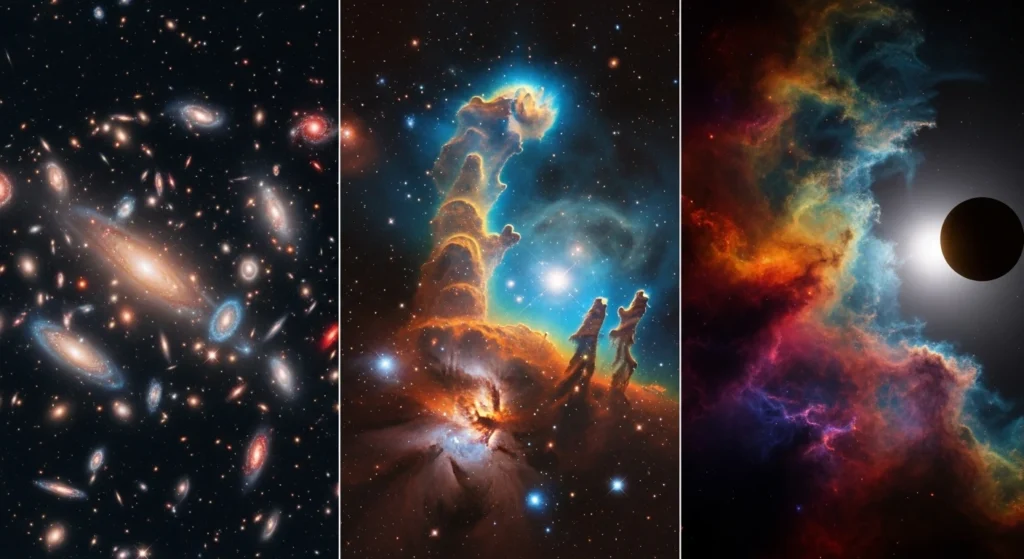
The James Webb Telescope’s Most Shocking Discoveries — How It’s Completely Changing Our View of the Universe
When the James Webb Space Telescope launched, it wasn’t just another space mission.
It was a new kind of eye.
An instrument designed to look deeper into time than any telescope before it—back to the first galaxies, the earliest stars, and worlds beyond our solar system.
And what it has found so far is genuinely breathtaking.
Webb hasn’t just confirmed what we already suspected.
In many cases…
It has completely surprised scientists.
From galaxies that formed too early, to strange planet atmospheres, to hidden chemistry in star nurseries, the James Webb Telescope is rewriting our understanding of the cosmos in real time.
Let’s explore the most shocking discoveries Webb has made—and why each one matters.
1. Webb Found Galaxies That Shouldn’t Exist So Soon After the Big Bang
One of Webb’s biggest surprises came almost immediately:
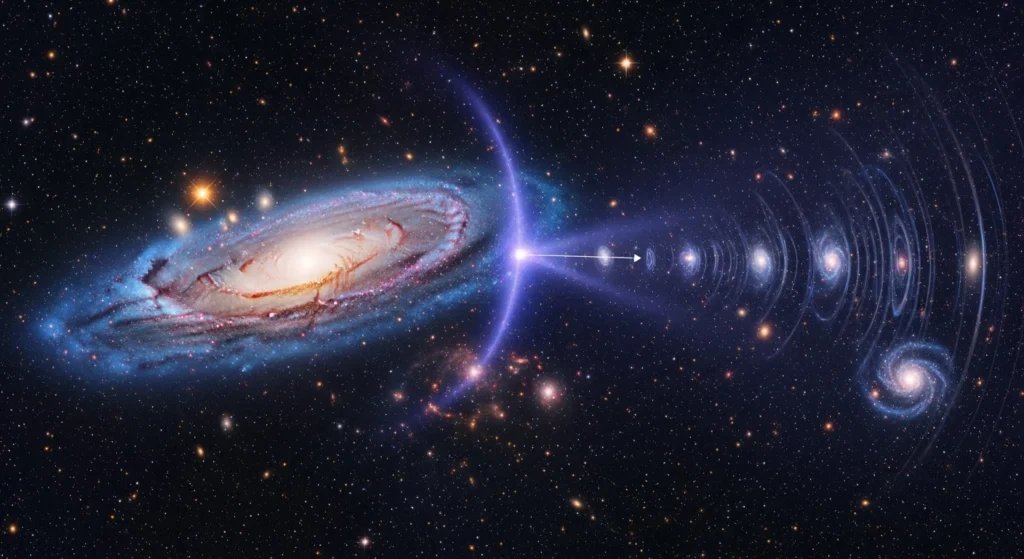
It discovered extremely bright, massive galaxies in the very early universe.
Some galaxies appear just 300 million years after the Big Bang, far earlier than older models predicted.
(JADES-GS-z14-0 is one major example.)
This was shocking because galaxies were expected to take much longer to:
- Form stars
- Build mass
- Develop structure
Yet Webb keeps finding large, mature-looking galaxies in cosmic infancy.
Why this matters
It suggests the early universe evolved faster and more efficiently than we imagined.
2. The Most Distant Galaxy Ever Seen Keeps Pushing Farther Back
Webb has now confirmed some of the most distant galaxies ever detected.
Recent findings like MoM-z14, seen only ~280 million years after the Big Bang, push observational limits further than scientists thought possible.
Real-life comparison
It’s like finding a fully built city in a place where you expected only empty land.
The earliest universe is proving far more complex than expected.
3. Webb Is Revealing How Dark Matter Shapes the Cosmic Web
Dark matter is invisible, but it structures the universe like scaffolding.
Using gravitational lensing, Webb has helped create one of the most detailed maps yet of dark matter distribution across a huge patch of sky.
This map shows where galaxies form inside vast dark matter filaments.
Why this matters
It strengthens our understanding of how the universe’s large-scale structure grew over billions of years.
4. Webb Is Watching Planets Form in Real Time
Webb has given astronomers direct evidence of something long theorized:
Young stars can forge crystalline minerals near their hot centers and then send them outward into colder planet-forming regions.
It observed this process happening around a star called EC 53, linking the origin of comet-building crystals to dynamic stellar bursts.
Why this matters
It helps explain how the ingredients for planets—and even comets—move and mix during solar system formation.
5. Webb Is Uncovering Strange Early Universe Objects Nobody Expected
Webb has detected puzzling new classes of objects:
- “Little red dots”
- Ultra-bright early galaxies
- Black holes that seem too massive too soon
Some scientists are exploring exotic explanations, including hypothetical “dark stars.”
Key takeaway
The early cosmos is full of surprises that may require updated theories.
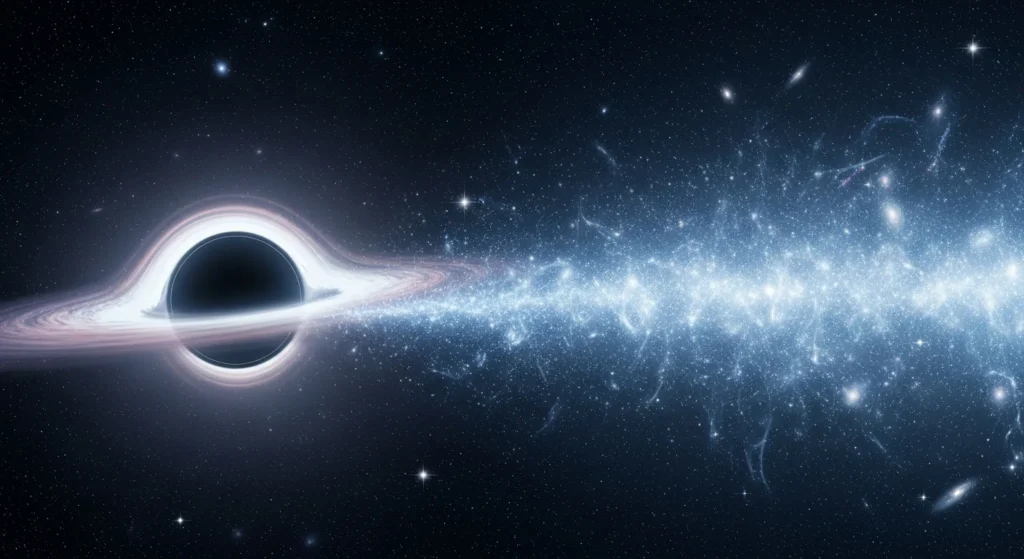
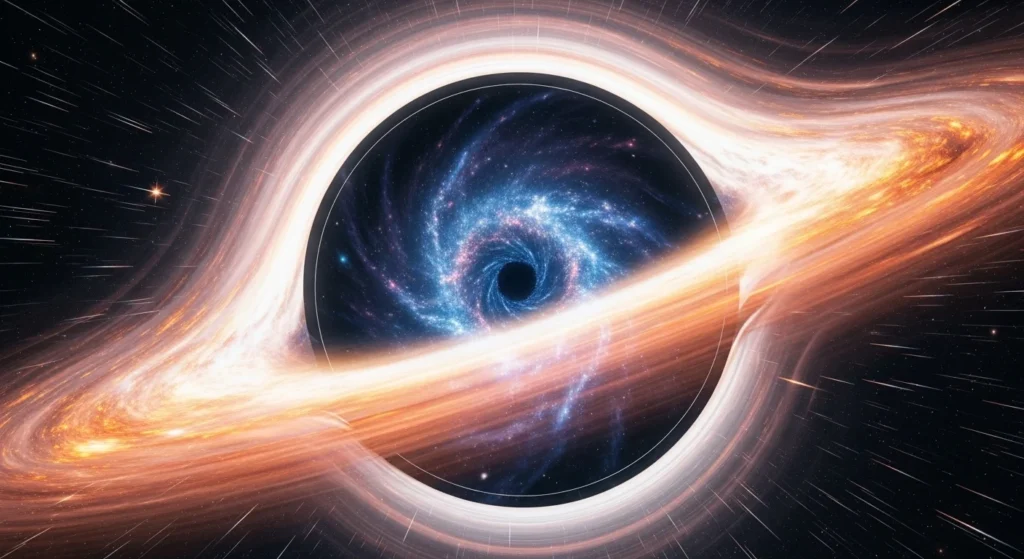
6. Webb Is Revealing Supermassive Black Holes Growing Too Fast
Another major shock:
Webb is finding evidence that supermassive black holes existed surprisingly early, at redshifts where the universe was still very young.
A growing body of research suggests black holes and galaxies formed earlier and faster than expected.
Common misconception
People assume black holes form slowly over cosmic time.
Webb is challenging that assumption.
7. Webb Captured the Largest Wobbling Black Hole Jet Seen in a Nearby Galaxy
Webb has also contributed to discoveries closer to home.
Astronomers found a gigantic, wobbling jet from a supermassive black hole in galaxy VV340a, stretching about 20,000 light-years.
Why it’s shocking
Such jets were expected mainly in older elliptical galaxies—not young merging disk galaxies.
This changes how scientists think black holes shape galaxy evolution.
8. Webb Directly Imaged an Extremely Cold Exoplanet Nearby
Webb has gone beyond galaxies—it’s also directly imaging exoplanets.
ESA reported that Webb captured an image of a cold exoplanet about 12 light-years away, among the coldest directly observed so far.
Why this matters
Direct imaging is incredibly difficult, and it opens the door to studying planetary systems in new detail.
9. Webb Is Transforming Our Understanding of Planet Atmospheres
One of Webb’s most exciting roles is studying exoplanet atmospheres.
Its infrared instruments allow scientists to detect:
- Water vapor
- Carbon dioxide
- Methane
- Atmospheric chemistry
This is foundational for the long-term search for habitable worlds.
Actionable insight
Webb is not “finding aliens,” but it is building the toolkit for detecting life-friendly conditions.
Comparison Table: What Webb Does Better Than Any Telescope Before
| Feature | Hubble Telescope | James Webb Telescope |
|---|---|---|
| Main Strength | Visible/UV light | Infrared vision |
| Best For | Nearby galaxies, nebulae | Early universe, dust-hidden regions |
| Looks Through Dust? | Limited | Extremely well |
| Exoplanet Atmospheres | Some capability | Game-changing sensitivity |
| Cosmic Dawn Galaxies | Hard to detect | Webb specialty |
| Launch Era | 1990 | 2021 |
Webb isn’t replacing Hubble.
It’s opening a deeper cosmic window.
Hidden Tips: How to Understand Webb’s “Shocking” Discoveries
To fully appreciate Webb, remember:
- Webb sees infrared, so it detects the oldest, reddest light
- Looking far away means looking back in time
- Early galaxies are challenging existing formation models
- “Unexplained” does not mean impossible—just incomplete science
Why This Matters Today (Evergreen)
Webb’s discoveries matter because they reshape the biggest questions humans ask:
- How did the first galaxies form?
- How quickly did the universe grow complex?
- How are planets born?
- What makes worlds potentially habitable?
Webb is not just collecting images.
It is transforming astronomy into a deeper, more detailed science of origins.
✅ Key Takeaways
- Webb has discovered massive galaxies far earlier than expected
- It keeps breaking records for the most distant galaxies observed
- It is mapping dark matter with unprecedented clarity
- It is watching planet formation chemistry unfold in real time
- Webb is uncovering mysterious early-universe objects
- It is reshaping theories of black hole growth
- Direct exoplanet imaging and atmosphere studies are accelerating
- Webb’s infrared vision is changing modern astronomy forever
FAQ: James Webb Telescope Discoveries
1. What is Webb’s most important discovery so far?
One of the biggest is the discovery of surprisingly massive early galaxies only a few hundred million years after the Big Bang.
2. Is Webb finding evidence of alien life?
Not directly. Webb studies planetary atmospheres and habitability indicators, but no confirmed biosignatures have been found.
3. Why does Webb see farther than Hubble?
Because Webb observes primarily in infrared, allowing it to detect redshifted ancient light and see through cosmic dust.
4. What makes early galaxies “shocking”?
They appear larger, brighter, and more developed much sooner than predicted, challenging formation models.
5. What’s next for Webb?
Webb will continue exploring cosmic dawn, exoplanet atmospheres, star formation, and the chemistry of planetary origins.
Conclusion: Webb Isn’t Just Observing the Universe — It’s Redefining It
The James Webb Space Telescope was built to answer big questions.
But its greatest achievement so far may be something even bigger:
It’s revealing that the universe is stranger, faster-evolving, and more surprising than our best predictions.
From the first galaxies…
To hidden planet-building chemistry…
To the atmospheres of distant worlds…
Webb is showing us that discovery is not finished.
In many ways, it has only just begun.