Space is cold.
That much seems obvious.
But here’s the twist:
Most of space is about 2.7 Kelvin — warmed slightly by the leftover glow of the Big Bang, called the cosmic microwave background.
So you might assume nothing in the universe could be colder than that.
And yet…
Astronomers have found an object so cold it breaks intuition:
A place in space colder than space itself.
It’s called the Boomerang Nebula, and it is the coldest natural object ever observed in the universe.
So what is this strange cosmic deep-freeze?
How did it get so cold?
And what does it teach us about stars, gas, and extreme physics?
Let’s explore one of the most fascinating temperature mysteries in astronomy.
First: How Cold Is Space, Really?
People often think space is “absolute zero.”
But space is not perfectly cold.
The universe is filled with faint radiation left over from the Big Bang.
This background sets a temperature floor:
2.7 Kelvin (−270.45°C)
That’s incredibly cold…
But not the coldest.
So the real question becomes:
How can something be colder than the background temperature of the universe?
That’s where the Boomerang Nebula comes in.
Meet the Boomerang Nebula: The Universe’s Coldest Known Object
The Boomerang Nebula is a cloud of gas and dust located about:
- 5,000 light-years away
- In the constellation Centaurus
It surrounds a dying star in a very rare transition phase.
What makes it extraordinary is its temperature:
About 1 Kelvin (−272°C)
That is colder than:
- Deep space
- Most interstellar clouds
- Any naturally occurring environment we know
It is essentially the coldest “place” ever found beyond Earth.
Why Is the Boomerang Nebula So Cold?
The Boomerang Nebula is not cold because it is far away from stars.
It is cold because of something much more interesting:
It is cooling itself from the inside out.
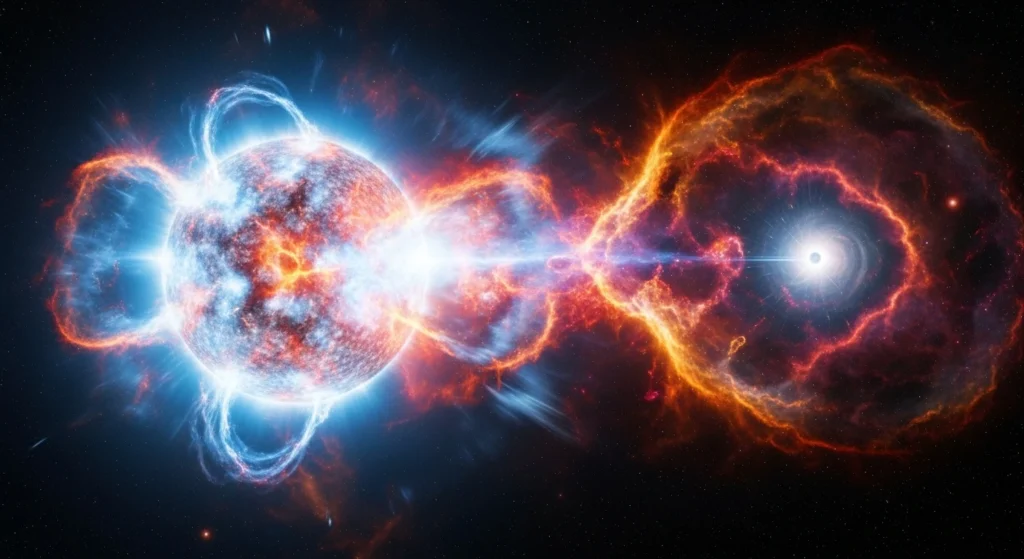
The nebula formed when its central star began rapidly ejecting gas.
That gas expanded outward at enormous speed.
And when gas expands rapidly…
It cools dramatically.
This is a key physical principle.
The Everyday Analogy: Why Spray Cans Feel Cold
You may have experienced this without realizing it.
When you spray deodorant or compressed air, the can becomes cold.
That’s because the gas is expanding quickly and losing energy.
The Boomerang Nebula is doing the same thing…
On a cosmic scale.
The Science Behind It: Expansion Cooling
This process is called adiabatic expansion.
When gas expands without gaining heat from outside sources:
- Its pressure drops
- Its molecules spread out
- Its temperature decreases
In the Boomerang Nebula, gas is being expelled at speeds of:
- Over 100 km/s
That rapid expansion makes the nebula colder than the surrounding universe.
It’s like a natural cosmic refrigerator.
A Star in a Brief, Unstable Phase
The star inside the Boomerang Nebula is not dead yet.
It is in a short-lived transition between:
- A red giant
- A planetary nebula phase
This is a moment when a star sheds its outer layers intensely.
The Boomerang Nebula is sometimes called a pre-planetary nebula.
Meaning:
It’s the star’s atmosphere being thrown into space before the final nebula forms.
This phase is rare and brief, making the Boomerang Nebula even more special.
Why It “Shouldn’t Exist” (At Least Intuitively)
Most objects in space are warmed by:
- Nearby stars
- Background radiation
- Internal energy
So having something colder than the cosmic background seems impossible at first.
But the Boomerang Nebula is a special case because:
- Its gas is expanding incredibly fast
- It is temporarily insulated from external heating
- The cooling is stronger than the background warming
It is not cold because it is empty.
It is cold because it is dynamically changing.
That’s the weird part.
What the Boomerang Nebula Looks Like
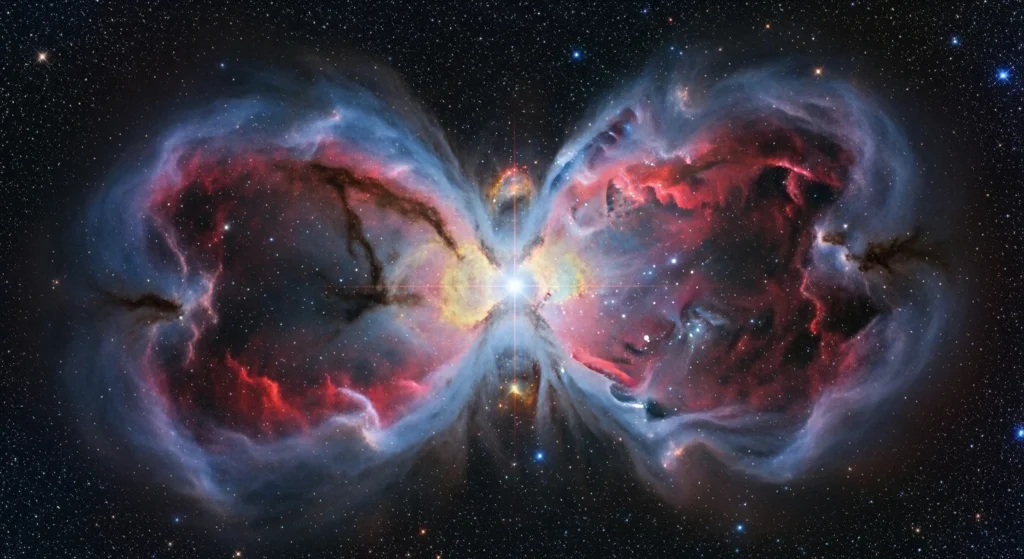
The nebula was imaged by the Hubble Space Telescope.
It has a symmetrical shape with two lobes—like a bow tie or boomerang.
That shape is likely caused by:
- Jets of material
- Interaction with a companion star
- Magnetic field shaping
So it is not just cold…
It is structurally beautiful and complex.
Comparison Table: Coldest Places We Know
| Object/Region | Temperature | Notes |
|---|---|---|
| Cosmic background radiation | 2.7 K | “Average” temperature of space |
| Boomerang Nebula | ~1 K | Coldest natural object known |
| Dark interstellar clouds | 10–20 K | Cold molecular gas regions |
| Pluto surface | ~44 K | Extremely cold dwarf planet |
| Earth’s coldest natural temperature | 184 K | Antarctica record |
The Boomerang Nebula is in a category of its own.
Why This Matters for Science
The Boomerang Nebula isn’t just a temperature record.
It helps astronomers understand:
- How stars lose mass near the end of life
- How planetary nebulae form
- How gas behaves under extreme expansion
- How cooling processes work in space
It also reminds us that space isn’t just static coldness.
It’s dynamic physics unfolding everywhere.
Hidden Tips: What People Commonly Misunderstand
Mistake 1: “Space is absolute zero”
No. Space has a background temperature of 2.7 K.
Mistake 2: “Colder means farther from heat”
Not always. Expansion cooling can create extreme cold even near stars.
Mistake 3: “Nebulae are hot”
Many nebulae glow, but some are extremely cold gas clouds.
Mistake 4: “This is the coldest possible temperature”
Absolute zero (0 K) is colder, but no natural object has reached it.
Could Anything Be Colder Than the Boomerang Nebula?
Possibly, but it would be difficult.
To get colder, you would need:
- Even faster expansion
- Extreme isolation from radiation
- A brief, rare stellar event
So far, the Boomerang Nebula remains the best-known example.
Why This Matters Today (Evergreen)
Studying objects like the Boomerang Nebula matters because:
- It reveals unexpected extremes in nature
- It helps explain the life cycle of stars
- It sharpens our understanding of temperature and physics
- It shows the universe still holds genuine surprises
Even in something as simple as “cold,” the cosmos can challenge everything we assume.
✅ Key Takeaways
- The coldest natural object in space is the Boomerang Nebula
- It is colder than deep space itself, reaching ~1 Kelvin
- Its extreme cold is caused by rapid gas expansion
- The nebula formed from a star shedding its outer layers
- Expansion cooling is the key mechanism
- It helps scientists study late-stage stellar evolution
- The universe contains physical extremes beyond imagination
FAQ: The Coldest Object in Space
1. What is the coldest object ever found in space?
The Boomerang Nebula, at about 1 Kelvin, is the coldest known natural object.
2. How can something be colder than outer space?
Because rapid gas expansion can cool material below the cosmic background temperature.
3. Is the Boomerang Nebula a dead star?
Not exactly. It surrounds a dying star in a rare transitional phase.
4. Could humans visit the coldest object in space?
It’s thousands of light-years away, far beyond practical travel.
5. What does this discovery teach scientists?
It helps explain stellar mass loss, planetary nebula formation, and extreme thermodynamics.
Conclusion: The Universe’s Most Beautiful Deep Freeze
The Boomerang Nebula is one of the strangest discoveries in modern astronomy.
A cloud of gas so cold…
It beats the background temperature of the universe itself.
It exists because physics sometimes creates extremes not through stillness…
But through motion.
Rapid expansion turned a dying star’s outflow into the coldest natural place we’ve ever seen.
It’s a reminder that the cosmos is filled with surprises—
Even in the simplest concept of all:
Temperature.