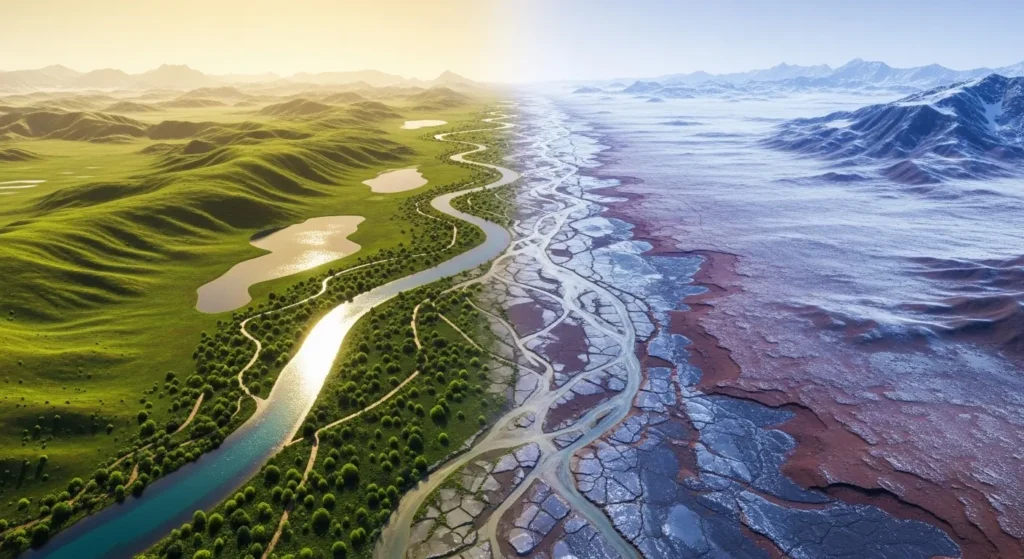
Mars today feels like a planet stuck in silence.
A cold desert.
Thin air.
Dust storms.
Frozen poles.
It looks like a world that never had a chance.
But here’s the surprising truth:
Mars was not always like this.
Long ago, Mars may have been warmer, wetter, and far more Earthlike than we ever imagined.
It likely had:
- Flowing rivers
- Shallow lakes
- Rain and snow cycles
- A thicker atmosphere
- Conditions that could have supported habitability
So the question becomes one of the most fascinating mysteries in planetary science:
Mars was once potentially habitable… so what happened?
How did a planet with water and possibility become the frozen world we see today?
Let’s explore the real science behind Mars’s dramatic transformation.
Mars: The Planet That Used to Look Familiar
When scientists first began studying Mars closely, they found something unexpected:
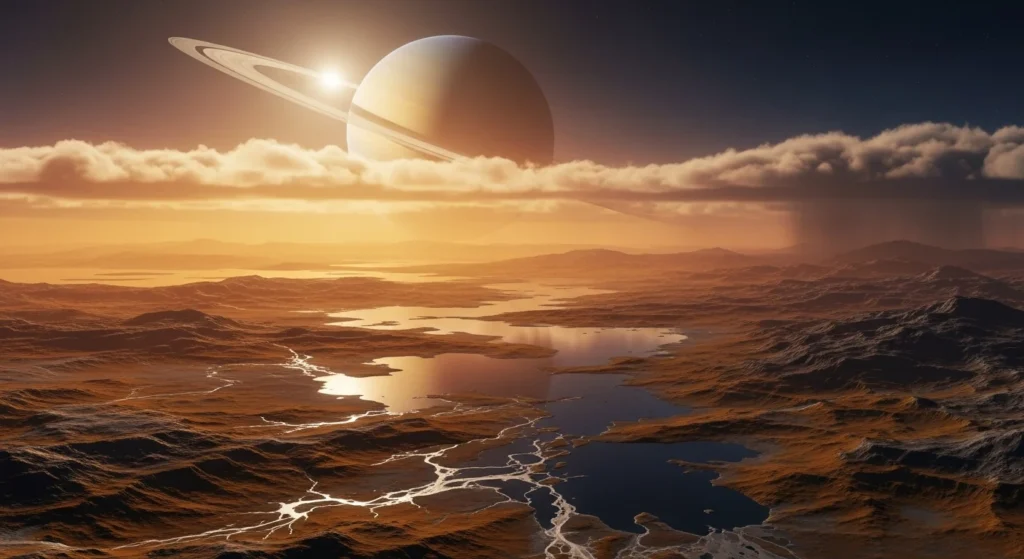
The surface is carved with features that look strikingly like Earth.
NASA orbiters and rovers have revealed:
- Ancient river valleys
- Lake basins
- Delta formations
- Minerals that form only in water
Mars isn’t just a dry rock.
It’s a planet with scars of a wetter past.
Real-life analogy
Imagine discovering dried-up riverbeds in the middle of a desert.
You would instantly know:
“This place used to have water.”
Mars gives us the same clue—on a planetary scale.
Evidence That Mars Once Had Liquid Water
One of the strongest reasons scientists believe Mars was once habitable is simple:
Water shaped its surface.
Key discoveries include:
- Rounded pebbles formed by flowing streams
- Clay minerals created in long-lasting water
- Ancient lake sediments
- Polar ice caps containing water ice
In some regions, Mars once had stable surface water for millions of years.
That matters because on Earth:
Where there is liquid water, there is chemistry, movement, and possibility.
Water is one of the essential ingredients for habitability as we understand it.
Mars Was Warmer Long Ago — Not Always Frozen
Today, Mars is bitterly cold.
Average temperature: around −60°C.
But early Mars likely had a stronger greenhouse effect.
A thicker atmosphere may have trapped heat, allowing:
- Rainfall
- Lakes
- Seasonal rivers
So why did Mars lose that warmth?
The answer involves the planet’s size, magnetic field, and atmosphere.
The Atmosphere Problem: Mars Couldn’t Hold Onto Its Air
Habitability requires more than water.
A planet also needs an atmosphere thick enough to:
- Keep temperatures stable
- Support liquid water
- Protect the surface from radiation
Early Mars likely had a denser atmosphere made mostly of carbon dioxide.
But over time…
Mars lost most of it.
Today, Mars’s atmosphere is less than 1% as thick as Earth’s.
That’s a huge change.
Mistake to avoid
Many people assume Mars is cold because it’s farther from the Sun.
Distance matters, but the atmosphere matters more.
Without a thick atmospheric blanket, warmth escapes into space.
The Missing Shield: Mars Lost Its Magnetic Field
Earth has a powerful magnetic field.
It acts like an invisible shield, protecting our atmosphere from the solar wind.
The solar wind is a stream of charged particles constantly blowing outward from the Sun.
Mars once had a magnetic field too.
But because Mars is smaller than Earth, its core cooled faster.
Once the core stopped churning, the magnetic field weakened.
Without that shield…
The solar wind began stripping away Mars’s atmosphere, particle by particle.
Comparison
Earth is like a planet wrapped in armor.
Mars became a planet exposed to space weather with no protection.
The Great Climate Collapse: Water Couldn’t Stay Liquid
As the atmosphere thinned:
- Pressure dropped
- Temperatures fell
- Liquid water became unstable
Eventually, Mars crossed a tipping point.
Instead of rivers and lakes, water began to:
- Freeze underground
- Become trapped in polar ice
- Evaporate into space
Mars didn’t lose water overnight.
It lost the ability to keep water liquid on the surface.
And that changed everything.
Where Did Mars’s Water Go?
Mars still has water today.
Just not in open oceans.
Most of it exists as:
- Ice at the poles
- Frozen soil deposits
- Possible deep underground reservoirs
Some water was also broken apart by sunlight, and hydrogen escaped into space.
Mars became a world where water survives mainly in hidden forms.
Volcanoes, Carbon Cycles, and a Planet That Stopped Recycling
Earth stays habitable partly because it constantly recycles carbon through:
- Volcanoes
- Plate tectonics
- Rock-weather cycles
Mars is geologically quieter today.
It lacks active plate tectonics like Earth.
That means Mars couldn’t regulate its climate over long timescales the way Earth can.
Once Mars began cooling…
It struggled to recover.
Mars vs Earth: Why Earth Stayed Habitable
Here’s a simple comparison:
| Feature | Earth | Mars |
|---|---|---|
| Size | Larger | Smaller |
| Atmosphere | Thick and stable | Thin and fragile |
| Magnetic Field | Strong | Lost early |
| Water Today | Liquid oceans | Mostly frozen |
| Plate Tectonics | Active | Mostly inactive |
| Climate Stability | Long-lasting | Collapsed early |
Mars wasn’t doomed from the start…
But it had disadvantages Earth didn’t.
Could Mars Have Supported Life-Friendly Conditions?
Mars may have had habitable conditions in its early history.
That doesn’t mean it definitely had life.
But it may have offered:
- Stable surface water
- Energy sources
- Organic chemistry
- Protection under sediments
If life ever emerged, it may have retreated underground as conditions worsened.
That possibility is one of the reasons Mars exploration matters so much.
Hidden Tips: Common Misunderstandings About Mars Habitability
Let’s clear up a few key points:
- ✅ Habitable does not mean inhabited
- ✅ Mars wasn’t a second Earth, but it may have been Earthlike
- ✅ Water evidence is strong, but oceans are still debated
- ✅ Mars didn’t “die” suddenly — it changed slowly over time
Understanding Mars requires patience, not myths.
Why This Matters Today (Evergreen)
Mars is more than a neighbor planet.
It’s a natural lesson in planetary evolution.
Mars helps scientists understand:
- What makes a planet habitable
- How atmospheres survive
- How climate can collapse
- What Earth might avoid in the far future
Mars is like a fossil planet—preserving a story Earth never wrote down.
Studying Mars helps us understand our own world more deeply.
Key Takeaways
- Mars was once warmer, wetter, and potentially habitable
- Ancient rivers, lakes, and water minerals prove a wetter past
- Mars lost its atmosphere over time, largely due to solar wind
- The planet’s magnetic field weakened early, leaving it unprotected
- Water became frozen or escaped, ending surface habitability
- Mars teaches us why Earth remained stable while Mars changed
- The question of ancient life remains one of science’s biggest mysteries
FAQ: Mars’s Lost Habitability
1. Was Mars ever like Earth?
Mars was never identical to Earth, but it once had water, a thicker atmosphere, and more Earthlike surface conditions.
2. Why did Mars lose its atmosphere?
Mars lost its magnetic field, allowing solar wind to strip away atmospheric particles over billions of years.
3. Does Mars still have water?
Yes, mostly as ice in polar caps and underground frozen deposits.
4. Could Mars have supported life?
Mars may have had habitable conditions long ago, especially in watery environments, but no life has been confirmed.
5. Why is Mars still important today?
Mars is a key example of how planetary climates evolve, helping us understand habitability across the universe.
Conclusion: Mars Was a World of Possibility — Until It Changed
Mars is not just a dead red desert.
It is a planet with a past.
A world that once had rivers, lakes, and air thick enough for warmth.
But Mars lost its shield.
Its atmosphere faded.
Its surface froze.
And the planet transformed into the quiet frontier we see today.
Mars reminds us that habitability is fragile.
And that Earth’s story could have been very different.