A Cosmic Surprise Written Into the Sky
Imagine blowing up a balloon with tiny dots drawn all over it.
As the balloon inflates, every dot moves away from every other dot.
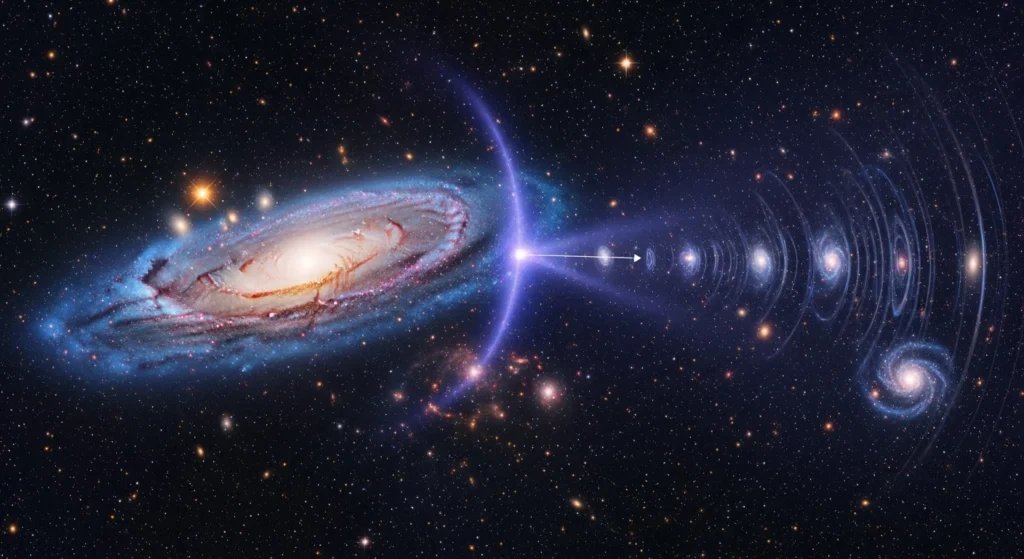
That’s one of the simplest ways to picture what astronomers mean when they say the universe is expanding.
But here’s where it gets truly fascinating:
Scientists now believe the universe may be expanding faster than expected.
Not by a small rounding error…
But by enough to make physicists pause and ask:
Are we missing something important about how the universe works?
This mystery has become one of the most talked-about questions in modern cosmology—and it has a name:
The Hubble tension.
Let’s explore what it means, why it matters, and what scientists are learning from this unexpected cosmic speed-up.
What Does It Mean That the Universe Is Expanding?
The universe isn’t expanding into empty space.
Instead, space itself is stretching.
A helpful analogy is raisins in rising bread dough:
As the dough expands, every raisin moves farther away from every other raisin.
The raisins aren’t running.
The dough is growing.
In the same way:
- Galaxies aren’t flying through space away from us
- Space itself is expanding between galaxies
This discovery goes back nearly 100 years, when astronomer Edwin Hubble found something astonishing:
The farther away a galaxy is, the faster it appears to be moving away.
This relationship is described by a number called the…
The Hubble Constant: The Universe’s Expansion Speedometer
The Hubble constant tells scientists how fast the universe is expanding today.
Think of it like a cosmic speed limit sign:
- A higher value means faster expansion
- A lower value means slower expansion
For decades, astronomers worked to measure this value more precisely.
But now they have reached a strange conclusion:
Different methods give different answers.
And they don’t match.
That’s the heart of the problem.
The Big Puzzle: Why Are Expansion Measurements Not Agreeing?
Scientists measure the universe’s expansion rate in two main ways:
1. Looking Back to the Early Universe
This method uses the cosmic microwave background (CMB)—
A faint afterglow left over from the Big Bang.
It’s like baby photos of the universe when it was only 380,000 years old.
Satellites such as Planck have measured this early universe signal in incredible detail.
From these measurements, scientists calculate what the expansion rate should be today.
Result: a slower expansion speed.
2. Measuring the Universe Today
The second method looks at the nearby universe:
- Supernova explosions
- Cepheid variable stars
- Distances to galaxies
This is more like using modern-day mile markers to measure how fast the universe is expanding right now.
Result: a faster expansion speed.
The Hubble Tension: A Mismatch That Won’t Go Away
Here’s the problem:
- Early universe method predicts one expansion rate
- Modern universe method measures a higher expansion rate
The difference is too large to ignore.
It’s not just a mistake in one study.
It has persisted across many experiments.
That’s why scientists call it a tension:
A real disagreement in the universe’s numbers.
And it may be hinting that something in our cosmic understanding is incomplete.
Common Misunderstanding: “Is the Universe Expanding Faster Everywhere?”
Not exactly.
The expansion is most noticeable on vast cosmic scales.
Small systems don’t expand like that.
For example:
- Atoms don’t expand
- People don’t expand
- The solar system doesn’t expand
- The Milky Way doesn’t expand internally
Gravity and other forces hold these structures together.
Cosmic expansion becomes dominant only across intergalactic distances.
So the universe is not “stretching your body”—
It’s stretching the space between galaxy clusters.
Why This Faster Expansion Is So Surprising
Modern cosmology is built on an extremely successful model called:
Lambda-CDM
It includes:
- The Big Bang
- Dark matter
- Dark energy
- General relativity
- Cosmic structure formation
This model explains an enormous amount of observational data.
So if the expansion rate truly disagrees…
It suggests one of two things:
- We’ve misunderstood part of the universe
- Something new is happening beyond current physics
That’s why this mystery is so exciting.
Possible Explanation #1: Measurement Challenges
Before rewriting physics, scientists ask the most careful question first:
Could the measurements be wrong?
Measuring cosmic distances is extremely hard.
Astronomers build what’s called the cosmic distance ladder:
- Measure nearby stars
- Use them to measure farther galaxies
- Use those galaxies to measure supernovae
- Extend outward across the universe
Each step introduces potential uncertainty.
Even tiny errors can grow into major differences.
So researchers are constantly refining instruments, recalibrating data, and checking assumptions.
But so far…
The mismatch remains.
Possible Explanation #2: Dark Energy Might Be Changing
One of the biggest drivers of cosmic expansion is thought to be dark energy.
Dark energy is the mysterious force causing the universe’s expansion to accelerate.
Most models assume dark energy is constant over time.
But what if it isn’t?
What if dark energy behaves more like:
- A dynamic field
- A changing cosmic pressure
- Something that evolves as the universe ages
That could lead to a faster expansion today than predicted from the early universe.
Scientists sometimes call this idea:
Early dark energy or evolving dark energy.
It’s still under investigation, but it’s one of the leading possibilities.
Possible Explanation #3: New Physics Beyond the Standard Model
Another possibility is even more profound:
We might be missing a fundamental ingredient.
Some researchers explore ideas like:
- Unknown particles in the early universe
- Extra types of radiation
- Modifications to gravity at large scales
- Hidden interactions in dark matter
These aren’t wild guesses—they are carefully tested hypotheses.
The Hubble tension may be a clue that the universe has layers we haven’t discovered yet.
Like finding a puzzle piece that doesn’t fit—and realizing the picture is larger than expected.
Possible Explanation #4: The Universe Might Be More Complicated Than “Smooth”
Many cosmology calculations assume the universe is uniform on large scales.
But real space is messy:
- Galaxies cluster
- Voids exist
- Matter distribution is uneven
Some scientists ask:
Could local cosmic structure affect expansion measurements?
For example:
What if our region of space is slightly less dense than average?
That could make nearby expansion appear faster.
It’s like measuring traffic speed in one neighborhood and assuming it represents the whole city.
This idea is still debated, but it shows how subtle the problem is.
Real-Life Analogy: Why Two Thermometers Might Disagree
Imagine you’re trying to measure the temperature of a giant ocean.
One thermometer is placed deep underwater.
Another floats near the surface.
Both are correct…
But they’re measuring different layers.
In a similar way:
- The early universe method measures deep cosmic history
- The local method measures the universe today
If something changed between those eras, the numbers might differ.
The disagreement could be telling us that the universe has more complexity than our simplest models capture.
How Scientists Are Trying to Solve This Mystery
Astronomers are not guessing blindly.
They are gathering better evidence through:
New telescopes and surveys
- James Webb Space Telescope
- Euclid mission
- Vera Rubin Observatory
Independent expansion measurements
Scientists are exploring methods beyond supernovae, including:
- Gravitational lensing
- Cosmic sound waves (BAO)
- Gravitational wave “standard sirens”
These tools may help confirm which measurement is closer to reality—or reveal something entirely new.
Why This Matters Today (Evergreen Perspective)
This question isn’t just about numbers.
It’s about understanding:
- The true history of the cosmos
- The forces shaping space and time
- Whether our physics is complete
- What the universe will do in the far future
The universe expanding faster than expected may seem abstract…
But it touches the biggest scientific goal of all:
Knowing what reality is made of.
Sometimes the most important discoveries begin with a simple mismatch.
A number that refuses to agree.
A mystery written into the sky.
The Takeaway: A Universe Still Full of Surprises
So why is the universe expanding faster than expected?
The honest scientific answer is:
But we do know this:
- The expansion of the universe is real
- Two powerful measurement methods disagree
- The mismatch is consistent and significant
- It may point to new physics, evolving dark energy, or hidden cosmic complexity
The Hubble tension is not a failure.
It’s what science looks like at the frontier:
A universe that still has secrets.
And scientists listening carefully.
Curious Thought to Leave You With
If the universe is expanding faster than expected…
It may mean that our best cosmic story is missing a chapter.
And the next discovery could reshape how we understand space, time, and everything in between.