The Question That Sits at the Edge of Human Knowledge
Black holes are already strange beyond everyday intuition.
They trap light.
They curve space so intensely that even the laws of physics seem stretched.
But one question stands above all others in mystery:
What happens at the very center of a black hole?
Is it an infinite point?
A crushed core of matter?
A gateway to something unknown?
Or simply a sign that our physics stops working?
The truth is both fascinating and humbling:
The center of a black hole is where our current understanding of reality reaches its limit.
Let’s explore what science can say—clearly, carefully, and accurately.
First: What Is “Inside” a Black Hole?
A black hole has a boundary called the:
Event Horizon
This is the point of no return.
Once anything crosses the event horizon:
- It cannot escape outward
- Not even light can return
- Information becomes hidden from outside observers
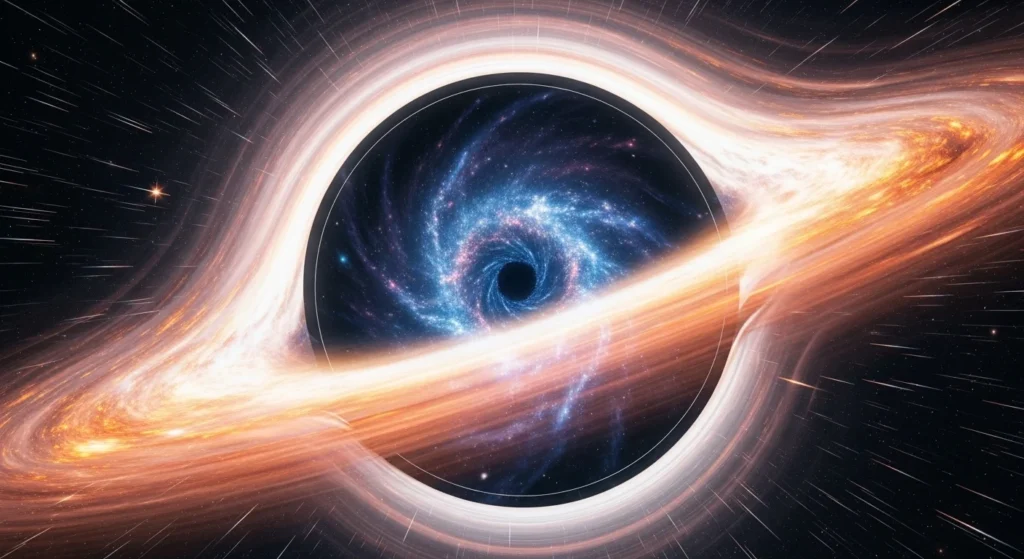
From the outside, we can study a black hole by watching how it affects:
- Nearby stars
- Gas and dust
- Light bending around it
But beyond the event horizon, direct observation becomes impossible.
So everything we say about the center comes from:
- Mathematics
- General relativity
- Physics models pushed to their extremes
That’s important to remember.
The Classic Answer: The Singularity
According to Einstein’s general relativity, the center of a black hole contains something called a:
Singularity
A singularity is not a normal object.
It is a point where:
- Density becomes infinite
- Gravity becomes infinite
- Spacetime curvature becomes infinite
In simple terms:
It’s where the equations of gravity predict a breakdown.
Matter collapsing inward has no known stopping point, so it compresses toward an infinitely small region.
That is the theoretical “center.”
A Key Clarification: Infinity Usually Means Physics Is Incomplete
Whenever physics produces infinities, scientists become cautious.
Infinity often signals:
✅ The model is being pushed beyond its valid range
✅ A deeper theory is missing
✅ Our equations are incomplete
So the singularity may not be a real “thing.”
It may be a placeholder for unknown physics.
The center of a black hole is where relativity and quantum mechanics collide.
And they don’t fully agree yet.
What Would It Feel Like to Approach the Center?
Let’s build the picture step by step.
Outside the event horizon:
Gravity behaves like any other strong gravitational field.
Crossing the event horizon:
Nothing special happens locally in that instant (for a large black hole).
But inside, the geometry of spacetime becomes extreme.
The direction “toward the center” becomes unavoidable.
It’s not just moving through space.
It’s like moving toward the future of your path.
Inside a black hole, according to relativity:
The center is not a place you can avoid any more than you can avoid tomorrow.
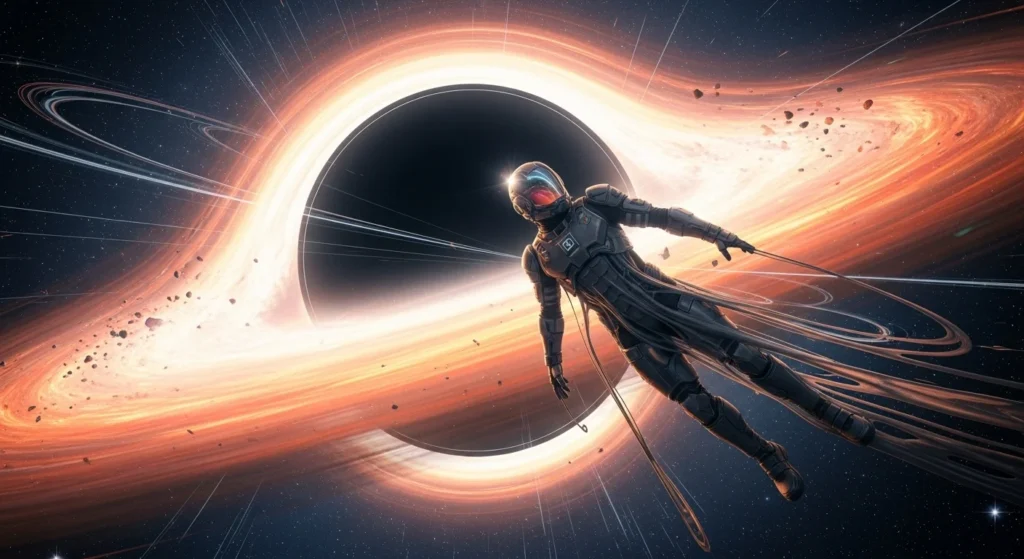
The Crushing Effect: Spaghettification
As objects fall inward, they experience tidal forces.
Gravity is much stronger closer to the black hole than farther away.
This difference stretches objects.
Scientists call this:
Spaghettification
An object would be stretched long and thin, like spaghetti, due to the uneven pull of gravity.
Near the center, these tidal forces become overwhelming.
Do Black Holes Have a “Center” Like a Planet Does?
Not exactly.
A planet has:
- A solid surface
- Layers
- A physical core
A black hole is different.
The “center” is not a normal region of matter.
It’s a place where spacetime itself is collapsing inward.
So the center of a black hole is not like the center of Earth.
It’s more like a boundary of physics itself.
What Does Science Actually Know?
Here is what scientists can confidently say:
✅ General relativity predicts a singularity
The math leads to an unavoidable collapse point.
✅ Our current physics cannot fully describe what happens there
Quantum effects should matter enormously, but we lack a complete theory of quantum gravity.
✅ The center represents an extreme frontier
It is one of the few places where both gravity and quantum mechanics must be unified.
Beyond that, answers become uncertain.
Common Misunderstanding: “Is the Center a Hole to Somewhere Else?”
Wormholes are a popular idea in science fiction.
Some solutions to Einstein’s equations allow wormhole-like structures.
But there is no evidence that real black holes contain stable portals.
Most scientists consider wormholes speculative.
So the safest, most accurate view is:
The center is not known to be a doorway—it is a region of unknown physics.
Could the Singularity Be Avoided?
Many physicists suspect that singularities may not actually form.
Instead, quantum physics might create a new outcome, such as:
- A tiny but finite core
- A “quantum bounce”
- A region where matter cannot compress further
- A new state of spacetime
Ideas like these are being explored, but none are confirmed.
This is active frontier research, not settled fact.
The Black Hole Information Puzzle
One reason the center matters is that it raises a deep question:
What happens to information that falls in?
Physics normally assumes information is never truly destroyed.
But black holes seem to hide it completely.
This leads to the famous:
Black Hole Information Paradox
Understanding what happens at the center may be crucial to resolving it.
Everyday Analogy: A Map That Ends at the Ocean
Imagine ancient explorers reaching the edge of a known map.
The paper ends.
Beyond it is blank.
That doesn’t mean reality ends there.
It means knowledge does.
The center of a black hole is like that edge:
- Our equations take us far
- But eventually, the map runs out
The singularity is where the blank space begins.
Why This Matters Today (Evergreen Perspective)
Black holes are not just cosmic curiosities.
They represent the deepest questions in physics:
- What is spacetime made of?
- Can gravity be quantized?
- Do infinities exist in nature?
- Is reality continuous or discrete?
The center of a black hole is one of the few places where answering these questions becomes unavoidable.
Studying black holes helps scientists move toward a more complete understanding of the universe.
The Takeaway: The Center Is Where Physics Reaches Its Limit
So what happens at the center of a black hole?
The most accurate answer is:
- General relativity predicts a singularity
- A region of infinite density and curvature
- But infinities likely signal missing physics
- Quantum gravity may change the story
- The center remains one of the greatest mysteries in science
The center of a black hole is not just a point in space.
It is a frontier of understanding.
A place where the universe challenges our deepest theories.
Final Thought
Black holes remind us that the universe is not fully solved.
At their center lies a question mark written into spacetime itself.
And one day, answering it may redefine what reality means.