Imagine Looking at a Voice
Close your eyes for a moment and listen.
Maybe you hear:
- A fan humming
- Birds outside
- Distant traffic
- Someone speaking nearby
Now imagine opening your eyes…
…and seeing all of it.
Not the objects making the noise.
But the noise itself.
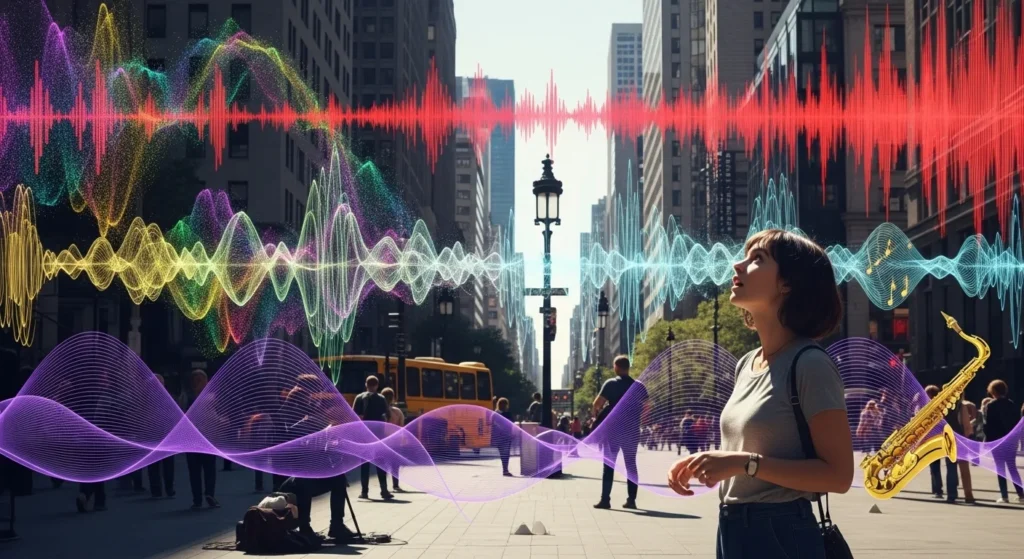
Voices would ripple through the air like colored smoke. Music might float in geometric patterns. Silence would look like emptiness.
It sounds impossible—but this question reveals something fascinating:
Sound already has shape.
We just don’t see it.
Exploring what it would mean to visually perceive sound helps us understand the physics of waves, the limits of our senses, and how our brains construct reality.
So what if humans could see sound?
Let’s step into that invisible world.
What Sound Really Is (And Why It’s Already Physical)
Sound is not a mysterious force.
Sound is simply vibration traveling through a material—usually air.
When something moves back and forth, it pushes nearby air molecules, creating a wave of compression and release.
That wave travels outward, like ripples spreading across a pond.
- Air
- Water
- Metal
- Wood
That’s why sound cannot travel through empty space.
A helpful analogy:
Sound is like a stadium wave, but made of molecules instead of people.
The molecules don’t travel far.
The pattern does.
So sound already exists as a moving structure in the air.
We just experience it with ears instead of eyes.
Why We Can’t Normally See Sound
Humans see light because our eyes detect electromagnetic waves within a specific range.
Sound, however, is a mechanical wave, moving much more slowly and at much larger scales.
Here’s the key difference:
- Light waves are extremely tiny and fast
- Sound waves are much bigger and slower
Your eyes are simply not built to detect air pressure changes.
If humans could see sound, we would need:
- New sensory receptors
- Brain regions to interpret vibrations visually
- A completely different relationship between sight and hearing
It would be like adding an entirely new layer to reality.
What Would Sound Look Like?
Sound waves have measurable properties:
- Frequency (pitch)
- Amplitude (loudness)
- Direction (where it comes from)
- Texture (tone and complexity)
If we could see sound, our brains might translate these features into visual patterns such as:
- Brightness for loudness
- Color for pitch
- Shape for tone
- Motion for rhythm
A whisper might appear as faint mist.
A shout might burst like a sharp flash.
Music could look like architecture in motion—living geometry in the air.
Everyday Life Would Become Visually Crowded
The modern world is full of sound.
If sound became visible, daily life might feel overwhelming at first.
Imagine walking through a city and seeing:
- Car engines pulsing
- Conversations weaving everywhere
- Phones buzzing like sparks
- Construction roaring like moving storms
Even inside your home:
- Refrigerators hum
- Pipes vibrate
- Footsteps echo
We think of the world as visually calm…
But acoustically, it’s always alive.
Seeing sound would reveal that we live inside an ocean of vibration.
Conversations Would Be Impossible to Ignore
Right now, voices are heard—but easily tuned out.
If voices were visible, speech would become visually present.
You could literally “watch” words leave someone’s mouth.
That could change communication profoundly:
- Lies might feel harder to hide
- Tone might become visually obvious
- Crowds would look like tangled streams of sound
Language would become partly visual, not just auditory.
Even silence between words would have shape.
Music Would Become a Visible Experience
Music is already emotional, but imagine seeing it too.
Different instruments might create different visual signatures:
- Drums: expanding bursts
- Violins: smooth ribbons
- Flutes: thin spirals
- Bass: heavy rolling waves
Concerts would become fully immersive environments of lightless motion.
This isn’t entirely imaginary.
We already visualize music through:
- Speaker vibrations
- Soundwave displays
- Cymatic patterns (shapes made by sound on surfaces)
Nature is full of hidden sound-geometry.
We just don’t normally witness it directly.
Comparison Table: Hearing Sound vs. Seeing Sound
| Feature | Hearing Sound (Humans Today) | Seeing Sound (Hypothetical) |
|---|---|---|
| Main sense organ | Ears | Eyes or new vibration-sight system |
| Information type | Pressure changes over time | Visible wave structures in space |
| Strength | Detects subtle pitch and tone | Instant awareness of direction and pattern |
| Limitations | Hard to locate in noise | Could become visually overwhelming |
| Music experience | Emotional through hearing | Emotional through hearing + sight combined |
| Silence | Absence of sound | Possibly visible emptiness |
How Would This Change Safety and Awareness?
Seeing sound could make humans extraordinarily aware of surroundings.
You might notice:
- A distant approaching vehicle before it’s visible
- Structural creaks before something shifts
- Footsteps behind a wall
- Storms far away through low-frequency rumbles
Sound carries information beyond sight.
That’s why many animals rely heavily on hearing.
If humans could see sound, we’d gain an entirely new kind of spatial awareness—like an added sense of vibration-mapping.
Nature Would Look Completely Different
The natural world is full of acoustic activity.
If sound were visible:
- Forests would shimmer with birdcalls
- Oceans would glow with whale communication
- Insects would trace delicate buzzing patterns
- Wind would appear as moving sound-texture
Nature would feel less silent and more alive.
Even places that seem still would reveal constant hidden motion.
It would remind us that sound is one of Earth’s main communication networks.
Common Misconception: Sound Is Invisible Because It’s Not Real
Many people unconsciously treat sound as less “real” than objects.
But sound is physical.
It can:
- Move glass
- Break structures at resonance
- Shake walls
- Carry energy through matter
Sound isn’t invisible because it’s imaginary.
It’s invisible because our eyes are tuned to light, not vibration.
Sound is a physical wave, just outside our visual bandwidth.
Reality is filled with things we don’t sense directly.
Why This Matters Today (Evergreen Perspective)
Even without seeing sound, we live in a world shaped by waves.
Understanding sound helps explain:
- Why certain spaces feel calming or loud
- How animals communicate across distances
- Why architecture changes acoustics
- How our brains interpret invisible forces
In a world full of information, our senses act like filters.
Imagining visible sound reminds us:
We don’t perceive everything that exists—only what evolution prepared us to notice.
That idea is both humbling and fascinating.
Key Takeaways
- Sound is vibration traveling through matter, not an abstract force
- Humans can’t see sound because our eyes detect light waves, not air pressure waves
- If sound were visible, everyday life would become visually dynamic and crowded
- Speech and music would have shape, direction, and visual presence
- Nature would appear alive with acoustic patterns we currently only hear
- Imagining visible sound reveals how limited—and specialized—our senses truly are
FAQ: Common Curiosity Questions
1. Is sound actually a wave you could theoretically see?
Sound is a real mechanical wave, but its scale and frequency don’t match human vision. We can visualize it with tools, but not naturally with eyes.
2. What would loud sounds look like if humans could see them?
They might appear brighter, thicker, or more intense—like dense shockwaves moving through space.
3. Do any animals “see” sound?
No animals literally see sound, but some (like bats and dolphins) use echolocation, turning sound into spatial awareness in the brain.
4. Why can we see light but not sound?
Light is electromagnetic radiation that eyes evolved to detect. Sound is molecule vibration, which requires different sensory equipment.
5. Would seeing sound make life easier or harder?
Both. It could improve awareness and communication, but it might also overload our senses in noisy environments.
Conclusion: The World Is Already Full of Invisible Waves
Sound may be unseen, but it is not absent.
Every moment, your environment is alive with vibrations:
- Voices
- Motion
- Weather
- Life
If humans could see sound, reality wouldn’t gain something new…
It would reveal something that was always there.
A hidden architecture of waves moving through the air, shaping experience without ever asking to be noticed.
Sound is already a physical world around you.
You just hear it instead of seeing it.
And sometimes, that invisibility is exactly what makes it so extraordinary.