Imagine a Mind With No Inner Words
Most people experience thought as a kind of inner conversation.
A silent voice that narrates:
- Plans
- Worries
- Ideas
- Questions
Now imagine that voice disappearing.
No internal sentences.
No mental “talking.”
Only images.
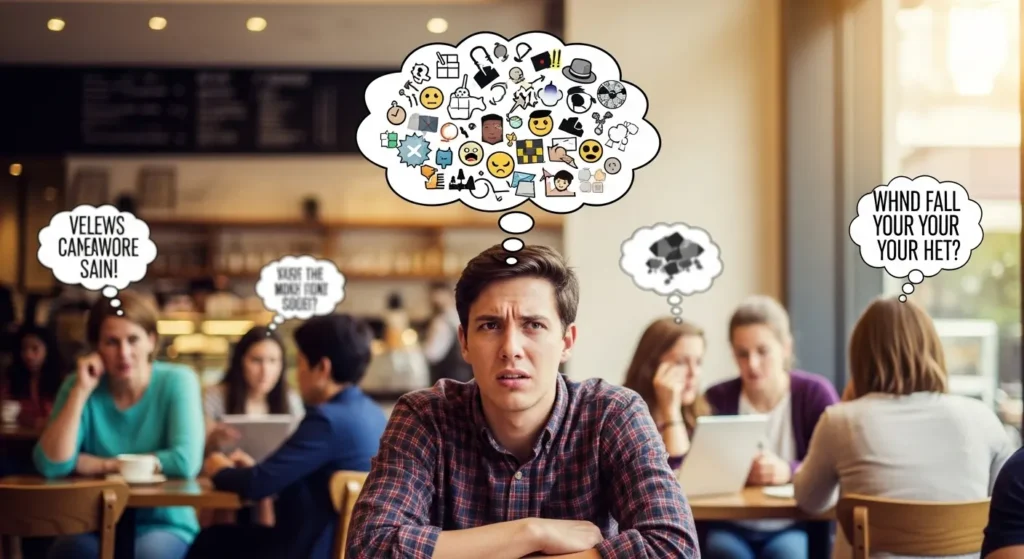
Your thoughts arrive like vivid snapshots, moving scenes, symbolic pictures—more like a dream than a dialogue.
This isn’t just a strange fantasy.
It’s a powerful way to explore something real:
Human thinking is not one single mode.
The brain uses multiple systems—language, vision, emotion, memory—to build consciousness.
So what if one system dominated completely?
What if humans thought only in images?
Let’s step inside that picture-based world.
How Humans Think Today: Words, Images, and Everything Between
A common misconception is that everyone thinks in words.
In reality, human thought is a mix of:
- Inner speech (silent language)
- Mental imagery (pictures and scenes)
- Emotional intuition
- Abstract pattern recognition
For example:
- Planning a trip often uses words
- Remembering a childhood moment uses images
- Recognizing a face happens instantly, without language
The brain is more like a multi-tool than a single voice.
Language is powerful, but it’s not the whole mind.
In our thought experiment, we’re asking:
What if the “visual tool” became the only tool?
What Does “Thinking Only in Images” Really Mean?
Thinking in images would mean:
- No internal sentences
- No silent narration
- No word-based reasoning
- All concepts represented visually
Instead of thinking:
“I need to buy groceries tomorrow,”
You might see:
- A refrigerator
- A shopping basket
- A bright scene of the store
Thought would become like a constant movie made of symbols and scenes.
This would not make humans less intelligent.
It would make intelligence work differently.
Why the Brain Can Think Visually at All
The brain evolved vision long before language.
In evolutionary terms:
- Seeing came first
- Speaking came much later
Vision is one of the brain’s fastest and most detailed systems.
A single glance can process:
- Distance
- Shape
- Motion
- Emotion in faces
Images carry enormous information instantly.
That’s why phrases like “a picture is worth a thousand words” feel true.
In an image-only mind, thought would rely on this speed and richness all the time.
Everyday Life Would Feel More Like Simulation Than Conversation
If humans thought only visually, daily life might feel like living inside a constant imagination overlay.
Consider making a simple decision:
Should I take an umbrella?
Instead of verbal reasoning, your brain might produce:
- A dark cloud scene
- Rain hitting your jacket
- You staying dry under an umbrella
Planning becomes mental cinema.
This could make some tasks faster:
- Spatial reasoning
- Visual creativity
- Memory for places
But it could make other tasks harder:
- Abstract debate
- Complex step-by-step logic
- Explaining invisible concepts
Language Would Become External, Not Internal
Humans might still speak.
But speech would feel less like “thinking out loud” and more like translating pictures into sound.
Words would become labels for images, not the structure of thought itself.
That could change communication dramatically.
People might:
- Speak more slowly
- Use more gestures
- Rely heavily on drawing
- Communicate through shared visual metaphors
Conversation might resemble describing a dream:
“I see a path… then a door… then a wide open field…”
Language becomes interpretation, not origin.
Abstract Ideas Would Need Visual Symbols
How do you think about something you cannot picture?
Examples:
- Justice
- Freedom
- Infinity
- Numbers
- Time
In a visual-only mind, abstract ideas would need symbolic representation.
For instance:
- Time might appear as a flowing river
- Justice as balanced scales
- Numbers as grouped objects or patterns
This is actually how early humans began thinking:
Through metaphor and imagery.
An image-only humanity might become extraordinarily symbolic—living in a world of mental icons.
Comparison Table: Word-Based Thought vs. Image-Based Thought
| Feature | Thought With Inner Words | Thought Only in Images |
|---|---|---|
| Main style | Silent narration and concepts | Scenes, symbols, snapshots |
| Strengths | Abstract reasoning, language planning | Visual creativity, spatial understanding |
| Weaknesses | Slower for instant pattern recognition | Harder for precise verbal logic |
| Communication | Easy to translate thought into speech | Speech requires decoding images |
| Memory style | Stories and sequences | Vivid moments and visual maps |
| Learning focus | Text and explanation | Demonstration and visualization |
Education Would Become Far More Visual
In a picture-thinking world, learning would shift.
Instead of textbooks full of words, education might rely on:
- Diagrams
- Animations
- Demonstrations
- Visual storytelling
Math might be taught through shapes.
History through immersive reenactment.
Science through simulations rather than definitions.
Schools could feel like studios, not lecture halls.
This highlights something already true:
Humans learn best when ideas become visible and concrete.
Art and Creativity Would Expand Dramatically
If thought itself was visual, artistic expression could become as natural as speaking.
People might “think in paintings.”
Creativity would likely surge in:
- Architecture
- Design
- Visual storytelling
- Engineering imagination
Music might also be imagined visually, as patterns and colors.
In a sense, everyone’s mind would function like a creative workspace.
The boundary between imagination and reality might feel thinner.
Common Misunderstanding: Visual Thinking Means No Logic
It’s easy to assume that without words, reasoning disappears.
But that’s not accurate.
Animals reason without language.
Engineers often solve problems visually.
Chess masters think in patterns, not sentences.
Logic can exist without words—it just uses different mental tools:
- Spatial modeling
- Cause-and-effect imagery
- Pattern prediction
Words make logic easier to share.
But the brain can still reason through pictures.
Relationships and Emotions Might Feel More Immediate
Images are emotional.
A single picture can trigger:
- Nostalgia
- Fear
- Warmth
- Motivation
In an image-only mind, emotions might blend more directly into thought.
Instead of thinking:
“I’m nervous about tomorrow,”
You might see:
- A looming event scene
- A crowd
- A symbolic shadow
This could make emotions feel more vivid, but also harder to separate from imagination.
Thought would feel less like analysis…
…and more like experience.
Why This Matters Today (Evergreen Perspective)
This thought experiment reflects a real truth:
Human cognition is diverse.
Some people naturally think more visually.
Others rely more on inner speech.
Modern life is increasingly visual:
- Screens
- Icons
- Videos
- Memes
- Infographics
Understanding visual thinking helps us appreciate that intelligence is not one format.
The brain is not a text document.
It’s a living, multisensory system.
Imagining thought without words reminds us:
Language is powerful—but it’s only one way to be conscious.
Key Takeaways
- Human thought today is a mix of words, images, emotion, and patterns
- Thinking only in images would remove inner speech and replace it with scenes and symbols
- Communication would involve translating pictures into language
- Abstract ideas would require strong metaphors and visual representations
- Learning and creativity would become far more visual and experiential
- Logic can still exist without words, through pattern-based reasoning
FAQ: Common Curiosity Questions
1. Do some people already think mostly in images?
Yes. Many people experience strong mental imagery, while others rely more on inner speech. Human cognition varies widely.
2. Would humans lose language if they thought only visually?
Spoken language could still exist, but it would feel more like translating mental pictures into words rather than thinking directly in sentences.
3. Would image-only thinking make people more creative?
It could increase visual creativity and imagination, but it might also make abstract verbal reasoning more difficult.
4. How would abstract concepts work without words?
The brain would rely heavily on symbols, metaphors, and visual analogies to represent invisible ideas like time or justice.
5. Is thinking in images less intelligent than thinking in words?
Not at all. It’s simply a different cognitive style. Intelligence can take many forms beyond language.
Conclusion: The Mind Is Bigger Than Words
If humans thought only in images, reality would feel like a continuous inner movie—rich, symbolic, immediate.
Language would still exist…
…but it would no longer be the structure of thought.
This imagined world reveals something deeply real:
Your consciousness is not just words.
It is vision, memory, emotion, pattern, and imagination working together.
Words are one lens.
Images are another.
And the human brain is extraordinary because it can think in both—sometimes at the same time.