The Force You Never Notice Until It’s Gone
Right now, gravity is quietly holding your entire life in place.
Your feet stay on the ground.
Oceans stay in their basins.
Air stays wrapped around Earth.
Gravity is so constant that it feels invisible.
But imagine something impossible and strange:
At sea level, gravity suddenly vanishes.
Not everywhere in space.
Not on mountaintops.
Just at the surface where most life exists.
What would happen?
This question isn’t just dramatic—it’s deeply educational.
Because gravity isn’t only about falling.
It’s the organizing force behind:
- Planets
- Atmospheres
- Oceans
- Biological life
- The shape of Earth itself
So let’s explore, calmly and scientifically, what gravity actually does…
…and what reality would look like without it.
What Gravity Really Is (In Simple Terms)
Gravity is the attraction between mass.
Anything with mass pulls on anything else.
Earth pulls on you.
You pull on Earth (very slightly).
The Moon pulls on oceans.
Gravity is like a universal tether.
A helpful analogy:
Gravity is the planet’s invisible handshake—everything is gently held in place.
At sea level, gravity gives us:
- Weight
- Falling motion
- Atmospheric pressure
- Ocean stability
Without it, the surface of Earth becomes a very different environment.
What Does “Gravity Vanishing at Sea Level” Mean?
This scenario is hypothetical, because gravity doesn’t work in layers like a switch.
But as a thought experiment, imagine:
- Above sea level: gravity still exists
- At sea level: gravity drops to zero
- Objects at that boundary lose their downward pull
The result?
The surface becomes a place where nothing is anchored.
It would be like living on the edge of space.
That single change would trigger a chain reaction through everything Earth depends on.
The First Thing to Happen: Everything Would Start to Float
Gravity provides the downward force that keeps objects resting.
Without gravity at sea level:
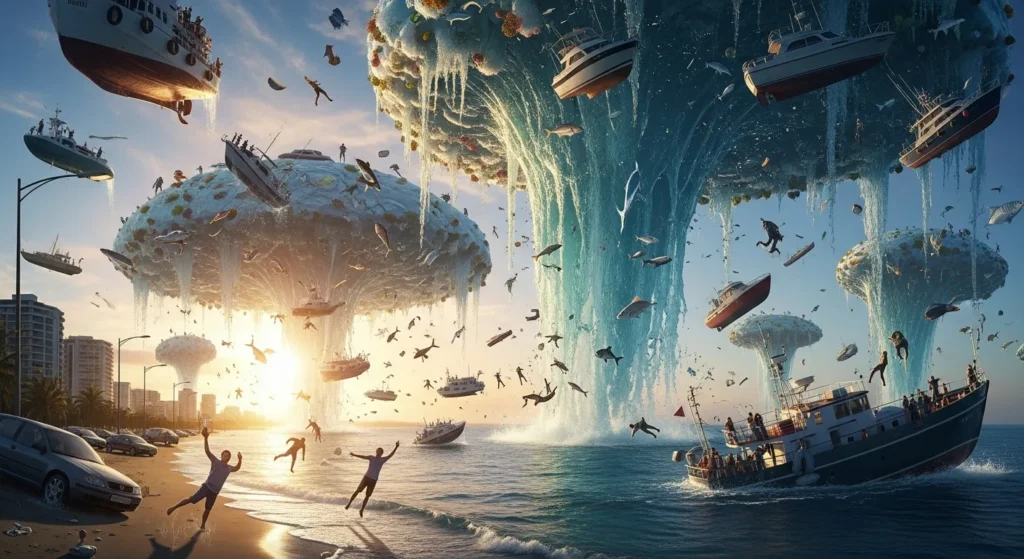
- People would drift upward
- Water droplets would lift
- Loose objects would no longer stay down
Even walking would be impossible, because walking requires friction and weight.
You could push off the ground…
…but you wouldn’t come back down.
Sea level would become a “launch zone” into weightlessness.
The world would feel like an astronaut training pool—except with no return.
Oceans Would No Longer Stay in Place
The ocean exists where it is because gravity pulls water into Earth’s lowest regions.
Without gravity at sea level:
- Water would not settle into basins
- Waves would lose their meaning
- The ocean surface would destabilize
Water might begin lifting into the air in vast floating sheets and blobs.
It wouldn’t “fall back” because falling requires gravity.
A common misunderstanding is that oceans stay put because of walls or shorelines.
They don’t.
Oceans stay because gravity constantly pulls water downward.
Remove that pull, and Earth’s largest feature loses its anchor.
The Atmosphere Would Begin to Unravel
Air stays on Earth for the same reason water does:
Gravity holds gas molecules close.
Without gravity at sea level:
- Air pressure would drop drastically
- Molecules would drift upward
- The atmosphere would thin near the surface
Earth’s breathable layer is like a blanket.
Gravity is the stitching that keeps it wrapped around the planet.
Without that stitching, the air begins to leak away—not instantly into space, but chaotically upward.
Sea level could feel strangely empty, like a high-altitude environment with no weight.
Comparison Table: Earth With Gravity vs. Sea-Level Gravity Loss
| System | Normal Gravity at Sea Level | Gravity Vanishes at Sea Level |
|---|---|---|
| Human movement | Walking and standing possible | Floating, no stable footing |
| Oceans | Water settles into basins | Water lifts, becomes unstable |
| Atmosphere | Air pressure supports life | Air thins and drifts upward |
| Weather | Rain falls, clouds circulate | Precipitation cannot fall normally |
| Buildings | Structures rest on foundations | Foundations lose anchoring force |
| Planet stability | Surface remains organized | Surface becomes chaotic boundary |
Rain Would Stop Falling in the Normal Way
Rain works because gravity pulls droplets down through air.
Without gravity:
- Clouds could still form higher up
- Water droplets would not fall naturally
- Precipitation would become suspended mist
Water might collect into floating spheres instead of rainfall.
Rivers wouldn’t flow downhill.
Water cycles would break, because gravity is the engine of drainage.
Earth’s surface would lose one of its most basic rhythms:
Up, down, fall, flow.
Buildings and Cities Would Become Structurally Meaningless
Structures rely on weight and compression.
Buildings stand because:
- Gravity holds them in contact with the ground
- Foundations press downward
- Materials balance forces
If gravity vanished at sea level:
- Loose structures might lift or separate
- Bridges lose tension
- Foundations no longer “hold” things down
Architecture assumes gravity the way fish assume water.
Remove it, and the entire design logic collapses.
Even sitting in a chair requires gravity.
Without it, furniture stops being furniture.
Life Itself Is Built Around Gravity
Biology evolved under constant downward force.
Gravity shapes:
- Muscle strength
- Bone structure
- Circulation of fluids in organisms
- Plant root growth
- Animal balance systems
A world without surface gravity would not just feel different.
It would require an entirely different kind of life.
On Earth, gravity provides orientation:
- Up vs. down
- Ground vs. sky
- Stability vs. drifting
Without gravity, sea-level ecosystems could not function normally.
Even simple things like:
- Standing
- Drinking
- Growing upward
Depend on gravity’s steady presence.
Earth’s Shape Would Eventually Change Too
Gravity is what pulls Earth into a sphere.
Planets are round because gravity pulls mass inward equally from all directions.
If gravity vanished only at the surface, Earth’s deeper gravity would still exist…
But the boundary layer would become unstable.
Over time, you could expect:
- Surface materials shifting unpredictably
- Water redistribution
- Atmospheric restructuring
It would be like loosening the skin of the planet while the inside still pulls inward.
Earth wouldn’t explode.
But its surface would stop behaving like a planet surface.
Common Misconception: Gravity Is Only About Falling
Many people think gravity only matters when something drops.
But gravity is doing far more, all the time:
- Holding oceans down
- Keeping air close
- Creating pressure
- Driving weather cycles
- Giving bodies weight and orientation
Gravity is not an occasional event.
It is Earth’s constant organizing rule.
Turning it off at sea level would remove the foundation beneath almost every everyday process.
Why This Matters Today (Evergreen Perspective)
We rarely think about gravity because it never changes.
But understanding gravity helps explain:
- Why planets form
- Why atmospheres stay bound
- Why life evolved the way it did
- Why space feels so different from Earth
Gravity is the silent architect of the familiar world.
Imagining its absence reminds us:
Earth is not just a rock in space.
It is a carefully balanced system shaped by invisible forces.
Gravity is one of the most important.
Key Takeaways
- Gravity is the force that holds oceans, air, and life in place
- If gravity vanished at sea level, objects would float and stability would disappear
- Oceans would lift and lose their basin-bound structure
- The atmosphere would thin near the surface as molecules drift upward
- Weather and rainfall depend completely on gravity-driven motion
- Life and civilization evolved assuming gravity as a constant foundation
FAQ: Common Curiosity Questions
1. Would Earth fall apart if gravity vanished at sea level?
Earth’s core gravity would still hold the planet together, but the surface environment would become chaotic and unstable.
2. Would the oceans float into space?
Not instantly, but water would lose its downward anchoring and could rise into floating masses, disrupting oceans entirely.
3. Could humans survive in zero gravity at sea level?
Humans are biologically adapted to gravity. A sudden loss would make normal movement and life processes extremely difficult.
4. Would the atmosphere disappear immediately?
Not immediately, but without gravity holding air down, surface pressure would drop and the atmosphere would begin drifting upward.
5. Why is gravity so essential for weather?
Gravity drives rainfall, drainage, and pressure differences. Without it, Earth’s entire water cycle would break.
Conclusion: Gravity Is the Quiet Force Behind Everything Familiar
If gravity vanished at sea level, Earth would still exist…
…but it would no longer feel like Earth.
The ground would lose meaning.
Oceans would unbind.
Air would thin.
Weather would unravel.
Gravity is not just why things fall.
It is why the planet holds together as a living world.
We live inside gravity the way fish live inside water—so constantly that we forget it’s there.
Until we imagine, even for a moment…
what it would mean for it to disappear.