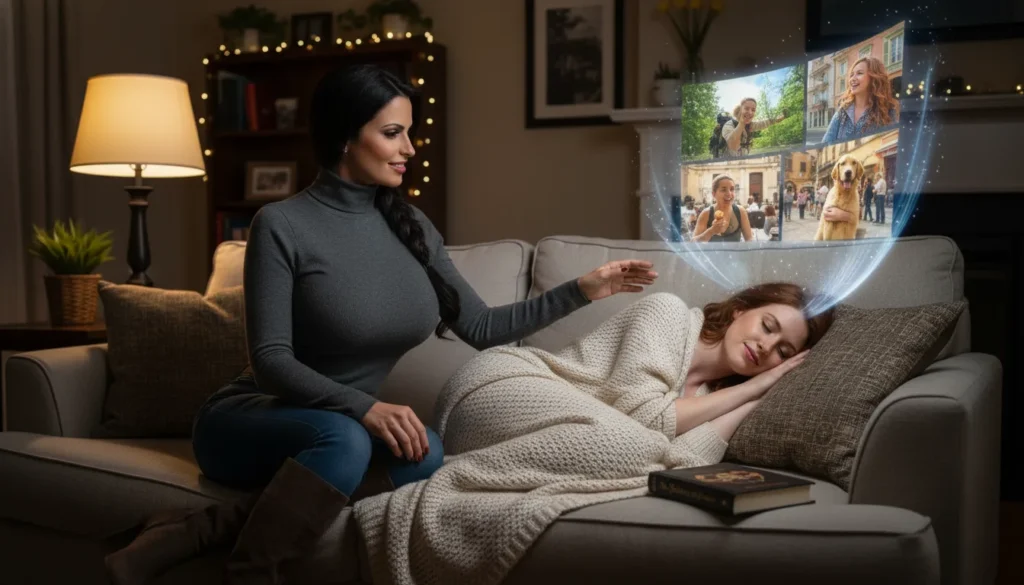
Imagine Waking Up From a Dream Everyone Saw
You wake up in the morning…
and your friend says:
“I was there too.”
Not in the real world.
In your dream.
The same shifting hallway.
The same impossible sky.
The same strange feeling that it meant something.
Dreams are usually the most private experiences we have—stories created inside the sleeping brain, seen by no one else.
But what if that changed?
What if humans could share dreams the way we share conversations?
This question is fascinating not because it predicts the future…
…but because it reveals something deeply real:
Dreams are one of the brain’s most mysterious and creative processes.
Exploring shared dreams helps us understand how sleep, memory, emotion, and imagination actually work.
Let’s step inside the science of dreaming.
What Dreams Really Are (In Everyday Terms)
Dreams are not random movies.
They are brain-generated experiences that occur mostly during REM sleep—the stage where the brain becomes highly active while the body stays still.
During dreaming, the brain combines:
- Memories
- Emotions
- Visual imagination
- Fragments of recent experiences
A helpful analogy:
A dream is like the brain’s nighttime editing studio—cutting, mixing, and reshaping the day into surreal scenes.
Dreams feel real because many of the same brain regions used for perception are active.
Your eyes are closed…
…but the brain is still “painting” reality internally.
Why Humans Dream at All
Science doesn’t point to a single purpose of dreaming, but several well-supported roles include:
- Processing emotional experiences
- Strengthening and organizing memories
- Testing scenarios in imagination
- Reinforcing learning patterns
Dreaming may be the mind’s way of exploring possibilities without physical risk.
Like a flight simulator for thought.
Dreams are not messages from outside the brain.
They are the brain’s own internal activity—creative, emotional, and deeply human.
What Would “Shared Dreams” Actually Mean?
For humans to share dreams, something extraordinary would need to happen:
Two brains would have to experience the same internally generated imagery at the same time.
That’s difficult because dreams are built from:
- Individual memories
- Personal emotions
- Unique brain wiring
Dreams are more like fingerprints than broadcasts.
But hypothetically, shared dreams would require:
- A way for brains to synchronize activity
- A method of transmitting sensory-like information
- A common dream “space” built from overlapping memory patterns
This thought experiment helps highlight something important:
Dreams are private because brains are private worlds.
How Sleep Would Feel If Dreams Became Social
If dreams could be shared, sleep would no longer be fully solitary.
Night might become a kind of mental gathering place.
People could experience:
- Collective adventures
- Shared emotional imagery
- Group storytelling without words
But it would also change the meaning of rest.
Right now, sleep is a psychological boundary.
In a shared-dream world, that boundary becomes porous.
The mind would remain socially connected even while unconscious.
That would transform what nighttime feels like:
Not just recovery…
…but connection.
Communication Would Become More Emotional Than Verbal
Dreams do not speak in paragraphs.
They speak in:
- Symbols
- Sensations
- Atmosphere
- Sudden emotional shifts
If humans shared dreams, communication might become less about sentences and more about feeling.
Instead of telling someone:
“I’m stressed,”
they might experience your stress as a dream landscape—stormy, chaotic, heavy.
Dream-sharing would be like emotional telepathy through imagery rather than words.
It could deepen empathy…
because dreams carry raw emotional texture.
Memory Would Become More Collective
Dreams are strongly tied to memory processing.
If dreams were shared, memories might become socially blended.
Imagine dreaming of your childhood kitchen…
and someone else experiencing it too.
That would blur the boundaries between:
- Personal memory
- Shared experience
- Individual identity
Civilizations might develop new forms of storytelling:
Not through books…
…but through shared dreaming as a memory archive.
History could become experiential rather than written.
Comparison Table: Normal Dreams vs. Shared Dreams
| Feature | Normal Human Dreaming | Hypothetical Shared Dreaming |
|---|---|---|
| Experience | Private, internal | Social, collective |
| Main building blocks | Personal memories and emotions | Overlapping mental imagery |
| Communication style | Symbolic and individual | Symbolic but shared |
| Emotional impact | Processed internally | Potentially processed together |
| Identity boundary | Strong separation between minds | More blended sense of experience |
| Morning recall | Personal interpretation | Group interpretation and discussion |
Creativity Would Expand Into a New Dimension
Dreams already inspire creativity.
Many artists and thinkers have drawn ideas from dreamlike states because dreams loosen logic and amplify imagery.
If dreams were shared, creativity could become collaborative in a completely new way:
- Groups might invent stories together unconsciously
- Music and art could emerge from collective imagery
- Problem-solving might become dream-based brainstorming
Imagine waking up with your team and saying:
“We all saw the same solution.”
Dream-sharing would create a new layer of imagination beyond waking life.
Privacy Would Become a Completely New Concept
A key feature of dreams is that they are unobserved.
Shared dreams would remove that privacy.
People might worry:
- Can others see my fears?
- Are my dreams truly mine?
- Do I control what appears?
Dreams are not carefully edited narratives.
They are spontaneous mixtures.
Sharing them would make the inner world less protected.
This highlights a calming truth about real life:
Dream privacy is one of the mind’s natural safe spaces.
Common Misunderstanding: Dreams Are “Hidden Messages”
Many people assume dreams are coded predictions or secret signals.
Scientifically, dreams are better understood as:
- Brain activity during sleep
- Memory integration
- Emotional processing
- Imaginative simulation
Dreams can feel meaningful because the brain is connecting emotional material.
But dreams are not external communications.
They are internal experiences created by a living nervous system.
Shared-dream ideas are powerful precisely because dreams feel so real…
even though they are generated entirely within the brain.
Why This Matters Today (Evergreen Perspective)
We already live in an era of deep connection:
- Social media
- Instant communication
- Shared digital spaces
Yet dreams remain one of the last truly private experiences.
Exploring shared dreams reminds us that:
- Consciousness is deeply personal
- The brain creates reality internally
- Connection has limits shaped by biology
Dreams show that the mind is not just logical…
It is imaginative, emotional, and constantly rebuilding experience.
Understanding dreams helps us understand ourselves.
Key Takeaways
- Dreams are brain-generated experiences, especially during REM sleep
- Dreaming helps process emotions, memories, and learning patterns
- Shared dreams would require impossible levels of brain synchronization
- If dreams were collective, empathy and creativity could deepen dramatically
- Privacy and identity boundaries would blur in a shared-dream world
- Dream science shows how actively the brain creates reality during sleep
FAQ: Common Curiosity Questions
1. Do humans actually share dreams in real life?
No. There is no scientific evidence that dreams are shared experiences. Dreams are internally generated by each brain.
2. Why do dreams feel so real?
Because brain regions involved in perception and emotion become active during REM sleep, creating vivid internal simulations.
3. Could technology ever allow shared dreaming?
Dreams involve complex personal brain activity. Current science does not support direct dream-sharing, though sleep research continues to grow.
4. Do dreams have a clear purpose?
Dreams likely serve several roles, including memory organization and emotional processing, though no single explanation fits all dreaming.
5. Why do we forget so many dreams?
Dream memories are often not stored strongly because the brain’s waking memory systems work differently during sleep.
Conclusion: Dreams Are Already a Universe Inside You
If humans shared dreams, sleep would become something entirely new:
A social world of imagination, emotion, and collective experience.
But even without shared dreaming, the real science is astonishing:
Every night, your brain becomes an artist.
It creates landscapes, stories, feelings, and simulations—entire realities built from memory and emotion.
Dreams are private not because they are small…
…but because they are vast.
They remind us that the mind is not only a machine for logic.
It is also a universe for experience.
And each night, you quietly travel through it alone.