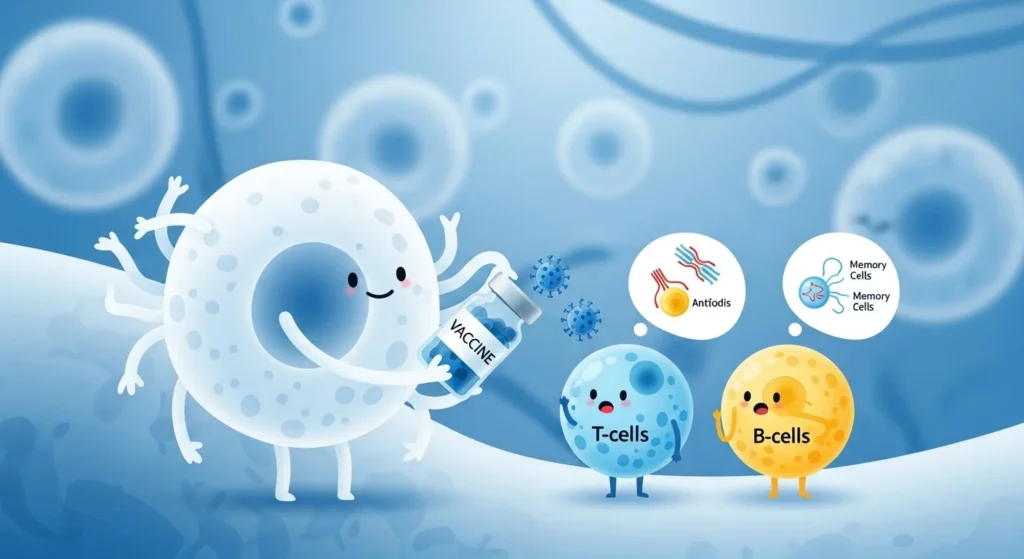
How Can the Immune System Learn Before It Faces a Real Threat?
The idea behind vaccines is one of biology’s most fascinating strategies:
Protection before danger arrives.
That can seem almost magical.
How can the body prepare for something it hasn’t experienced yet?
How can the immune system recognize a virus or bacterium faster the next time?
The answer is that the immune system is not just a defense wall.
It is a learning system.
Vaccines work by training that learning system—introducing safe information about a threat so the body can build memory without experiencing the full infection.
Vaccines don’t act like shields.
They act like lessons.
Let’s explore the science behind how vaccines train the immune system.
The Immune System Is a Defense System That Remembers
Your immune system has one extraordinary feature:
Memory.
When it encounters something unfamiliar, it doesn’t just respond once.
It learns.
It stores recognition patterns.
So if the same threat appears again, the body responds faster and more effectively.
That memory is what makes immunity possible.
Vaccines are designed to activate this memory system in a controlled way.
They introduce the immune system to a harmless version or piece of a threat, allowing practice without full illness.
Vaccination is essentially immune education.
Innate Immunity vs Adaptive Immunity: Two Layers of Defense
To understand vaccine training, it helps to know the immune system has two main layers:
1. Innate Immunity (Fast, General Response)
This is the body’s first alarm system.
It responds quickly to anything suspicious but doesn’t remember specifics.
2. Adaptive Immunity (Slow, Specific, Memory-Based Response)
This is the learning system.
It builds tailored responses and long-term memory cells.
Vaccines mainly work through adaptive immunity.
They help the body build a specific memory of a pathogen so future encounters are handled quickly.
Why This Happens: The Body Needs Practice, Not Surprise
Imagine the immune system like a security team.
If a burglar breaks in unexpectedly, the team must scramble.
But if the team has already seen the burglar’s photo, they can act instantly.
Vaccines provide that “photo.”
They allow the immune system to recognize key features—often called antigens—without needing the real infection to occur first.
The immune system practices:
- Recognition
- Response
- Memory formation
So when the real threat arrives, it is not new.
It is familiar.
That familiarity is protection.
What Exactly Does a Vaccine Show the Immune System?
Vaccines don’t usually introduce an entire dangerous organism in its full harmful form.
Instead, they provide safe biological signals such as:
- Inactivated (non-living) versions
- Weakened versions
- Protein pieces of a pathogen
- Genetic instructions that allow cells to briefly display a harmless antigen
The immune system responds to these signals by learning what the pathogen looks like.
The vaccine is not the illness.
It is the immune system’s training material.
Antibodies: The Immune System’s Precision Tools
One of the major products of vaccine training is antibodies.
Antibodies are proteins made by immune cells that can:
- Recognize specific invaders
- Bind to them
- Help neutralize them
Think of antibodies like custom-designed keys that fit one lock.
After vaccination, the immune system produces antibodies as part of practice.
Over time, antibody levels may change…
But the deeper training remains.
That deeper training comes from memory cells.
Memory Cells: The Real Long-Term Goal
The most powerful part of vaccination is immune memory.
Vaccines help create:
- Memory B cells, which remember how to make antibodies
- Memory T cells, which help coordinate immune defense
These cells can persist for years, sometimes decades.
They act like an archived playbook.
So if the pathogen shows up later, the immune system doesn’t start from scratch.
It starts with experience.
Vaccines accelerate the immune timeline.
Why Vaccines Make Future Responses Faster
Without prior training, adaptive immunity takes time.
The body must:
- Identify the invader
- Build the right antibodies
- Expand the right immune cells
- Coordinate a defense
This can take days.
With vaccine training, many steps are already prepared.
Memory cells respond rapidly.
That speed can reduce the window in which a pathogen can spread.
Vaccination is like pre-installing a defense program instead of downloading it during an emergency.
Everyday Example: Fire Drills for the Immune System
Vaccines are often compared to fire drills.
A drill doesn’t create a real fire.
But it teaches the system:
- What alarms mean
- Where to go
- How to respond
So if a real fire happens, confusion is reduced.
Vaccines do the same for immunity.
They simulate recognition and readiness.
The body becomes practiced rather than surprised.
Common Misconception: “Vaccines Give You the Disease”
A frequent misunderstanding is that vaccines cause the illness they prevent.
In reality, vaccines are designed to present immune information safely.
They do not represent uncontrolled infection.
Instead, they offer:
- A blueprint
- A training signal
- A rehearsal immune target
The immune system responds with learning, not disease.
The purpose is preparation, not harm.
Comparison Table: Immune Response Without vs With Vaccine Training
| Feature | First-Time Infection (No Training) | After Vaccination (Trained Immune System) |
|---|---|---|
| Recognition speed | Slower | Faster |
| Immune memory | Not yet formed | Already built |
| Antibody readiness | Must be created from scratch | Can be produced quickly |
| Response coordination | Delayed | More efficient |
| Outcome experience | More uncertainty | More prepared defense |
| Main advantage | Natural learning after exposure | Learning before exposure |
Why This Matters Today (Evergreen)
Vaccines represent one of the clearest examples of how biology can prepare instead of react.
In a world where infectious threats can spread quickly, immune preparation matters.
Vaccination is not just about individual protection.
It reflects a deeper scientific principle:
The immune system is trainable.
It can learn from controlled exposure.
Vaccines harness the body’s natural memory ability, turning biology into prevention.
That is one of the most powerful concepts in modern health science.
Immunity Is Not One-Dimensional
Another common misconception is that immunity is simply “strong” or “weak.”
In reality, immunity is specific and learned.
Your immune system improves through:
- Experience
- Memory
- Recognition patterns
Vaccines contribute to this learning safely.
They don’t replace the immune system.
They activate it.
They work with biology, not against it.
Simple, Educational Understanding (No Medical Claims)
Vaccines train the immune system because:
- They introduce harmless information about a pathogen
- The immune system practices making antibodies
- Memory B and T cells are created for long-term recognition
- Future responses become faster and more efficient
- The body shifts from surprise to preparedness
Vaccines are like lessons for the immune system’s memory network.
Key Takeaways
- Vaccines train the immune system by building immune memory before real infection occurs
- Adaptive immunity is the learning branch that vaccines activate
- Antibodies are precision tools created during immune training
- Memory cells allow faster future responses
- Vaccines prepare the body rather than forcing it to learn through illness
- Immunity is specific, learned, and shaped by experience
FAQ: Common Curiosity Questions
1. How do vaccines “teach” the immune system?
They present safe antigens that allow immune cells to practice recognition and memory building.
2. What is immune memory?
It’s the ability of immune cells to remember a pathogen and respond faster in the future.
3. Do antibodies last forever after vaccines?
Antibody levels can change over time, but memory cells often remain ready to respond.
4. Why is the second exposure usually easier for the body?
Because the immune system has already trained and built recognition pathways.
5. Are vaccines working with natural biology?
Yes. Vaccines use the immune system’s built-in ability to learn and remember.
Conclusion: Vaccines Work Because the Immune System Is a Learning System
Vaccines are powerful because they align with one of the immune system’s greatest strengths:
Memory.
They don’t act as external armor.
They act as internal education.
By introducing safe biological information, vaccines allow the body to rehearse defense, build immune memory, and respond faster when real threats appear.
Vaccination is one of biology’s smartest strategies:
Prepare before danger arrives.
That is why vaccines train the immune system—because the immune system is designed not just to fight…
But to learn.
Disclaimer: This article explains scientific concepts for general educational purposes and is not intended as professional or medical advice.