The Instant Relief You Feel When You Finally Stretch
You’ve been sitting for a while.
Your shoulders creep upward.
Your hips feel tight.
Your back feels oddly heavy.
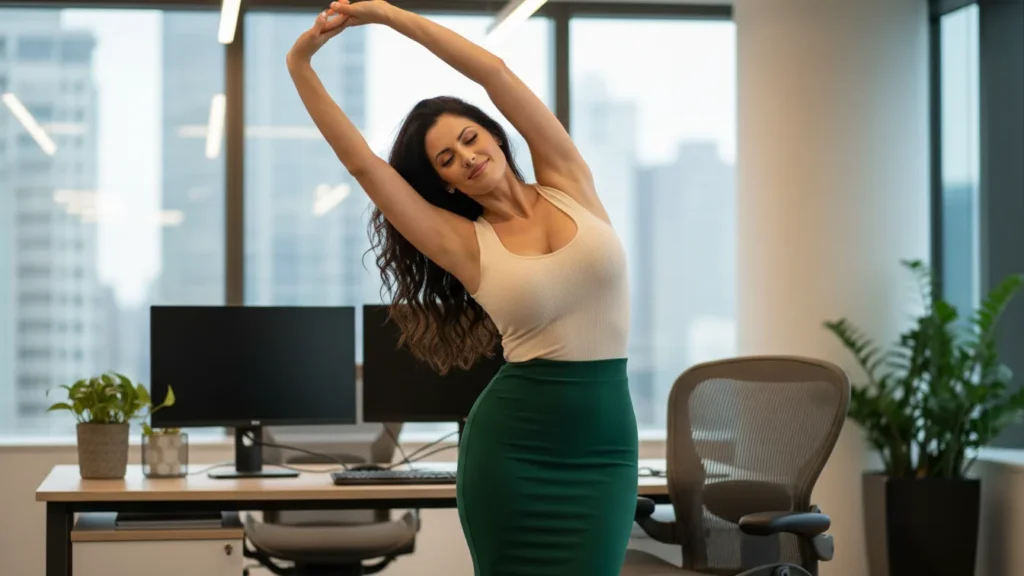
Then you stand up and stretch.
Your arms reach overhead.
Your spine lengthens.
Your body exhales — sometimes with a sound.
That relief feels immediate and unmistakable.
This isn’t imagination, habit, or coincidence. Stretching after sitting activates several biological systems at once, all of which have been quietly constrained by stillness.
Once movement returns, your body resets.
Sitting Puts the Body in a Holding Pattern
The human body is built for movement, not long periods of stillness.
When you sit:
- Certain muscles stay shortened
- Others stay lightly contracted
- Joint angles remain fixed
- Blood flow becomes less dynamic
Nothing “breaks,” but the system becomes static.
Over time, this static state creates a sense of pressure, stiffness, and restlessness — not pain, just unfinished movement.
Stretching resolves that unfinished state.
Why Muscles Feel Tight Even Without Strain
Muscle tightness after sitting doesn’t mean muscles are damaged.
It means they’ve been:
- Held in one position
- Receiving repeated low-level signals
- Not moving through full ranges
Muscles rely on movement to regulate tone.
When movement stops, tension doesn’t disappear — it stabilizes.
Stretching reintroduces change, which muscles interpret as permission to release.
Stretching Restores Length and Balance
When you stretch:
- Shortened muscle fibers lengthen
- Opposing muscles rebalance
- Joint positioning improves
This doesn’t require force.
Even gentle stretching changes internal feedback from muscles to the brain, signaling that the holding pattern is no longer needed.
The sensation of relief comes from normalization, not correction.
Blood Flow Plays a Big Role in the “Ahh” Feeling
Sitting reduces circulation in certain areas, especially:
- Hips
- Lower back
- Upper shoulders
Stretching reverses this quickly.
As muscles lengthen and joints move:
- Blood vessels open
- Oxygen delivery improves
- Metabolic byproducts disperse
This shift creates warmth and lightness — sensations the brain associates with comfort.
Why Stretching Feels Better Than Simply Standing
Standing alone helps, but stretching adds something extra.
Stretching:
- Actively changes muscle length
- Stimulates nerve endings
- Signals completion of a movement cycle
The nervous system responds more strongly to active change than passive posture shifts.
That’s why stretching feels more satisfying than just standing up.
The Nervous System’s Role in Stretch Relief
Muscles don’t decide when to relax — the nervous system does.
Stretching sends clear sensory signals that say:
“The body is moving again. Tension is no longer required.”
In response:
- Muscle activation signals soften
- Protective tension decreases
- Baseline muscle tone lowers
This neurological shift is why stretching can feel calming, not just physical.
Why You Sometimes Yawn or Sigh When Stretching
Many people yawn, sigh, or take deep breaths while stretching.
That’s not accidental.
Stretching:
- Encourages deeper breathing
- Reduces nervous system alertness
- Signals safety and release
Breath and muscle tone are closely linked. When muscles release, breathing naturally deepens — reinforcing the sense of relief.
Sitting vs Moving: A Body Comparison
| State | Muscle Behavior | Sensation |
|---|---|---|
| Prolonged sitting | Fixed length, low movement | Stiff, heavy |
| Standing briefly | Partial activation | Slight relief |
| Stretching | Active length change | Strong relief |
| Walking | Rhythmic movement | Sustained comfort |
This shows why stretching stands out as the most satisfying transition after sitting.
Why Stretching Feels Better the Longer You Sit
The longer you remain still:
- The stronger holding patterns become
- The more noticeable the contrast when movement returns
Stretching doesn’t just feel good — it feels better because of the contrast between stillness and motion.
The nervous system is highly sensitive to change.
A Common Misunderstanding: “My Body Is Out of Shape”
Many people interpret post-sitting stiffness as a personal failing.
It isn’t.
Even highly active people experience this because:
- Sitting restricts movement regardless of fitness
- The body adapts to whatever position it’s held in
- Stretching simply reverses that adaptation
Relief doesn’t mean something was wrong — it means something was paused.
Why Stretching Feels Mentally Refreshing Too
Stretching doesn’t just affect muscles.
It:
- Breaks mental monotony
- Shifts attention into the body
- Interrupts prolonged focus
This creates a mild cognitive reset.
That’s why stretching can make you feel clearer and more alert — even without physical exertion.
Why This Matters Today
Modern life involves extended sitting:
- Desks
- Screens
- Travel
- Meetings
Stretching offers one of the fastest ways to restore normal body signaling without effort or equipment.
Understanding why it feels good helps explain why the urge to stretch is so universal — it’s the body requesting completion of a movement cycle.
A Simple Analogy That Explains It Perfectly
Think of your body like a spring held halfway compressed.
Nothing is wrong with the spring.
It’s just waiting to return to its natural length.
Stretching lets it do exactly that.
Key Takeaways
- Sitting creates static muscle holding patterns
- Stretching restores movement and muscle balance
- Blood flow improves rapidly during stretching
- The nervous system reduces protective tension
- Relief comes from normalization, not fixing damage
Frequently Asked Questions
Why does stretching feel good even if I’m not sore?
Because it restores movement and nerve signaling, not because soreness was present.
Why do hips and shoulders feel tight first?
They stay in fixed positions longest during sitting.
Does stretching have to be intense to feel good?
No. Gentle movement is enough to trigger relief signals.
Why do I instinctively stretch without thinking?
The urge is automatic — the nervous system initiates it.
Why does relief feel almost immediate?
Nerve and blood flow changes happen quickly, often within seconds.
A Calm Conclusion
Stretching feels good after sitting because the body is returning to motion — its natural state.
Muscles lengthen, blood flows, nerves relax, and unfinished movement finally completes.
Once you understand that, the relief feels less like a luxury…
and more like the body quietly thanking you for letting it move again.
Disclaimer: This article explains scientific concepts for general educational purposes and is not intended as professional or medical advice.