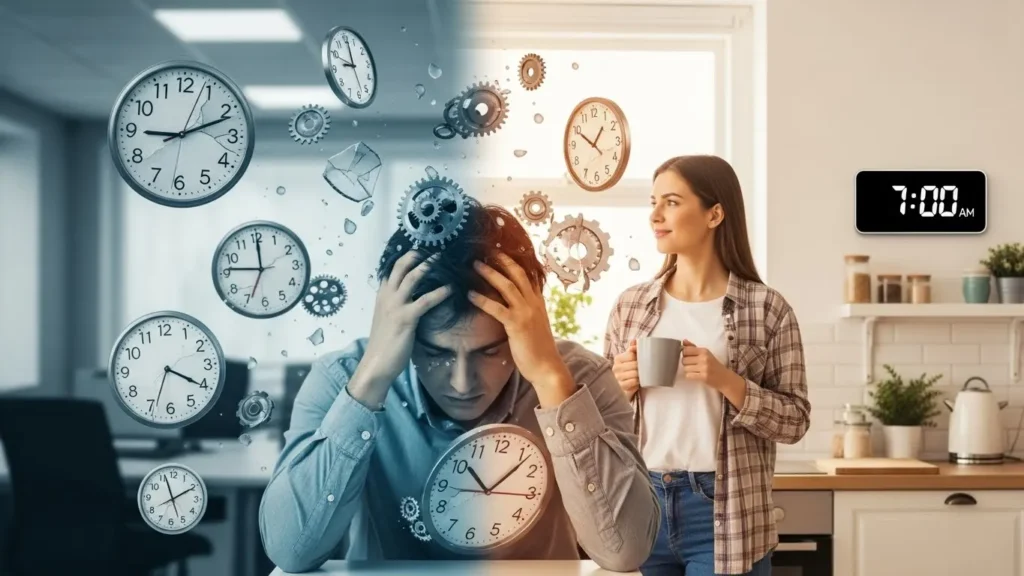
When Time Stops Feeling Predictable
Most of us don’t check a clock to know when it’s time to sleep.
We feel it.
Hunger rises around familiar hours. Energy dips in the afternoon. Alertness sharpens in the morning light. These patterns feel natural — automatic.
But what if they weren’t?
What if humans had no internal sense of time at all?
Not forgetting dates or schedules, but lacking the built-in rhythm that quietly organizes our days. Life would still continue — but it would feel strangely unanchored, like living without a metronome guiding the pace of experience.
What Is the Human Internal Clock?
The internal clock is not a ticking device in the brain.
It’s a network of biological timing systems that help the body and brain anticipate regular changes — especially day and night.
This system helps coordinate:
- Sleep and wakefulness
- Energy levels
- Attention patterns
- Daily habits and routines
It works continuously, even when we aren’t aware of it.
Think of it as background software that schedules processes before we consciously notice the need.
How the Internal Clock Works (In Simple Terms)
The internal clock responds mainly to light and darkness.
When light enters the eyes:
- The brain interprets it as daytime
- Alertness gradually increases
- The body prepares for activity
When light fades:
- Signals shift toward rest
- Attention softens
- The body prepares for sleep
This timing system doesn’t force behavior — it nudges it.
Without those nudges, daily life would feel less predictable from the inside.
What “No Internal Clock” Really Means
Having no internal clock wouldn’t erase intelligence or memory.
It would mean:
- No natural sense of when to feel alert or tired
- No internal rhythm guiding daily transitions
- Greater reliance on external cues
People would still sleep, eat, and work — but only because of schedules, reminders, and habits, not internal signals.
Time would become something you manage consciously instead of something you feel.
Everyday Life Without Internal Timing
Imagine waking up without feeling morningness.
No natural alertness.
No familiar sleepiness at night.
No sense of “now feels right.”
Daily activities would depend on:
- Clocks
- Alarms
- Social schedules
- Environmental structure
Without these, routines would drift.
Life would feel less like a flowing sequence and more like a checklist.
Attention and Focus Would Change
The internal clock helps regulate when focus rises and falls.
Normally:
- Attention peaks at predictable times
- Mental fatigue appears in waves
- Breaks feel naturally timed
Without an internal clock:
- Focus might fluctuate unpredictably
- Fatigue wouldn’t arrive with clear signals
- Transitions between tasks would feel harder
It wouldn’t reduce intelligence — but it would reduce efficiency and flow.
Social Life Would Feel Less Synchronized
Human societies depend on shared timing.
Meals.
Workdays.
Sleep cycles.
Social gatherings.
Internal clocks help people align naturally.
Without them:
- People would rely entirely on external schedules
- Group coordination would require constant reminders
- Social rhythms would feel more mechanical
We’d still gather — but timing would feel imposed rather than shared.
Common Misconception: “Clocks Create Our Sense of Time”
Clocks don’t create time awareness — they measure it.
The internal clock creates:
- Anticipation
- Readiness
- Rhythmic expectation
That’s why people often wake just before alarms or feel hungry before lunch.
Without an internal clock, clocks wouldn’t feel helpful — they’d feel necessary.
Comparing Life With and Without an Internal Clock
| With Internal Clock | Without Internal Clock |
|---|---|
| Natural sleepiness | Schedule-based rest |
| Predictable energy waves | Irregular alertness |
| Easy daily transitions | Conscious time management |
| Social synchronization | External coordination |
| Felt sense of “when” | Measured sense of time |
Would Humans Adapt Without an Internal Clock?
Yes — but adaptation would be effortful.
Humans would rely on:
- Strict schedules
- Environmental lighting
- Cultural routines
- External reminders
Life wouldn’t collapse.
But it would feel less intuitive, like driving without a speedometer and relying only on road signs.
Possible — but mentally demanding.
Why This Matters Today
Modern life already strains internal timing systems.
Artificial lighting, screens, irregular schedules, and constant stimulation can blur natural rhythms.
Understanding the internal clock helps explain:
- Why routines feel grounding
- Why sudden schedule changes feel disorienting
- Why consistency supports focus and clarity
The internal clock isn’t about control — it’s about predictability.
Key Takeaways
- The internal clock helps humans anticipate daily changes
- It supports focus, energy balance, and routine
- Without it, life would feel less intuitive and more effortful
- Social and personal timing would rely entirely on external systems
- Small biological rhythms quietly shape daily experience
Frequently Asked Questions
Would humans still sleep without an internal clock?
Yes, but sleep would rely heavily on external cues rather than internal signals.
Would time feel slower or faster?
Time perception would feel inconsistent, varying with activity rather than rhythm.
Do animals rely on internal clocks too?
Yes. Many animals show strong timing patterns that guide behavior and survival.
Could technology fully replace an internal clock?
Technology can schedule actions, but it cannot fully replicate felt timing and anticipation.
Is the internal clock the same as habit?
No. Habits are learned behaviors; the internal clock is a biological timing system that supports them.
A Calm Conclusion
The internal clock doesn’t announce itself.
It doesn’t tick loudly or demand attention. It simply guides — helping humans feel when it’s time to wake, work, rest, and reset.
If it disappeared, life would continue.
But days would feel flatter, transitions rougher, and time less lived — more managed.
And that quiet rhythm we rarely notice would reveal just how much structure it provides to everyday life.
Disclaimer: This article explains scientific concepts for general educational purposes and is not intended as professional or medical advice.