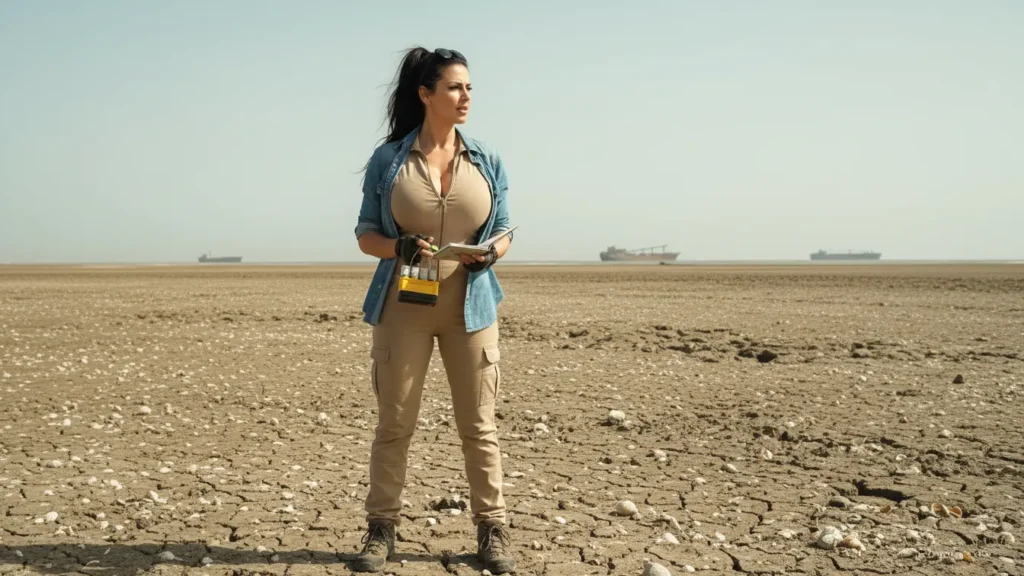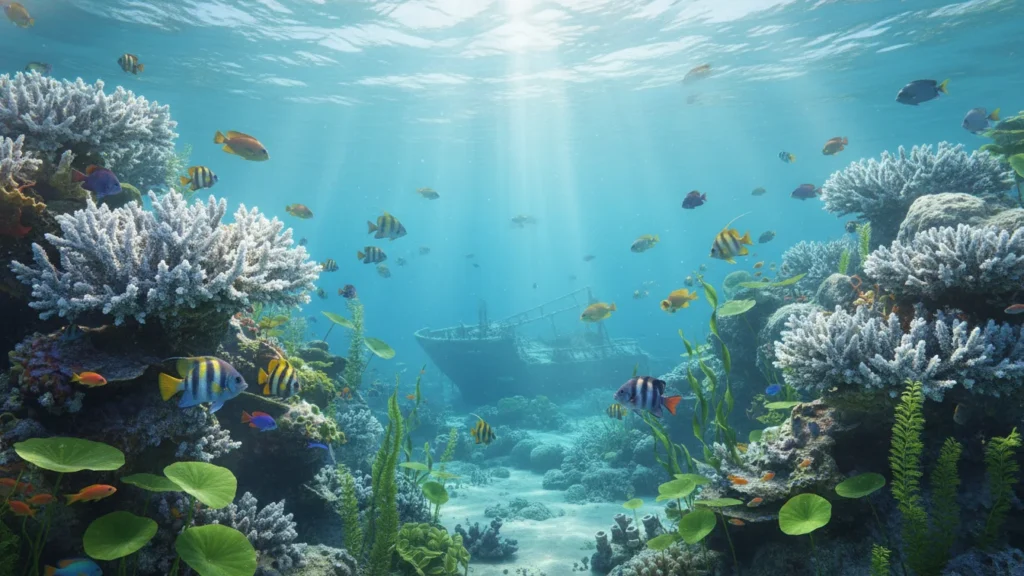
When a Familiar World Suddenly Changes
The ocean looks calm.
Waves move the same way.
The horizon hasn’t changed.
But beneath the surface, something fundamental is missing.
The salt.
It’s easy to think of salt as a flavor or a preservative. But in Earth’s oceans, salt is far more than a seasoning. It is a silent organizer—shaping currents, regulating climate, and determining which forms of life can exist.
So what if Earth’s oceans were suddenly freshwater?
Not slowly over millions of years.
Not in isolated regions.
But everywhere.
This thought experiment reveals just how delicately balanced our planet truly is.
Why Earth’s Oceans Are Salty in the First Place
Ocean saltiness—known as salinity—is not an accident.
It comes from a long, slow process:
- Rain dissolves minerals from rocks on land
- Rivers carry dissolved salts into the sea
- Water evaporates, but salt stays behind
- Over billions of years, salt accumulates
The result is an average ocean salinity of about 3.5%.
That number may sound small, but its effects are enormous.
Salt changes how water behaves—how heavy it is, how it moves, and how energy flows through the planet.
The First Immediate Change: Ocean Water Gets Lighter
Saltwater is denser than freshwater.
Remove the salt, and ocean water becomes lighter—more buoyant.
That single shift would quietly disrupt one of Earth’s most important systems: global ocean circulation.
Today, differences in temperature and salinity create a slow, deep conveyor belt of water that moves heat around the planet.
Freshwater oceans would weaken this system dramatically.
How Salt Controls Ocean Currents (Without Being Seen)
Ocean circulation works like a planetary engine.
Cold, salty water sinks.
Warm, less salty water rises.
This movement drives massive currents that transport heat across continents.
Without salt:
- Water density differences shrink
- Deep-water sinking slows or stops
- Heat transfer across the planet weakens
This doesn’t mean oceans would become still—but they would lose their organized, global rhythm.
Climate patterns we take for granted depend on that rhythm.
Climate Without Salty Oceans: Subtle but Profound Shifts
Salt helps stabilize Earth’s climate by keeping ocean circulation active.
If oceans were freshwater:
- Heat would stay closer to the equator
- Polar regions could cool more rapidly
- Seasonal extremes would become stronger
- Weather patterns would grow less predictable
Importantly, this wouldn’t happen overnight. The changes would unfold gradually, quietly reshaping climates over decades and centuries.
The planet wouldn’t “break.”
But it would feel unfamiliar.
Marine Life Faces the Greatest Challenge
For ocean life, salt is not optional.
Marine organisms are finely tuned to specific salinity ranges. Their cells constantly balance water moving in and out through membranes.
In freshwater oceans:
- Many marine species could not regulate their internal chemistry
- Coral reefs would collapse
- Shell-forming organisms would struggle
- Entire food webs would reorganize
Some species might adapt over long timescales. Others would vanish.
Freshwater ecosystems do exist—but they support very different forms of life than oceans do today.
Why Fish Can’t Simply “Adjust” to Freshwater Seas
A common misunderstanding is that fish could just adapt quickly.
But salinity affects:
- Cell pressure
- Enzyme function
- Nerve signaling
- Energy use
Saltwater fish constantly lose water to their environment and drink seawater to compensate. Freshwater fish do the opposite.
Switching environments isn’t a preference—it’s a biological redesign.
Evolution can do many things.
It cannot work instantly.
The Chemistry of the Ocean Would Change Too
Salt isn’t just sodium and chloride.
Ocean salinity includes magnesium, calcium, sulfate, potassium, and more. These dissolved ions:
- Buffer ocean acidity
- Support shell and skeleton formation
- Influence nutrient cycles
Freshwater oceans would lose much of this chemical stability.
The ocean’s ability to regulate carbon dioxide—a key part of Earth’s climate balance—would weaken.
A Side-by-Side Comparison
| Feature | Saltwater Oceans (Today) | Freshwater Oceans (Hypothetical) |
|---|---|---|
| Water Density | Higher | Lower |
| Global Circulation | Strong, organized | Weaker, fragmented |
| Climate Stability | Moderated | More extreme |
| Marine Biodiversity | High | Severely reduced |
| Chemical Buffering | Strong | Limited |
| Ecosystem Structure | Complex | Simplified |
This table shows a simple truth: salt quietly holds complexity together.
Why Earth Never Naturally Loses All Ocean Salt
You might wonder: could this ever happen?
In reality, Earth has strong safeguards:
- Rivers constantly deliver new salts
- Evaporation concentrates minerals
- Plate tectonics recycle elements
- Ice melt dilutes but doesn’t eliminate salinity
Even massive freshwater inputs—like melting ice sheets—only change salinity locally and temporarily.
A fully freshwater ocean would require conditions far outside Earth’s natural systems.
Why This Thought Experiment Matters Today
This isn’t about predicting disaster.
It’s about understanding balance.
Salt reminds us that Earth’s stability depends on quiet, invisible factors—not dramatic events.
Things we rarely think about:
- Mineral cycles
- Density differences
- Slow-moving currents
These are what make the planet livable.
When we understand them, climate, ecosystems, and even weather feel less mysterious—and more interconnected.
Common Misconceptions Clarified
- “Freshwater is better for life.”
Different—not better. Marine life depends on salt. - “Oceans would freeze faster.”
Freshwater freezes at higher temperatures, but circulation changes matter more than freezing points. - “Humans wouldn’t notice much.”
Changes would be gradual—but deeply felt through climate and food systems.
Key Takeaways
- Ocean salinity is essential to Earth’s climate stability
- Salt controls water density and global circulation
- Marine life depends on precise salinity balance
- Freshwater oceans would simplify ecosystems, not improve them
- Earth’s systems are stable because many quiet processes work together
Frequently Asked Questions
1. Would freshwater oceans be safer or cleaner?
Not necessarily. Cleanliness depends on ecosystems and chemistry, not salinity alone.
2. Would whales and dolphins survive?
Most marine mammals depend on food webs that would collapse without salt-based ecosystems.
3. Could humans drink ocean water if it were freshwater?
In theory yes—but access and ecosystem consequences would outweigh benefits.
4. Would tides still exist?
Yes. Tides are caused by gravity, not salinity.
5. Has Earth ever had freshwater oceans?
No evidence suggests Earth’s global oceans were ever entirely freshwater.
A Calm Conclusion
Salt rarely gets credit.
It doesn’t shine.
It doesn’t roar.
It simply works—quietly holding systems together.
Earth’s oceans are not salty by coincidence. They are salty because that’s what allows motion, balance, and life to coexist on a planetary scale.
Understanding that makes the ocean feel less like a backdrop—and more like a carefully tuned instrument playing endlessly beneath our feet.
Disclaimer: This article explains scientific concepts for general educational purposes and is not intended as professional or medical advice.